I think about these pages a lot, every time I read meta about Steve not being as… expressive or emotive in the MCU as other characters.
Steve is an artist. And a bookworm. Who loves fantasy most of all. This is canon, none of these things are indicators of someone who is stoic and taciturn by nature. So what we can deduce from this is that Steve learned to keep things close to the chest through nurture not nature.
Why?
Three factors, all summed up above.
1) Steve was heavily bullied as a child. Picked on, beat up, tormented. There have been depictions of this in almost every single Cap run I’ve read, and I’ve read a lot of Cap. I could show you panels that would make you cry, where a child!Steve is laid out on the pavement bleeding because his childhood bullies got a hold of him.
This is not solely indigenous to 616!Steve, as in the MCU!Steve also indicated to Peggy that he was beat up a lot as a child.
Someone who is targeted by that kind of physical and mental abuse learns to keep it all in, so as not to show any weakness less his tormentors use that against him.
2) Steve lived through the Great Depression during his most informative years. The small, sickly child of a single mother. The dialogue here breaks my heart:
“And with every broken bone or black eye I knew I was letting my mother down. Sure I was scared of the bullies waiting for me but my REAL fear was that I’d get home and she wouldn’t be there. I knew it was irrational, she was a GREAT mother, but that’s just how life felt back then, like it could all fall apart at any moment.”
Loss. Steve’s greatest fear and the heartbreaking thing is that it’s he’s had to live through again and again and again. And it all started because he was raised during a time when the bulk of America had lost everything and were starving in the streets. If we look at Maslow’s Hierarchy of Needs, the most basic necessities for survival weren’t being met for a very large population of people: food, water, safety.
Steve’s words here are actually very accurate. I have a 96-year-old grandmother who can personally collaborate the sentiment expressed here. In fact she told me that it was very common for children to be sent away to relatives who could feed them, for families to be split up because the parents could no longer afford to provide basic necessities. And in other families children were actually put to work in factories. In fact, Steve worked. As early as six he was selling newspapers when he wasn’t in school (Remender’s run, Cap vol. 7).
3) War. The most destructive war in recent history no less.
The highest suicide rate in the country goes to veterans. This is fact.
In 2014, an average of 20 Veterans died from suicide each day. 6 of the 20 were
users of VA services.
Any war related issues such as PTSD and Survivals Guilt would have been even worse during WW2 because no one recognized PTSD as being valid. In fact General Patton once slapped soldiers who were bed ridden due to exhibiting PTSD symptoms. This is also fact.
So, as a soldier, your choices were try your hardest to keep a stiff upper lip or exhibit your symptoms and be considered a coward and a traitor.
And yet despite all of this Steve said this…
“And I think THAT was what shaped me. How the whole world felt unfair… unjust. That’s why I tried over and over again to enlist before we were even in the war. Because I wanted to punch Hitler in the jaw.”
This is it, this is the essence of Steve Rogers.
The underdog. The defender of the maligned and the targeted.
Steve Rogers took his pain and rather than letting it make him bitter like others would in his circumstances, he became determined to help others.
….I just think that maybe we, as a fandom, should not assume that the silent type aren’t grappling with unimaginable pain just because they’re silent. I think we should recognize that perhaps the silence, itself, is also a symptom.
Writing the copyright page is legitimately giving me a heart attack. Either that or I’ve fucked up my meds. Aaaaah. I’ve only ever had to do this for other people before. I can’t believe I’m writing my own copyright page.
Also hi it’s 4am and I’m still a raging insomniac, how we all doing?
Oh, educational moment, just in case you ever need to write one of these things, they are actually really simple. All it consists of is
You can also get away with writing just all rights reserved if you want, but it’s often better to go into more detail, things like “all rights reserved, no element of this book may be recreated or distributed except with the express permission of [either your name or your publisher]” tend to hold up a lot better when it comes to suing someone for stealing your work, as does adding in the disclaimer spiel that all elements of the book are fictional and you totally didn’t base that one character on that one guy/place etc etc. You don’t technically need one, but it’s good to have. Like underwear ie cover your ass.
The copyright page is also a good place to give your contact details, such as author website or email, and to also credit your artists/editors/people who helped you get the book in print. If you are going through a place like Barnes and Noble for distribution, I think you need to buy your own ISBN regardless of whether epub or not, but I’d need to look that up. As it stands you don’t need an ISBN for kindle publishing or self distribution, although I know some people think it’s a good idea to, and honestly it’s good if you can afford it. I can’t at the moment but I likely will at some point.
(This does not include fanfiction written for
fun, you are welcome to play in my sandpit <3)
Please only purchase authorized electronic copies
of this story. If you have somehow obtained this book through other means and
have enjoyed it, please consider buying an official copy from [weblink].
The author appreciates your support and despite
popular belief, does not subsist on the tears of readers alone.
This is a work of fiction. Names, characters,
places, and incidents either are the products of the author’s imagination or
are used fictitiously. Any resemblance to actual persons, living or dead,
businesses, companies, events, or locales is entirely coincidental.
This book contains content of an explicit and mature themed nature, and is intended to be enjoyed by those of and above the age of consent.
The author does not assume responsibility for
third-party websites or their contents. (As an aside, <—this is how I get out of saying I’m not responsible for the weird vampire kink y’all are gunna post on Ao3 just in case some puritan mob gets their pantaloons in a twist over it and decide I’m responsible for your lack of morals lol)
Cover art by _____; cover design and layout by _____.
Edited by _________
Digital copies of Hunger Pangs are available for purchase on Amazon, Patreon or by contacting Joy at [info @ weblink]
For Trade Paperback visit [weblink].
I’ll likely edit this again and run through it a few more times before I consider it finalized but yea. Job done. That’s a copyright page.
Asperger’s and autism are the same thing. Asperger’s was a diagnosis used to separate out those who spoke before three years of age but was in practice mainly used for white boys. It has since been phased out by the DSM and incorporated under the autism spectrum. Some diagnosed with Asperger’s is autistic.
As far as the differences between ADHD and autism the following is a breakdown taken from this awesome post by autpunk:
more ADHD than autism:
impulsivity
getting distracted
constantly forgetting what you were just doing or thinking
being unable to sit still ever
hyperfocusing randomly
hyperactivity
losing every object. always
forgetting plans and appointments and everything really
addiction to distraction and entertainment
more autism than ADHD:
sensory hypersensitivities
sensory hyposensitivities
the bliss that stimming is
the overwhelm of sensory overload
auditory and visual processing difficulties
trouble with verbal communication
trouble with nonverbal communication
being unable to figure out social rules and conventions
relying on sameness, rules, schedules and rituals
both autism and ADHD:
needing to fidget or stim
special interests or hyperfixations
living in a fantasy world
trouble with socializing
appearing eccentric
appearing childlike or younger than you are
executive dysfunction
reactions to over- and understimulations
meltdowns / shutdowns
developing anxiety or depression
creativity and unconventional thinking
daydreaming and spacing out
getting caught up in a task
I hope this helps!
-Sabrina
This is a good breakdown.
It also irritates me to literally no end when doctors/teachers/parents lump ADHD and any other comorbility under Autism as if it was a giant umbrella diagnosis and then don’t properly treat the comobility as the separate diagnosis that it technically is.
Does autism influence them? Of course because autism influences literally everything. But especially when doctors and teachers do this, it confuses the heck out of parents and actual autistics on what is what.
Not every autistic has ADHD. But a lot do and many aren’t having their ADHD addressed properly.
But there was one scenario in which the Autistic people left a positive first impression: when people read a transcript of their words instead of seeing and hearing the Autistic people saying those words, observers rated them as more likable and more intelligent. In fact, in the scenario where observers just read the written words of Autistic and non-autistic people, they rated both groups the same. For non-autistic people, the written transcripts were their lowest-rated mode of communication, although only by a small amount. For Autistic people, the written transcripts were their highest-rated mode of communication by a very significant margin.
Written communication is the great social equalizer.
Remember this if you start to fear your Autistic child is spending too much time interacting with others online and not enough time interacting with others face-to-face. Online communication is a valid accommodation for the social disability that comes with being Autistic. We need online interaction and this meta-study demonstrates exactly why that is the case.
Autism and the Burden of Social Reciprocity | Sparrow R. Jones unstrangemind.com
The most basic and the most important task of any technician in both music and theatre production is simply wrapping a cable. It may sound basic, but *how* you wrap a cable can actually determine how long it lasts. Now, most professional for-profit productions do list cable as “consumables”, meaning that they are designed to be thrown out and purchased or manufactured anew if they develop an issue. But you will catch hell by any Foreperson, TD or SM for wrapping cable in a way that damages it.
There is a correct technique accepted by both IATSE and Teamsters production houses, and that is called the “Over/Under” technique. Trying to describe it in words is maddening, and even I have a hard time trying to tell someone what has become a reflex to me over 20 years. But, this video by the London School of Sound perfectly shows the way I learned how to wrap cable.
Now, I know what you are saying if this is a new thing to you, or if you’ve been too embarrassed to ask because some asshole stagehand called you out for not knowing such a “basic” thing (And, if any tech does pull that, they are a bad person and shouldn’t be on the gig, FYI)
“But, WHY?!??! Why do Techs gotta make EVERYTHING so hard and, well, dramatic!!??”
Excellent Question!
It all comes down to how the cable is constructed. The cable itself is actually made up of various different wires (which is why we don’t call a cable a “wire” on a show, because they technically mean two different things). The wires in a cable, such as a balanced XLR cable, are actually wrapped around one another, like this:
Now you see that the wires are actually wrapped AROUND one another! This means that the cable, once covered in shielding, it going to want to twist a certain way, because the cable is tensioned around one another (usually counter-clockwise). This means if you try to wrap it like your extension cord you use for your Christmas lights, it is going to get kinked up, and the wires inside will start binding against one another because by just wrapping it over your arm like a garden hose is going to force those cables to bind and twist in a way that is unnatural.
In short: You end up forcing them against one another until they simply break.
Yep. Wire itself is just thin bits of copper (anywhere from 22 to 10 gauge thick, with the bigger the number being the thinner the wire), and it doesn’t take much to bend them out. Just like when you shove your earbuds in your pocket without making sure they are coiled up nicely.
So, when you wrap Over/Under, you are actually alternating the coil of the cable to match the natural way the cable wants to go (this is called the “lay” of the cable). When you get the over/under technique down, you will feel that the cable naturally wants to coil that way, and it takes no effort. When you wrap a coil just one over the other like a home extension cord, you can feel the cable actually twist and want to fight you.
Also, to know if you got it right, all you have to do is take one end of the cable, and then throw the rest of it out away from your body. If you did it right the cable will FLY out of your hands and land straight and true right on the deck, making you look like a badass stage ninja!
It may take a lot of practice, but eventually you will literally do it in your sleep. Just like any motor action, it just takes practice! And, you will find that many professional houses still have people who cannot coil cable correctly (these tend to also be the know-it-alls who will give new techs trouble, ironically). Master fast, accurate cable wrapping and you will save the band or the venue a TON of money in cable costs, and it will make you more attractive too! Trust me.
My face is having uncontrollable spasms. Great. It hurts really, really, really bad.
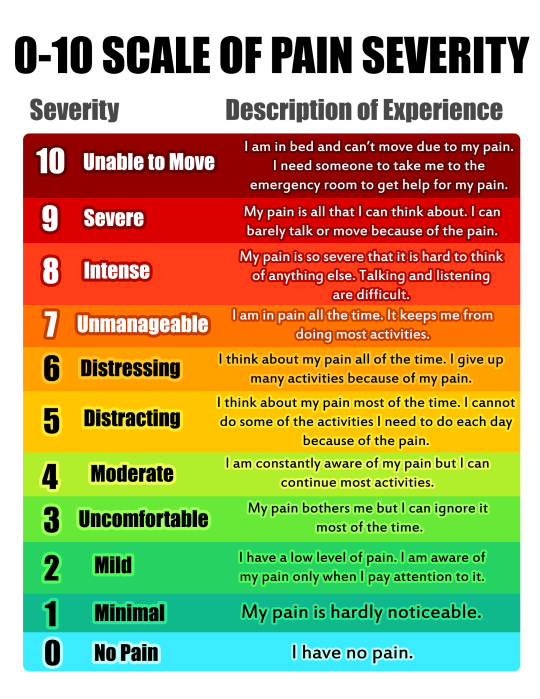
I think part of why I have trouble explaining pain to the doctor is when they ask about the pain scale I always think “Well, if someone threw me down a flight of stairs right now or punched me a few times, it would definitely hurt a lot more” so I end up saying a low number. I was reading an article that said that “10” is the most commonly reported number and that is baffling to me. When I woke up from surgery with an 8" incision in my body and I could hardly even speak, I was in the most horrific pain of my life but I said “6” because I thought “Well, if you hit me in the stomach, it would be worse.”
I searched and searched for the post this graphic was from, and the OP deactivated, but I kept the graphic, because my BFF does the same thing, uses her imagination to come up with the worst pain she can imagine and pegs her “10″ there, and so is like, well, I’m conscious, so this must be a 5, and then the doctors don’t take her seriously. (And she then does things like driving herself to the hospital while in the process of giving birth. Probably should have called an ambulance for that one!)
So I found this and sent it to her. Because this is what they want to know: how badly is this pain affecting you? Not on a scale of “nothing” to “how I’d imagine it’d feel if bears were eating my still-living guts while I was on fire”.
I hate reposting stuff, but I’ll never find that post again and OP is deactivated, so, here’s a repost. I can delete this later, i just wanted to get it to you and I can’t embed images in a chat or an ask.
This is possibly why it took several weeks to diagnose my fractured spine.
Pain Scale transcription:
10 – I am in bed and I can’t move due to my pain. I need someone to take me to the emergency room because of my pain.
9 – My pain is all that I can think about. I can barely move or talk because of my pain.
8 – My pain is so severe that it is difficult to think of anything else. Talking and listening are difficult.
7 – I am in pain all the time. It keeps me from doing most activities.
6 – I think about my pain all of the time. I give up many activities because of my pain.
5 – I think about my pain most of the time. I cannot do some of the activities I need to do each day because of the pain.
4 – I am constantly aware of my pain but can continue most activities.
3 – My pain bothers me but I can ignore it most of the time.
2 – I have a low level of pain. I am aware of my pain only when I pay attention to it.
1 – My pain is hardly noticeable.
0 – I have no pain.
Oh. Oh. This is. This is real sobering.
Living life thinking you’re a 4 but really you’re a 6 is. Sobering.
replace the engagement ring with an engagement sword
Fun fact: The Vikings literally exchanged swords at a wedding. The man was supposed to BREAK INTO HIS FATHER’S/GRANDFATHER’S CRYPT, STEAL HIS SWORD, AND GIVE IT TO HIS WIFE WHEN THEY GOT MARRIED. The woman gave her husband a brand-new sword. And like, the woman was apparently supposed to hang onto this ancient sword and make sure that it was buried with her husband when he died.
So yeah. Engagement swords or at least wedding swords should definitely be a thing.
so wait, were viking men not allowed to get married until their father died? Or did everyone just build a crypt as soon as they had a son and put a sword in it? Or if your dad was still alive, were you just supposed to break into his room and steal it from him while he slept? I NEED ANSWERS
Seconded.
Factoid and fanciful, but a bit too pat to be fact, at least in any sweeping “this is how it ALWAYS happened” way.
Viking-era swords were indeed recycled, but usually by being handed down not dug up, even though in “Grettis Saga” the protagonist
Grettir Ásmundarson
carries a
short sword or long knife
(a saex or seax or scramasax or sax but not AFAIK a sex) called Kársnautr
–
“Kárr’s gift” – which he took from
Kárr’s burial mound.
This one, similar to No. 13, is the “seax of Beagnoth”, held by the British Museum…
…and this repro shows one of the simplest hilt-types it might have had when new.
, including several
ending in “-nautr”. The giver of the gift might be a king or jarl although, given the cynical Viking sense of humour, the donor might equally be a
defeated enemy





 There's a Mirror on the Wall