*this is especially important: these days on Tumblr there’s a wonderful atmosphere of being able to talk openly about your mental illness or your struggle. And that’s great! But there’s a difference between sharing in order to help yourself and other people and sharing just because you have no other coping mechanisms. As much as you’re able, try to work on developing a different outlet. People aren’t qualified to be your therapist because they’re nice to you a couple of times. Please remember that they have lives too, and their job is not to make you feel better or pity you, no matter how difficult your life is.
And last but not least:
But…
I really don’t have a way to better this.
Your interests are your own. I can’t advise anyone to change their interests to fit in with a certain group of people – that’s stupid, and actually quite damaging to your sense of self.
Instead, I would recommend that, maybe if you feel like your topics of conversation are falling flat with this group of people, you move on to other, greener pastures. There are bound to be places where your ideas mesh better with an audience.
And of course – try to be considerate about what you say and how you say it.
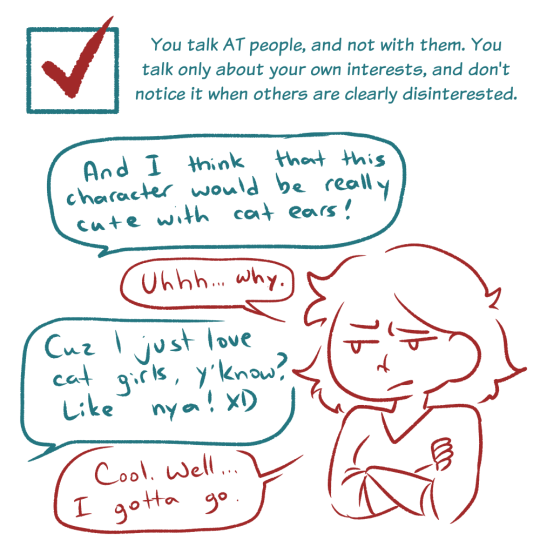
Sometimes, what might seem like a harmless comment to you might be a very discomforting thought to another person. I recently had a conversation on a forum with a guy who was telling me that his headcanon was that Pearl (from SU) would soon get a male love interest who loved mechanics and weapons next, and that would be her best arc, because she would finally get a ‘healthy’ love interest.
His intentions were good, but he was entirely unaware of how cringey this kind of thing was to a bunch of (probably queer) people, who have spent their entire lives being told that the only ‘good’ character development for them would be to get a ‘male love interest’. No one wanted to be the jerk to say “fuck off, we don’t want that to happen” but everyone was answering him in a flat way, trying to discourage the discussion further. Instead of picking up on the hint, he bulldozed on, thinking he was having a ‘lively conversation’ which was, in fact, in its late stages of death.
I know I’ll probably get a few messages to this saying: What about people on the Autistic Spectrum? Sometimes, people can’t pick up social cues or ‘hints’. And if that’s the case, it’s incredibly difficult to understand why you’re not having any luck communicating despite your best efforts.
I feel that on a person level, please believe me. I made this infograph for THAT VERY REASON. Because I WAS that awkward kid who didn’t pick up on hints well. In fact, I still have trouble talking to people. If any of you have had the misfortune of being my conversational partner, you’ll know that I tend to be overly blunt and come off as very unfriendly. It’s something that I, myself, am working on currently in order to grow into a better person. It’s a struggle in progress, but I am aiming towards the progress side, and I just wanted to help out others while I was at it.
This is a really good starting guide to the social skills everyone thinks you should have just picked up magically.
So, yes, this is exactly the advice I think autistic people would benefit from; it actually tells you concrete, actionable, things you could do. I wish someone had told me this stuff when I was a kid.
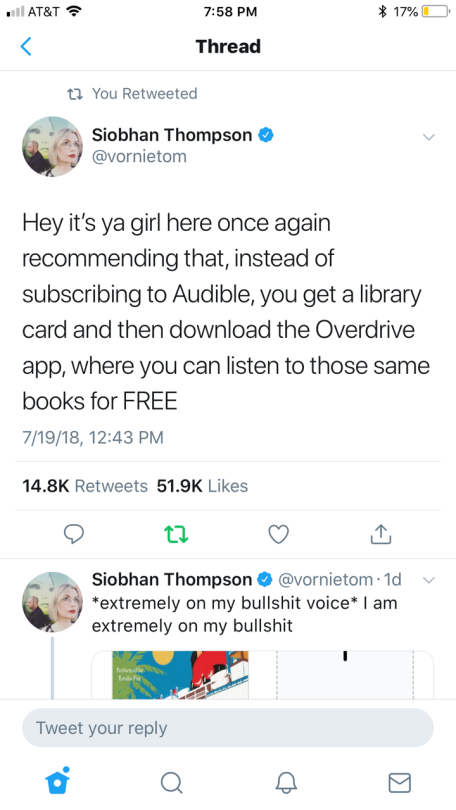
Free Graphic Novels (DC, Marvel, Image, etc), Music, TV shows, and music on HOOPLA.
Free music that you can KEEP on FREEGAL
You are PAYING for all this with your tax money – USE THEM. Most likely systems will have all 3 or 2 out of 3, so if you aren’t sure call your local library’s reference/information desk and how you can get set-up or started.
Realistic Stuttering: “Sorry, I uh… I didn’t mean- I didn’t mean to do that…”
When people stutter, they usually reword what they’re saying as they speak, and subconsciously insert “filler words” such as “uh, like, you know,” and etc.
*puts on speech therapist hat*
ACTUALLY! It depends on why they are stuttering.
A Nervous Stutter results in what is called Mazing, or rewording the sentence. That is the classic “I, um… well I… look it’s just that… so we…” that @hellishhues is talking about. When someone is mazing their words you’re seeing a form of Speech Apraxia where the brain is having trouble forming verbal speech. This can be brought on by brain damage, memory loss, anxiety, nerves, and several other things.
The root cause of a nervous stutter is a disconnect between the mouth and the brain.
With this you will also sometimes see the classic “S-s-s-sorry…” especially if the person has been training to speak clearly and is now at a point of fatigue or stress where they are not mentally capable of forming the words.
The other kind of stutter is a Physical Stutter, sometimes referred to as slurring, and another facet of Speech Apraxia. This stutter is caused when the muscles of the mouth, tongue, and throat are physically unable to form certain sounds. This is most often seen in the very young and victims of brain trauma.
Sounds are acquired at different ages, so a 2-year-old will probably not be able to clearly pronounce certain words (which is why toddler sound so off when they’re written with developed dialogue). These mis-pronunciations are sometimes referred to as lisping, but only if the sounds are run together. If the person starts and restarts the sound because they got it wrong, it can also sound like the classic sound stutter.
But it all depends on why the character is stuttering!
Do they have Speech Apraxia, Audio Processing Disorder, muscle dysfunction, or another medical reason to stutter? (1)
Are they stuttering because of anxiety, stress, or fatigue? (2)
Does the stutter stem from intoxication or blood loss? (3)
All of those will sound different!
1 – Will have mazing, repeated sound stutters, and be the classic stutter that annoys OP.
2 – This is where you’ll see the repetition stutter, mazing, rephrasing, and filler words.
3 – This is where you are more likely to see starts and stops and slurring of words.
My mum has apraxia and I just wanted to say that’s one of the most concise and clear ways I’ve seen it explained, thank you!
v. intr. feeling the tranquil pleasure of being near a gathering but not quite in it—hovering on
the perimeter of a campfire, chatting outside a party while others dance inside,
resting your head in the backseat of a car listening to your friends chatting up front—feeling blissfully invisible yet still fully included, safe in the knowledge that everyone is
together and everyone is okay, with all the thrill of being there without the burden of
having to be.
Wow, there’s a word for it? Cool. This is the feeling I sometimes go to local queer parties for 🙂
I think saying something can never be done is in the same snobbish vein as people who say “prologues and epilogues are dead!” like excuse the entire fuck out of you, but who died and made you king of the slushpile.
I’ve seen some truly awful flashback/prologue/epilogues in my time, but just because some authors fail to find a way to use them correctly, doesn’t mean the rest of us need to suffer from the restrictions of their ineptitude. A good editor will tell you if something isn’t working, or if there’s a better way to do it. A bad one will tell you you ought never to do something simply because it’s currently out of fashion.
As for how to do it well? I dare say if I sat down and tried it I could think of ways to do it, but the main questions to ask yourself are: does this add to my narrative in a way I could not otherwise achieve? Do flashbacks and visions work well within the world I have created? Is there another way I could relay this exposition in a way that is more effective? Does it feel convoluted and heavy when I do it? Does it slow the narrative down? Do I want to slow the narrative down? What effect am I trying to achieve by doing so?
If say, I were writing a fast paced contemporary piece, I would not use the above writing tools in my narrative. Now, an epic fantasy sci fi where the lines of reality are blurred and I can get away with heavier world building exposition? Sign Me The Fuck Up.
Prologues and the like are very good for creating a sense of oration, like you are being sat down and read to from a text long since forgotten to the passages of time by an old man with a snowy white beard and the zeal of madness in his eyes. But, in the hands of a different author, it could also be used to give the narrative equivalent of an introductory handshake. This is my world, this is the narrative tone we’re going for, bathroom is down the hall on your left, bedrooms to the right, and yes, sorry about the mess on the carpet. The cat’s just been sick.
Flashbacks, dreams and other forms of internal and external analepsis (that’s injecting backstory to you and me, internal being central to the character experiencing it, external referring to the world they are in) can perform a similar role. It can either serve to break up or cement the narrative as the author desires. Breaking it up may create a sense of instability or fragility pertaining to the internal state of your main character.
Or, like the pensieve in Harry Potter, (which I didn’t see a lot of people bitching about the same way they do “flashbacks” even though it’s a literal vessel for retaining and reliving memories, making me believe that most people bitching about certain things don’t actually know what the fuck they’re complaining about. The time turner on the other hand was handled like a piece of shit, but that’s another argument for later.) it can be used creatively to give the author more narrative freedom to introduce their main character(s) to elements of exposition in their world, that otherwise they wouldn’t get to experience, and would perhaps, need to spend several pages of conversational dialogue imparting. So what would have been worse in that instance? Fourteen pages of dialogue telling you the story, or a quick hop skip and a jump down memory lane that lets the author show it to you?
It’s almost as though sometimes, not using valid narrative tools….could be worse…
At that’s what it is, at the end of the day. It’s a narrative tool and one worth having in your toolkit, even if you never foresee yourself using it. Like that miniature blowtorch you picked up at Home Depot that one time on an impulse buy cause it was on sale. You only went in for a hammer and nails but it was there and while the higher reasoning part of your monkey brain is telling you it was a waste of money and you’ll never use it, not with all the other tools you have, there’s another smaller, more ancient part of you, grinning in the darkness. Because it knows. It knows that what no matter others might say, fire is indeed sometimes the solution. How you use it however is up to you.
You can either burn down the village by doing it poorly, or, you can figure out how it works and how best to contain it to better fuel your purposes. And if you decide you prefer to do it another way, great, fantastic, we are glad you found your way. But it’s just exactly that, your way. So I guess to answer your question a little more briefly than I have up until now:
Said is not dead, there is no one correct way to write. Anyone that claims otherwise is, in all kindness and honesty, talking out their arse.
> The college I attended was small and very LGBT friendly. One day someone came to visit and used the word “gay” as a pejorative, as was common in the early 2000s. A current student looked at the visitor and flatly said, “we don’t do that here.” The guest started getting defensive and explaining that they weren’t homophobic and didn’t mean anything by it. The student replied, “I’m sure that’s true, but all you need to know is we don’t do that here.” The interaction ended at that point, and everyone moved on to different topics. “We don’t do that here” was a polite but firm way to educate the newcomer about our culture. […]
> It turns out talking about diversity, inclusion, and even just basic civil behavior can be controversial in technical spaces. I don’t think it should be, but I don’t get to make the rules. When I’m able I’d much rather spend the time to educate someone about diversity and inclusion issues and see if I can change how they see the world a bit. But I don’t always have the time and energy to do that. And sometimes, even if I did have the time, the person involved doesn’t want to be educated.
> This is when I pull out “we don’t do that here.” It is a conversation ender. If you are the newcomer and someone who has been around a long time says “we don’t do that here”, it is hard to argue. This sentence doesn’t push my morality on anyone. If they want to do whatever it is elsewhere, I’m not telling them not to. I’m just cluing them into the local culture and values. If I deliver this sentence well it carries no more emotional weight than saying, “in Japan, people drive on the left.” “We don’t do that here” should be a statement of fact and nothing more. It clearly and concisely sets a boundary, and also makes it easy to disengage with any possible rebuttals.
> Me: “You are standing in that person’s personal space. We don’t do that here.”
> Them: “But I was trying to be nice.”
> Me: “Awesome, but we don’t stand so close to people here.”
> Them: Tells an off-color joke.
> Me: “We don’t do that here.”
> Them: “But I was trying to be funny.”
> Me (shrugging): “That isn’t relevant. We don’t do that here.”
I really really do want to endorse this. Making a person’s behavior about capital-M Morality is a great way to get people to dig in their feet and escalate situations. By going “Hey, that behavior doesn’t fit in this context.” it removes a ton of the resentment and toxicity on both sides of the interaction.

 There's a Mirror on the Wall