One of the reasons the Roman Empire was such a big deal in the ancient world is because it was able to punch way above its weight class technology-wise due to its sophisticated civic infrastructures. When the Western half of the empire collapsed, those infrastructures essentially imploded, leaving a huge chunk of Europe with large caches of technology that they could still use, but lacked the means to reproduce or repair. A lot of what modern Eurocentric history books present as the natural technological progression of civilisaton is glossing over this massive hiccup where innovation was being driven primarily by the need to repurpose or maintain this leftover tech in the absence of the infrastructures that produced it. Things basically went all Mad Max for a while there – that actually happened.
(This is all hugely oversimplified, of course, but that’s the gist of it.)
The thing about modern fantasy settings is that, by and large, they’re also going all Mad Max. Your typical Western fantasy setting used to be dominated by this huge, technologically sophisticated empire, but then somebody screwed up and blew up the world, and now everything sucks and people live in fortified shanty towns separated from each other by miles of barren wilderness populated by gnarly monsters, where the most valuable commodities are the scavenged detritus of that bygone empire. It’s straight up post-apocalyptic – the only variable is how much time has passed between the apocalyptic event and the present day.
And in terms of literary and artistic antecedents? You can pretty much draw a direct line between Western fantasy fiction’s obsession with post-apocalyptic worldbuilding and the fall of the Western Roman Empire. It’s been 1500 years and we still haven’t gotten over it.
These are the solutions we need to policing right now.
Remember: the problem cannot be solved by technocratic solutions (i.e. body cams, further trainings, etc.)
The problem is policing itself.
This is the sort of shit I am talking about when I say we need to only talk about getting rid of police but also about what sort of actual safety could replace it.
And no, it is not enough for this to exist ‘next to the police’. The harm is in the fact that circumstances of personal and interpersonal harm are viewed through the lens of law and punishment.
The moment we take the concept of laws & punishment completely off the table and start thinking in needs and how to provide them, we become capable of seeing what is needed to achieve actual safety.
The photo above is the closest humanity has ever come to creating Medusa. If you were to look at this, you would die instantly.
The image is of a reactor core lava formation in the basement of the Chernobyl nuclear plant. It’s called the Elephant’s Foot and weighs hundreds of tons, but is only a couple meters across.
Oh, and regarding the Medusa thing, this picture was taken through a mirror around the corner of the hallway. Because the wheeled camera they sent up to take pictures of it was destroyed by the radiation. The Elephant’s Foot is almost as if it is a living creature.
Friendly reminder that this blob of core material was so hot and dense, it melted/burned through three floors of the building before coming to rest in the lowest basement.
And there’s now a unique species of black mold that feeds off the gamma radiation it produces.
Is no one else seriously freaked out by that mold? No? Just me, then?
wwwwwwwwwwwwwwwwhy was someone shooting it with a kalashnikov
dps check
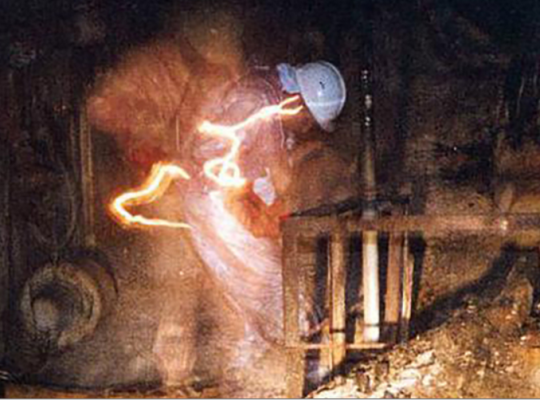
I mean, the Elephant’s Foot is very very dangerous, but it wouldn’t kill you instantly. When it was first created about a minute of exposure would give you a fatal dose (x, x). That number is now around one hour. And yes, that photo was taken with mirrors, but you know which one wasn’t?
Yeah, this is a selfie. The guy set the timer on the camera and went and stood by it, and it produced this horrifying image that now haunts my dreams. The reason all the photos from Chernobyl are grainy and poor-quality, by the way, is due to radiation. The cameras were fine; radiation just… does that.
Anyway, that guy’s name is Artur Korneyev- and I use ‘is’ because he’s still alive! He helped to build the original sarcophagus which encased reactor 4 after the meltdown, and kept going back inside with reporters to be like ‘look how fuckin weird this is’. He helped plan the New Safe Confinement which now surrounds the sarcophagus, and would probably have helped build it too if they didn’t full-on ban him.
A quote:
‘Korneyev’s sense of humor remained intact, though. He seemed to have no regrets about his life’s work. “Soviet radiation,” he joked, “is the best radiation in the world.”‘
Possibly the coolest guy alive? I’m tempted to think so.
Honestly, I feel like Chernobyl has been shunted into this category of like, ‘a lot of innocent and naive people died horribly’, when in reality a lot of tough as fuck people saved everybody else. The oft-told story of the ‘suicide mission’ to dive into the reactor and open the valves of the pool? Yeah, all three of the men who dove lived. One died in 2005 of heart failure; the other two are still alive.
A total of 31 direct and 15 indirect deaths are thought to have occurred from the Chernobyl disaster. Long-term deaths are… difficult to measure. Oh, and there’s a few hundred people still living in the exclusion zone.
If you’re at all interested, I really recommend reading up about Chernobyl- and, in particular, what was done to contain it and deal with the radiation. This is a beautiful write-up, and the wiki page is also worth checking out.
A lot of people did absolutely incredible work and it goes unrecognised most of the time.
Those willing to poke gentle fun at American Baptists say: “No dancing, because it might lead to sex. And no sex, because it might lead to dancing.” So yes, there actually was religious resistance to dancing, which has persisted beyond all belief. Not to mention the suppression of various types of folk dancing as European immigrants were assimilated into bland whiteness and encouraged to do “non-ethnic” dances like square dancing.
I’m a Canadian white and it’s also my observation that the British colonists especially brought the notion that civility, culture, class, professionalism, and correct behaviour were all undergirded by the ability to sit still, stand straight, and maintain an unemotional facade no matter what. “Stiff upper lip” and all that. Acceptable forms of dance among Whiteness are often formal, complicated, and difficult to pick up without paid instruction. White people often make the mistake, even when writing about our own culture from a couple hundred years back, of thinking that dance is ONLY a mating ritual–you don’t dance for sadness, or joy, or anger, or fun. It’s not an accident that anti-colonial resistance by Indigenous groups, people of colour, and non-English white people, have in many cases used dance as an avenue of resistance and identity. Nor is it an accident that moral panics have often been over white people enjoying “ethnic” forms of dance and music like jazz, swing, hip-hop, or rap.
By denying people dance, rhythm, and movement, colonizers denied them a powerful kind of literal medicine, a form of resilience that could have allowed them to heal enough to defy colonial rule. But it’s no accident that the intrinsic motions of colonialism–dictating what people wear, where they live, who educates their children, what they eat, what language they speak, what music they can make, and how they can dance–are those that contribute most directly to PTSD and widespread mental health and addiction problems.
When mental health professionals work to heal trauma, there’s a growing understanding that rhythm, music, and dance are all deeply powerful tools of healing and resilience. Our bodies are primed to thrive on rhythm, beginning with the heartbeat of the person gestating with, moving to being rocked as a baby. It’s why the stereotypical shellshocked person rocks back and forth. It’s a primal self-soothing mechanism. And that’s why we’re increasingly doing not just breathing exercises, but encouraging drumming, clapping rhythms, and basic dance. It’s why I’m starting to ask my clients to share songs that are important with me. It’s something that white settlers have literally been trained for years to think of as not just unimportant, but dangerous and alien.
in d&d, deer have 14 wisdom. a deer is just as wise as my ranger for whom i put his second-highest ability roll in wisdom and who uses wisdom to cast most of his spells. a deer is wiser than everyone in the friendship campaign party other than erwyn, who is tied with said deer. what the fuck
“The first bombshell on our list concerns the origins and spread of agriculture. There is no longer any support for the view that it marked a major transition in human societies. In those parts of the world where animals and plants were first domesticated, there actually was no discernible ‘switch’ from Palaeolithic Forager to Neolithic Farmer. The ‘transition’ from living mainly on wild resources to a life based on food production typically took something in the order of three thousand years. While agriculture allowed for the possibility of more unequal concentrations of wealth, in most cases this only began to happen millennia after its inception. In the time between, people in areas as far removed as Amazonia and the Fertile Crescent of the Middle East were trying farming on for size, ‘play farming’ if you like, switching annually between modes of production, much as they switched their social structures back and forth. Moreover, the ‘spread of farming’ to secondary areas, such as Europe – so often described in triumphalist terms, as the start of an inevitable decline in hunting and gathering – turns out to have been a highly tenuous process, which sometimes failed, leading to demographic collapse for the farmers, not the foragers. Clearly, it no longer makes any sense to use phrases like ‘the agricultural revolution’ when dealing with processes of such inordinate length and complexity. Since there was no Eden-like state, from which the first farmers could take their first steps on the road to inequality, it makes even less sense to talk about agriculture as marking the origins of rank or private property. If anything, it is among those populations – the ‘Mesolithic’ peoples – who refused farming through the warming centuries of the early Holocene, that we find stratification becoming more entrenched; at least, if opulent burial, predatory warfare, and monumental buildings are anything to go by. In at least some cases, like the Middle East, the first farmers seem to have consciously developed alternative forms of community, to go along with their more labour-intensive way of life. These Neolithic societies look strikingly egalitarian when compared to their hunter-gatherer neighbours, with a dramatic increase in the economic and social importance of women, clearly reflected in their art and ritual life (contrast here the female figurines of Jericho or Çatalhöyük with the hyper-masculine sculpture of Göbekli Tepe). Another bombshell: ‘civilization’ does not come as a package. The world’s first cities did not just emerge in a handful of locations, together with systems of centralised government and bureaucratic control. In China, for instance, we are now aware that by 2500 BC, settlements of 300 hectares or more existed on the lower reaches of the Yellow River, over a thousand years before the foundation of the earliest (Shang) royal dynasty. On the other side of the Pacific, and at around the same time, ceremonial centres of striking magnitude have been discovered in the valley of Peru’s Río Supe, notably at the site of Caral: enigmatic remains of sunken plazas and monumental platforms, four millennia older than the Inca Empire. Such recent discoveries indicate how little is yet truly known about the distribution and origin of the first cities, and just how much older these cities may be than the systems of authoritarian government and literate administration that were once assumed necessary for their foundation. And in the more established heartlands of urbanisation – Mesopotamia, the Indus Valley, the Basin of Mexico – there is mounting evidence that the first cities were organised on self-consciously egalitarian lines, municipal councils retaining significant autonomy from central government. In the first two cases, cities with sophisticated civic infrastructures flourished for over half a millennium with no trace of royal burials or monuments, no standing armies or other means of large-scale coercion, nor any hint of direct bureaucratic control over most citizen’s lives. Jared Diamond notwithstanding, there is absolutely no evidence that top-down structures of rule are the necessary consequence of large-scale organization. Walter Scheidel notwithstanding, it is simply not true that ruling classes, once established, cannot be gotten rid of except by general catastrophe. To take just one well-documented example: around 200 AD, the city of Teotihuacan in the Valley of Mexico, with a population of 120,000 (one of the largest in the world at the time), appears to have undergone a profound transformation, turning its back on pyramid-temples and human sacrifice, and reconstructing itself as a vast collection of comfortable villas, all almost exactly the same size. It remained so for perhaps 400 years. Even in Cortés’ day, Central Mexico was still home to cities like Tlaxcala, run by an elected council whose members were periodically whipped by their constituents to remind them who was ultimately in charge. The pieces are all there to create an entirely different world history. For the most part, we’re just too blinded by our prejudices to see the implications. For instance, almost everyone nowadays insists that participatory democracy, or social equality, can work in a small community or activist group, but cannot possibly ‘scale up’ to anything like a city, a region, or a nation-state. But the evidence before our eyes, if we choose to look at it, suggests the opposite. Egalitarian cities, even regional confederacies, are historically quite commonplace. Egalitarian families and households are not. Once the historical verdict is in, we will see that the most painful loss of human freedoms began at the small scale – the level of gender relations, age groups, and domestic servitude – the kind of relationships that contain at once the greatest intimacy and the deepest forms of structural violence. If we really want to understand how it first became acceptable for some to turn wealth into power, and for others to end up being told their needs and lives don’t count, it is here that we should look. Here too, we predict, is where the most difficult work of creating a free society will have to take place.”
It has come to my attention as of late that people do not fully understand the difference in the punks. Some people seem to think that Steampunk is pretty much everything when you see it.
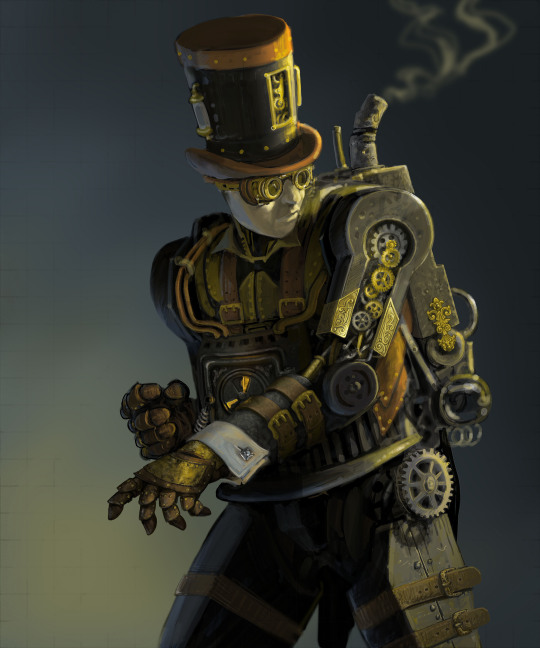
Let us review the fundamentals. Steampunk is set in an alternate future where steam was the primary technology and they continued on that path till now. That’s basically it. However there are MANY alternate futures with alternate technology’s, and lumping all of them into steampunk is just cheapening them. So let me just show you an example of each.
CLOCK/STEAMPUNK: This era is often Victorian in style for some reason and the steam powered robots often use lots of smoke stacks, gears, clockwork, belts and goggles.
TESLAPUNK: Unlike steampunk, this world functions as if Nikola Tesla had revolutionized the world with his electricity. Lots of lightning rods, Tesla rods and power cables. Often this is confused as steampunk because they often have the a similar look.
DIESELPUNK: This universe takes place in a world where diesel engines and machines using oil are everywhere. This is criminally underused. They usually use a more art deco and WW1/2 style.
ATOMIC/RAYPUNK: This one uses atomic technology. Lasers, blasters, radiation, green glows, aliens and giant robots. Also rarely used but I dare you to watch “The Iron Giant” and tell me you don’t love it.
CYBERPUNK: Possibly more well known than steampunk. A future, in which technology is so advanced people are more technologically advanced than some of the robots. Chainsaw arms, robotic eyes, hooking your brain up to the internet and evil corporations.
BIOPUNK: Imagine a future where technology has advanced so much that we construct living organisms as easily as building a robots. Living machines, weapons, organic clothing and new and improved limbs.
JUNKPUNK: Almost as unknown as candlepunk but still one to remember. This world all technology is composed of random parts you might find in a junkyard. Kind of like the ‘Coolest’ cooler.
SOLARPUNK: This one has been getting some recent attention. However in a world where technology is powered by the sun I have yet to find one robot picture so sorry about this one.
PUNKPUNK: You have gone off the far side of the spectrum. Turn back.
Hopefully now you can tell the different alternate futures apart and can better survive in the world with this Essential information.
(Note this is not my artwork just a quick google search, but I am working on a series that will clarify these examples better with my own work.)
Yo, just saying, but Cyberpunk ISN’T just an aesthetic.
Cyberpunk is a genre about contrast between high technologies and low life, and as such they focus on sadder/violent parts of people’s lives, like crime, law enforcement (treated realistically and not like in cop dramas), cybercrime, drug dealing, terrorism or warfare.
Common themes include any variation on a concept of identity (from identity theft, through search for identity, to identity politics), loneliness in digital age, anti-capitalism focusing on unchecked power of corporations, anti-fascism focusing on technological surveillance state, ethics of artificial intelligence and other technologies.
Best known examples are probably Robocop, Ghost in the Shell, Matrix (especially the first movie, sequels are more like post-apo war stories), Neuromancer, Snow Crash, Deus Ex, Shadowrun, System Shock.
Steampunk was an offshoot of cyberpunk, but since stopped being a genre and became only an aesthetic.
Biopunk is offshoot of cyberpunk, and usually contains similar themes (just with genetic engineering). Other offshoots include nanopunk (with nanotechnology) and, which has recently been getting more attention, nowpunk – stories that use concepts and themes of cyberpunk, but are set in contemporary times – we’re talking stuff like Mr Robot tv show, or Watch_Dogs video games.
Honestly, a lot of the punk settings and ideas are in some way political, or at least VERY good at exploring issues relevant to the time period they pull inspiration from.
Steampunk for imperialism, biopunk for ethical issues of biotechnology, atompunk for the red scare and cold war, etc. etc.
Not saying every story with these looks NEEDS to deal with those specific issues, but each punk type opens itself up to discussing those types of issues much more easily.
Also, each punk doesn’t need to exist separate from each other. I have a setting that is bio, solar, and junkpunk all at once.
These genres and aesthetics are tools, and the rules about ‘em aren’t hard and fast to say the least.
The “punk” part of all of these is a political analysis and a rebellion.
Steampunk without addressing the imperialism and class privilege of the Victorian era is “gaslamp fantasy” or “alternative history sci-fi”, depending on how sci-magical it goes.
Cyberpunk without the dystopia of a world ruled by megacorporations, and the small rebellions people engage in just to survive, is just gritty sci-fi.
Dieselpunk that doesn’t analyze how the imperialism of the late 19th century evolved into the rise of fascism in the early 20th is just more alternative history sci-fi.
Teslapunk have some similar imperialism themes to steampunk plus some of the anti-corporate vibe of cyberpunk. It’s an analysis of thing like “what would the world be like if an autistic dreamer like Tesla hadn’t been ground into the dirt by the corporate greed of Edison and others?” or “what if Edison and the other corporatists had stolen EVEN MORE of Tesla’s work?”
Solarpunk seeks to build clean energy, green spaces, and sustainable industries in response to the real threat of climate change.
The “punk” part is important. It gives us tools to dismantle injustice in the real world by analyzing or overcoming the injustice in a fictional one.
Inspired by this post, I wanted to a separate post about the destruction of the Jedi Order.
Their destruction wasn’t an event, it was a process. A long process that
started generations before Anakin was even born. Yes, Anakin made his terrible
life choices (no one is denying that) but he’s not the one thing that went wrong with Order
or why they fell apart. So I made a list of terrible things the Jedi
Order did that are not Anakin Skywalker’s fault:
The Order’s decision to take little kids from their parents.
The Order’s indoctrination of said kids;
The Order’s decision to keep Yoda in charge for 900 years;
The Order’s lack of action to end slavery;
Their turning a blind to the corruption in the Senate.
Their decision to follow the Senate even when they knew they shouldn’t.
The Order’s growing arrogance;
The Council’s nepotism;
The Council’s decision to not send extra help along with Qui-Gon and Obi-wan right after they were told the Sith was back.
Their decision to hide the truth about Qui-Gon’s death.
Their decision to personally aid the leaders of a planet but not its citizens.
Their decision to help slaver Jabba the Hutt but not his slaves.
The order’s diminishing popularity.
The Council’s decision to fight in the Clone Wars.
Turning children and teenagers into soldiers
Hiding prisoners in secret prisons (without trial).
Their plan to overthrown the Chancellor before they even knew he was a Sith.
Using a slave army.
Hiding the truth about the slave army’s creation.
The Council lying to their own members.
Turning their back on a teenager they raised (and used) to avoid “political complications”
Allowing an older man to have unrestrained access to a little boy.
Sending a little boy to an adult prison.
* Acting like they had All The Answers To Everything when they couldn’t even handle a scared kid who missed his mommy.
* Making the scared kid feel like he was a bad, dangerous person for being scared, despite the fact that he’d just helped their asses out bigtime.
* Wait, so Anakin’s Dangerous, but a fucknut like Pong Krell flies below the radar? Yeah, no.
* Giving Anakin shit about his arm when he lost it in battle against a Sith Lord…who used to be a Jedi himself and left the Order because he finally got fed up with the Jedi and their shit.
* Having a fucked up system that involved sending aspiring Jedi kids off to be farmers if they didn’t get chosen by a master. Wow, glad you guys took them away from their families and fucked up their lives so they could go grow beans for you or some shit, good job.
* Being hypocritical assholes. There is no ignorance…but only Masters can access certain parts of the archives and we’re gonna lie out our asses on a regular basis about pretty much everything we can think of. There is no fear…but we’re afraid of literally everything, including being unpopular, so let’s throw Ahsoka to the wolves so we can keep sitting at the cool kids’ table at lunch.
* Failure to have a basic fucking freshman level psychology textbook in the goddamn archives because then so much of this royal goddamn clusterfuck could have been prevented in the first place!




 There's a Mirror on the Wall