So, I’ve seen a lot of fanfics about Tina and Queenie Goldstein celebrating Christmas. I’ve also heard that people are using Christian theology in their tributes to Carrie Fisher. When called out, people do a few things; claim that they just wanted to write a nice fic or tribute and didn’t mean to erase the person’s Jewishness, state that the character or person wasn’t really Jewish because they weren’t that religious, or state that religion shouldn’t be considered important.
So let’s talk about this. What’s going on here is Christianormativity. This refers to the fact that those of us in the US live in a society based on Christianity. This doesn’t mean that everyone believes in Jesus; it means that mores and customs are based in Christianity, and that people’s idea of what “religion” is is based in Christianity. It manifests in people having Jewish characters celebrate Christmas because to them, Christmas isn’t a Christian holiday, it’s just a holiday. Everyone celebrates it, right? And using Christian theology to publicly mourn isn’t Christian mourning, it’s just mourning, right?
To understand why Jews see it differently, we need to understand the difference between Christianity and Judaism.
According to Christianity, a person is Christian if they accept Jesus Christ as their lord and savior. As far as I understand it, if someone ceases to believe this, then they are no longer Christian, no matter how they were raised or what holidays they celebrate. They now are just a regular, non-religious person. Since you can stop being Christian and still celebrate Christmas, that makes Christmas not a Christian holiday, right?
If we define religion based on Christianity, the definition of a religion is “a set of metaphysical beliefs about the world” and an adherent of a religion is “someone who believes those beliefs.” Christians look at the world and see many other religions: Judaism, Islam, Hinduism, Buddhism… and say “okay, I understand this, those are different sets of beliefs that people have.”
But the thing is, that definition of religion is one of the beliefs of Christianity. People from different religions don’t define their religion that way.
Judaism/Jewishness is an ethnoreligion. Being Jewish involves heritage more than anything, and culture second to that. Religion is inextricably tied in, as I’ll discuss, notably in that conversion to Judaism is a religious process that confers virtual Jewish heritage on the convert. Judaism is a religion in the sense that it is a set of beliefs and practices, but Jewishness is about heritage and culture.
Confusing? Okay, let’s break it down a bit more. Jews, before anything else, were a tribe. We were a tribe with a religion, and our tribal narrative is inextricably tied to that religion. Anyone part of that tribe is Jewish. And not everyone in that tribe chooses to practice religion. Judaism – the religion – believes that everyone in the tribe should practice the religion, but even if someone doesn’t, they’re still Jewish. It’s kind of like how your mom wants you to do your work, get exercise, and go to sleep early, but you’re still her kid even if you don’t do those things.
But it’s still not even that simple. For one thing, the definitions of terms I’ve given aren’t clear-cut or universally accepted: A practitioner of Judaism could accurately describe themself as Jewish. Another is that whether someone is a practitioner of Judaism isn’t clear-cut either. The first thing to know is that, as the word “practitioner” should imply, whether you are one depends on what you do rather than what you believe. Which isn’t to say that Judaism doesn’t have a belief system, but again, you can still practice Judaism without that. It’s sort of like how you can do your homework even if you don’t accept the views your professor is teaching. And even with that, there is a pretty wide range of theological belief that can fit into the Jewish system if you’re clever (I once managed to pray the evening prayers, which talk pretty explicitly about an omniscient, personified God, while interpreting them to be about an abstract Force-like God, convincingly enough that I had a legit spiritual experience.)
But it’s… still more complicated! Because Jewish practice isn’t a simple binary, 0 or 1 (unless you’re a Jewish robot, but I think that’s beyond the scope of this post). You can participate in some practices, but not others. You can participate constantly throughout the day, or once a week, or once a year. You can do something by yourself in your house or publicly at a synagogue. Also, Jewish culture is inextricably tied to religion. So you can choose to participate only in the culture, but if you celebrate the holidays, you’ll be engaging in practices that, according to Judaism the religion, have religious meaning – even if the religious part is not what it’s about for you.
So, what does all this mean about Christianity and Christmas? It means that according to Judaism, there is no such thing as a non-religious holiday, no matter how many non-religious people celebrate it. Beyond that, Christianormativity means that Christians see their own holidays as universal, and everyone else’s holidays as Other. But to someone who is Jewish, it’s the opposite! Our own holidays are familiar to us. Christmas comes from Christian culture, and to many of us it is fundamentally foreign and Other. We have a taboo against celebrating it, because of what it represents – assimilation into the majority culture and giving up our own. That perception is changing now, but it is still very present for many of us.
And it means that from our perspective, non-religious people with Christian heritage who celebrate Christian holidays are Christian. We don’t mean they’re religious, we mean they’re secular Christians. Wait, what? But that makes no sense! “Secular Christian” is an oxymoron! Well, yes, intellectually I know that. Which is why I’ve avoided the term and instead referred to “people with Christian heritage who celebrate Christian holidays.” There’s no term for these people because to most Americans, they don’t need a name, because they’re Just Regular People. And in that vain, secular Jews are Just Regular People too, right? Well… many do see themselves that way, after decades of living in a Christianormative culture. But many don’t. Many see themselves as Jewish.
Basically, because of the info I mentioned before, a person can be a Jewish atheist or a Jewish agnostic. And because of the different ways Christianity defines itself and Judaism defines itself, saying “she wasn’t Jewish, she was agnostic” is just as nonsensical – and just as culturally ignorant – as saying “secular Christian.”
So. Tina and Queenie Goldstein do not have a Christmas tree and they do not host Christmas dinner.
And Carrie Fisher, may her memory be for a blessing, was an amazing agnostic Jewish mentally ill activist feminist strong beatiful Space Mom who drowned in moonlight, strangled by her own bra.
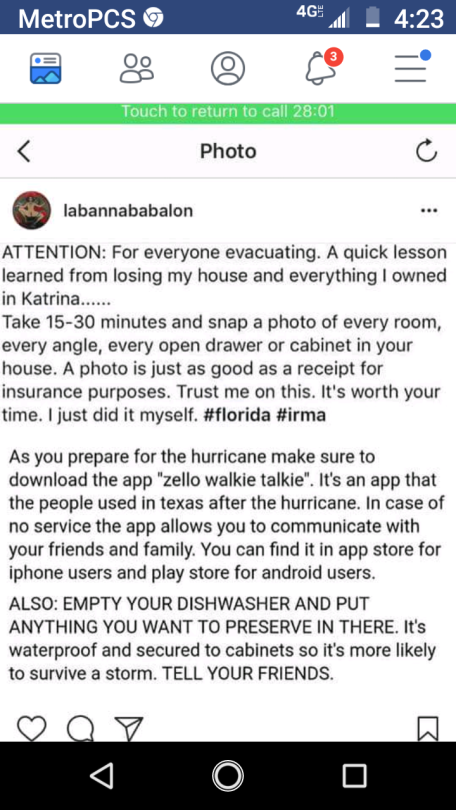
My mom saw this on Facebook and I thought it should be shared here.
To my coastal comrades, please stay safe.
This is true. We didn’t lose our ENTIRE house in Ivan. But you see in places the roof came off and pictures we sent on were basically reciepts for the fact that everything was destroyed anyway by black toxic mold.
Yes. Toxic mold is going to happen if you get ANY kind of water damage at all.
Here’s something NO ONE teaches you in hurricane evacuation unless you’re in Hurricane Alley:
Take ANYTHING you possibly can that was handmade(think school art projects, gifts from friends of art you can take out of the frame, knitware from grandma), stuff inherited from a relative especially paperwork like marriage licenses and family bibles that hold your history and pictures that are non-digitized. If you have insurance you can rebuild and if you don’t you can find donations of additional clothing food even housing, though it will be a struggle I know. But let look here’s the thing.
Pieces of your history are the one thing, aside from your physical safety, you cannot replace. Trust me on this ok?
The Katrina people lost everything but I come to you as a multiple hurricane survivor who was displaced and made precariously housed on the homelessness scale twice by hurricanes in less than 20 years.
My first major evacuation was when I was 8 for Opal. My mom gave me a suitcase and sent me into my room and said “Go see what you want to bring that’s just yours. We can buy new toys and new clothes but we may not come back. What can’t we buy no matter how much we want to if the house is gone when we come back. See how I’m bringing these pictures of you and your sister and this that my mommy got me for my wedding? What is like that for you?” It was heavy shit to lay on an 8 year old but she was right … I don’t remember but it took more than six months to get back into our house in any real way and at 8 the toys I brought were THE comfort items and not much else and even then? I didn’t need for much because I had the irreplaceables.
Ivan gets lost because it was right before Katrina and was not a racist catastrophe but let me tell you: we never real moved back. Not really. Same situation- photos, letters, handmades, gifts from the dead, records. And this time we lost it all in slow motion.
These two major ones don’t count the fact that I had at least one(1) evacuation every two or so years after Opal until I was 25. After more than a dozen evacuations, you learn what to take.
Hear my experience where federal officials don’t listen to what Floridans have tried to teach.
If a storm is going to make landfall at a Category 3: You are facing a very real possibility that you might NEVER go home even if the building is still standing. Take what CANNOT be replaced. You don’t know how life will be when you return – the crises, stressors and obligations of hurricane aftermath create massive restrictions you cannot predict. You may not have a chance to replace it.
Please signal boost this with my addition attached because every time I hear a report about people lamenting how it’s the pictures they regret the most I just think “Someone should have told you. You deserved to be told as part of basic evacuation procedure.” I’m trying to post this to help fix that. At least a litt.
Something that i’ve seen happening in my notifications this week is a new kind of porn blog interacting with my posts, and i want to explain WHY its so important to block them.
In the past all that would happen if a porn blog would follow you is just that, they’d follow you. It was all to do with google algorithyms where if a porn blog was shown as ‘linked’ or following a legitimate site/blog then it increased the place they came in the google searches. Great if you are one of those scam websites that gets people to click on links that either plant malware or are just shady as fuck. Porn blogs were also sometimes shut down without warning so all the scammers hard work was over and gone. Good for us, not good for them. Most of these blogs were just stolen gifs/videos from other porn blogs anyway. If you thought gif stealing was bad/rife in the geek/nerd fandoms, just have a peep at the porn blogs.
Well a lot of the search engines etc caught onto this and built controls into their software, so they found a new way of getting (or at least trying to get) people to click on links to take them off of the tumblr site. This is by finding a random post from a legitimate blogger, which could be about anything, and either deleting the entire content of the post and adding in some ridiculous comment like ‘For more fun follow this link’ with a hyperlink off of tumblr, or if its a photo that in any way is either fun/a meme/or a little nsfw, they keep that in place and just add their link like above. Scroll down their blog and literally every single post will be a reblog and have exactly the same comment on, getting you to click and take you off site.
What does this matter i hear you ask? Well, when it comes to reporting a post, it helps to confuse the tumblr bots/staff as to what’s being reported… the comment or the original post? This means that when a bunch of posts are reported, they are all coming from different originators, this will make tumblr staff’s life even harder, and legitimate blogs are at risk of someone hitting ‘deactivate blog’ in the admin settings, meaning YOU COULD LOOSE YOUR ENTIRE BLOG BECAUSE SOME ASSHOLE PORN BOT REBLOGGED FROM YOU.
So don’t ignore this kind of thing, if you see one of these stupid reblogs (the bots very rarely actually follow you anymore), BLOCK THEM RIGHT THERE AND THEN.
heads up, this is happening again and it’s affecting gif/graphic makers that post links to their sources in their captions. don’treport porn bot reblogs, just block and if you make content, do not link to anything outside of tumblr.
OP, you give some good advice, BUT, you are mixing up a couple of things.
Here’s how you procede when a pr0n blog follows you, likes a post, or reblogs a post.
If they follow you / like a post (either one you created, or that you reblogged from someone else. You simply report the blog for SPAM (reporting for sensitive content does not work/count because TECHNICALLY, NSFW content IS allowed in this website.
You go to the blog in question and click the little buddy icon (red circle)
You see there’s a “Report option”, you click that and you’ll see “Report Spam”, in addition, you’ll see under that the option to “Flag & Report”. You click that. (The screenshot is from a pr0n website that I’m waiting tumblr to remove a post of mine, hence why in the options it says “Unblock” instead of “Block”
Now, when they REBLOG form you, there’s 2 scenarios
Scenario 1:
You are not the original poster of that reblog, you contact the original poster and send them the link, then you follow the steps I mentioned above (report for spam).
Scenario 2:
You ARE the original poster, then you report THE POST ITSELF.
First you visit the post in question and hit the little arrow (the same one you click/tap when you want to send a post to someone in a chat), and you’ll see the option to report, you tap/click that one. (I removed the icons and blog URLs for privacy reasons)
It will bring you to this next window, where you select “report something else” and hit continue:
Which gives you the following, where you select “misattribution violation”:
Once you click that, it’s gonna ask you “Is it your work that’s being misattributed, or that’s missing an attribution?”
You click YES.
Next it’s gonna ask you “Did you originally post this work on Tumblr, or somewhere else?” Select “I posted it on Tumblr”.
Next is gonna ask you:
“Which of the following best describes your issue?”
Someone reposted it instead of reblogging it
Someone reblogged it and injected a link back to their own blog
You select the second option, which will bring you to this window, where you gotta fill the URL of YOUR original post (red square, in the blue square, your email address will already be there, I cropped mine out for privacy). You hit the CAPTCHA thing, and then simply click “Submit and Block”
It’s important to remember to ALWAYS report the BLOG and not the post, UNLESS you are the original poster.
Spread the words, guys, because a lot of people don’t know how to proceed when a post of theirs gets hijacked by pr0n blogs.
Smash that mf reblog button if you stoically ignore all labelled washing instructions and everything your mama ever told you about laundry and just send those bastards hurgling around in an overfilled tub to meet either death or glory
Something I learned from a costume designer: if an item can be washed multiple ways the designer is only legally obligated to put one of the ways on the tag, but if there’s only one way to wash that item they have to put Only on the instructions
If the tag says “Dry Clean” it’s safe to machine wash but the designer thinks it looks better if you get it dry cleaned
But if it says “Dry Clean Only” you will destroy it if you wash it any other way
Reblogging for that last bit which this 37 yr old adult did not lnowy
Those willing to poke gentle fun at American Baptists say: “No dancing, because it might lead to sex. And no sex, because it might lead to dancing.” So yes, there actually was religious resistance to dancing, which has persisted beyond all belief. Not to mention the suppression of various types of folk dancing as European immigrants were assimilated into bland whiteness and encouraged to do “non-ethnic” dances like square dancing.
I’m a Canadian white and it’s also my observation that the British colonists especially brought the notion that civility, culture, class, professionalism, and correct behaviour were all undergirded by the ability to sit still, stand straight, and maintain an unemotional facade no matter what. “Stiff upper lip” and all that. Acceptable forms of dance among Whiteness are often formal, complicated, and difficult to pick up without paid instruction. White people often make the mistake, even when writing about our own culture from a couple hundred years back, of thinking that dance is ONLY a mating ritual–you don’t dance for sadness, or joy, or anger, or fun. It’s not an accident that anti-colonial resistance by Indigenous groups, people of colour, and non-English white people, have in many cases used dance as an avenue of resistance and identity. Nor is it an accident that moral panics have often been over white people enjoying “ethnic” forms of dance and music like jazz, swing, hip-hop, or rap.
By denying people dance, rhythm, and movement, colonizers denied them a powerful kind of literal medicine, a form of resilience that could have allowed them to heal enough to defy colonial rule. But it’s no accident that the intrinsic motions of colonialism–dictating what people wear, where they live, who educates their children, what they eat, what language they speak, what music they can make, and how they can dance–are those that contribute most directly to PTSD and widespread mental health and addiction problems.
When mental health professionals work to heal trauma, there’s a growing understanding that rhythm, music, and dance are all deeply powerful tools of healing and resilience. Our bodies are primed to thrive on rhythm, beginning with the heartbeat of the person gestating with, moving to being rocked as a baby. It’s why the stereotypical shellshocked person rocks back and forth. It’s a primal self-soothing mechanism. And that’s why we’re increasingly doing not just breathing exercises, but encouraging drumming, clapping rhythms, and basic dance. It’s why I’m starting to ask my clients to share songs that are important with me. It’s something that white settlers have literally been trained for years to think of as not just unimportant, but dangerous and alien.
Time for some kitchen charts to help you adult better 😉
Cause I know a lot of my followers get stuck on some of these.
Reblogging because charts like these are always useful, especially when trying to convert between US Cups (volume measure) and oz / gr (weight measure).
Not having grown up with them, cups have always seemed an inaccurate way to measure anything coarse: liquids, flour, sugar, no probs, but surely 1 cup of (say) whole almonds is going to be a smaller amount than 1 cup of ground almonds, because of the air spaces.
And then there’s the “pint’s a pound the world around” business… Imperial pints are bigger, 20 fl.oz rather than 16.
@dduane has a set of US Cups, and just for fun we also got a set of these amusing spoons. What I really want are measures for Some, A Bit and most important, Far Too Much.
Um, cilantro and coriander are the same thing? Why do they have two different rows for the same thing in the spice/herb table?
When it’s “cilantro” they’re usually talking about the leafy part of the plant, and when it’s “coriander” they mean the seeds.
Wow! This is the most incredible site! If you’re disabled and trying to figure out (in the U.S.) disability, food stamps, section 8, other benefits, accessibility resources (wheelchairs, etc.), affordability of everyday stuff (phones, cars), etc. this is THE site! I wish I’d found this years ago. I hope lots of people get to see this.
The most common cause of female infertility – polycystic ovary syndrome – may be caused by a hormonal imbalance before birth. The finding has led to a cure in mice, and a drug trial is set to begin in women later this year.
Polycystic ovary syndrome affects up to one in five women worldwide, three-quarters of whom struggle to fall pregnant. The condition is typically characterised by high levels of testosterone, ovarian cysts, irregular menstrual cycles, and problems regulating sugar, but the causes have long been a mystery. “It’s by far the most common hormonal condition affecting women of reproductive age but it hasn’t received a lot of attention,” says Robert Norman at the University of Adelaide in Australia.
As the curator of Radio Free Monday, I see a lot of fundraising pitches every week, and as someone who also works in fundraising, I see a lot of information about giving cross my desk each day.
Sometimes I see a pitch on YouCaring or GoFundMe or other fundraising sites, or even just in a tumblr post, and I wince, because I know that the pitch isn’t as effective as it could be, but also that now is not the time to give the person a lesson in fundraising technique.
Some of the problem is that we are a community of storytellers, and some of it is that when you’re trying to raise money after a disaster in your life, you’re just not feeling super coherent. A lot of it, I think, is inexperience. Not just inexperience in raising funds, but inexperience in the kind of thing I deal with every Sunday night when I assemble Radio Free Monday: reading a ton of fundraising efforts and trying to discern the goal and needs of each.
Because of all this, I wanted to bang together a guide to asking for money for people who don’t usually ask for money. This isn’t meant to be any kind of professional essay on the art of fundraising and it’s not really meant for organizations, but I hope that it may be helpful to individuals and small orgs who have an immediate need and maybe need a voice of reason and order in a life that has suddenly become unreasonable and chaotic.



 There's a Mirror on the Wall