So I get really narky when people pull the whole ‘oh Eowyn’s
storyline came to such a sucky ending; she was really cool going around killing
orcs and Witch-Kings and then she got shoved into a traditional girly role by marrying
Faramir and becoming a healer’ thing, because no. No-no-no-no-no. Not only does that
stray dangerously into the territory of ‘women only have worth if they’re doing
traditionally blokey things’, but that misses almost the entire point of Lord of the Rings.
Tolkien was in the trenches in the first world war, right?
He got all that ‘for death and glory’ shit shoved down his throat, that was the
whole point about the war, it was when so many people came to see how awful and
misleading all the propaganda about winning glory through violence and death was. And Tolkien’s work completely shows
that: it’s why the hobbits, who’ve never craved power or battle the way men do,
are the heroes of the book; it’s
why strong men like Aragorn and Faramir are shown to be lovers of peace rather
than war. It’s why the quote – but I do not love the bright sword for its sharpness, nor the arrow for
its swiftness, nor the warrior for his glory; I love only that which they
defend – is so poignant and beautiful, when
seen in the context of all Tolkien had gone through. He’d seen all but one of
his closest friends die in an utterly pointless war; the prevalent message in
his books is ‘if you’re going to have that many people die, let it be for
something worth dying for.’ (Like
defending your home from the lord of all darkness, for example.)
And Eowyn
might be a fantastic female character, but she’s also got so much development
to go through, and she’s by no means perfect. I find it really interesting that when Eowyn talks to Aragorn
about wanting to go off and fight she never really actually mentions protecting
her people, but speaks about wanting to ‘face peril and battle’, and to
do ‘great deeds’. And it’s not that Eowyn doesn’t want to protect her people, because of course she does, but she’s also got such a
driving motivation within her to do glorious and fell deeds simply for the sake
of valour and renown. It’s one of her defining features, having an attitude
that got so many young men killed in the war and which, obviously, Tolkien
would have been very wary of.
(Also, I think, there’s so much in Eowyn that wants to prove
herself to be more than ‘a mere woman’; because twice in that conversation she
asserts that she’s no mere ‘dry-nurse’ or ‘serving-woman’, but a member of the
house of Eorl and therefore capable of greater things. There’s almost this
slight sense of Eowyn considering herself more than ‘just’ a domesticated woman that I
sometimes get from her in the books? Which is very sad – the idea of Eowyn having less regard for others of her sex who do mind the house or raise the children – and why I so love that ‘I am no man’ moment in RotK. Eowyn’s no longer hiding herself, or dismissing fellow women as the weaker sex,
but acknowledging and embracing the fact that women in all their forms can fuck you up.)
And then we reach
the Houses of Healing, and Eowyn yearning for death in battle just like her
Uncle Theoden, and basically buying into that whole world war one ethos that
Tolkien would have considered so poisonous. Which is why her friendship and
courtship with Faramir is so fricking beautiful.
Remember that quote I wrote earlier? That’s from Faramir. He’s not backing down
from conflict, he’s in no way less of a ‘real man’ than anyone else; he’s just
saying there needs to be more to the fight than simply having a fight. There needs to be a reason; something worth
fighting for. Eowyn recognises that Faramir is a good man in every sense of the
word: he’s strong and valiant, but he doesn’t fight simply to prove himself or
for the sake of winning glory, he fights for other people. And Faramir gently challenges Eowyn on her
idolisation of battle-glory and encourages her not to scorn gentleness or
peace, and he’s so freaking good for her.
(Seriously. Can we just stop for a moment and think about how
wonderful Eowyn and Faramir are for each other: Faramir encouraging Eowyn to
turn towards life and healing and openness while never denying her strength or courage, and Eowyn giving Faramir the
validation and security he never got after so many years of an awful
relationship with his father? I honestly don’t know why I don’t get all giddy
about these two more often, because they make the very best otp.)
And the result of the departure of the Shadow and her
friendship with Faramir is Eowyn’s decision that ‘I will be a shieldmaiden no longer, nor vie with the great Riders, nor take joy only in the songs of slaying. I
will be a healer, and love all things that grow and are not barren.’
I think that last bit is so important because I’m certain
that Tolkien doesn’t mean for Eowyn to immediately pack up her sword and shield
and become a good girl sitting at home with her knitting and waiting for the
men to return home after the fight – after all, she’s going to be the wife of
the Steward of Gondor and there’s a lot of mess to clean up after the War of
the Ring. Eowyn’s probably still going to find herself defending hearth and
home from time to time. But the important thing is that she’s no longer
defining herself simply by the doing of valiant deeds; she’ll no longer compare
herself to the great warriors of her house and feel lacking simply because she
hasn’t killed as many men. Most importantly, she’s not going to take joy only in the songs of the slaying, in
destruction and death. Tolkien was all about healers symbolising life and
rebirth, and Eowyn’s decision to become one – to aid in the preservation of
life rather than the taking of it – is so beautiful. I don’t think Tolkien ever
wrote Eowyn’s ending to make her reclaim her ‘lost femininity’; I think it’s a
lovely way of adding to the ever-present theme in Lord of the Rings of hope and
frailty and healing and friendship over glory and battle and strife.
Ah, fuck, you’re gonna catch me smiling and crying about this excellent and terrific piece of analysis you got here OP. Thank you for sharing this 💖
thank you
the thing about Eowyn is that it’s very clear that her attitudes towards battle don’t come out of a healthy place. and I don’t just mean a place of “war is glorious” or “fighting is more worthy than ‘womanly’ things.” there’s some of that, yes (and who could blame her, really, growing up among the songs of great men and great deeds, while feeling an ill fit for the role in life she was forced into?) but there’s something else too.
when Eowyn’s being tended to in the Houses of Healing Gandalf and Aragorn talk about how she’s been suffering for a long time. Aragorn says that there’s been a darkness over her since before the Witch King ever got to her. when Eomer is confused because he never noticed anything, Gandalf points out that Eomer at least could ride out and defend his country when it was under attack but Eowyn had to stay home and look after Theoden while Wormtongue corrupted him and abused her.
Eowyn went through hell. she was trapped in an awful, awful situation, watching her country crumble and her people suffer, war break out, her brother get exiled, her uncle who was like a father figure to her become ill and twisted by the machinations of this horrible man who was leching on her in his spare time, and there was nothing she could do about it. nothing but sit at home and tend to Theoden and watch.
the narrative and characters come about as close as they possibly can without using modern language to saying that Eowyn went through severe depression culminating in serious suicidal ideation. all of which fits into the ongoing themes in the book about how war can psychologically affect people.
yes, Eowyn wanted glory in battle, but I think that largely came out of her desperate need to just do something when for so long she was effectively powerless. and even after killing the Witch King, which I think can be pretty much universally agreed to be about as good as it gets when it comes to glory in battle, she was trying to get back in the fight. she’s literally wandering around the Houses of Healing with a broken arm angry that she’s not being allowed to fight some more while the healer begs her to go lay down already.
and that makes sense to me because at that point what Eowyn wanted wasn’t to do great deeds and be praised for them. she wanted to die in battle–gloriously, yes, but she wanted to die. and then she doesn’t. and she doesn’t know what to do afterwards. and the war is still on. and everyone’s gone to attack Mordor and she’s been left behind, again, and again she cannot do anything but wait.
and then she meets Faramir, and Faramir understands her because he has been through the same things. he has watched his country come under attack from within and without and been able to do nearly nothing about it. he has been the unfavored one in the shadow of a sibling who was a great warrior. he has seen his father die. he has been hurt by the Nazgúl. we have both come under the same shadow, and the same hand drew us back. Faramir doesn’t magically step in and make Eowyn better because he’s a man. they help each other because they are two people who can relate to the hell they have been through and they hold hands and walk back into the light.
I don’t see Eowyn’s story climax as being a woman who goes “oh, I’ll stop being badass then and let the men do everything.” I never have. I see it as Eowyn choosing to live, and that to me is the most amazing, profound strength, to overcome everything she has been through, to fight through the hell in her own head and the darkness that has plagued her and to start moving forward.
deciding to live when you have spent so long only wanting to die is not an easy thing. it is an act of tremendous courage. it should not be mistaken for weakness simply because it coincides with putting down the tools of war.
The Minas Tirith Archives Department probably had strict rules about proper record keeping procedures too, but try telling Gandalf anything and you’d probably get some form of “I do what I want.”
Eh, I’m gonna quibble with “the Minas Tirith Archives Department probably has strict rules about proper record keeping procedures”, given that we see Gandalf being shown into a poorly lit room full of jumbled stacks of books and loose papers that was clearly a disaster before he arrived. Maybe they did have good standards at one point, but Denethor cut the library budget and they had to downsize their storage space, let go of some staff, you know how it is.
You know, I still like this and it makes me giggle, but I have some quibbles about some things on it. Mostly because, well, I have been watching living history stuff the last few days, and dude.
That bit about no beverages? That’s not a beverage. That’s a magnifier.
By at least the early 16th century – possibly earlier – they had figured out that fill a spherical glass container with water, and you can magnify details on a manuscript being illuminated. By no more than a century after that, they also were well aware you could use the same thing to magnify light from candles or rushlights, for a brighter light to do detail work.
In Middle Earth, I’m betting the dwarves came up with the water-in-glass-bulbs for magnifiers, both for seeing detail work up close, and for magnifying light to have brighter lights for that detail work. That spread, probably to elves sometime in the First or Second Age first, and then from there to humans.
(And it’s probably those who used it for sewing, and anyone who did manuscripts who adopted it first as it spread out of Dwarven cultures, because hey, look, tools to make thier lives easier!)
In the context of Gandalf doing research? He’s probably using it to magnify the candle light so as to keep the candles further away from the manuscripts.
Which, they would have used candles for light even around manuscripts, when they couldn’t get natural light. Now, granted, they’d probably have done most of their writing/reading in daylight, because it’s better anyway, but still. Sometimes things happen, and you’re trying to do that by candle light. Or, it’s the middle of winter, and you never have enough light anyway.
The desk is the wrong sort of desk to do any writing at, so the ink is, indeed, misplaced, at least with the quill for a writing implement. You need an angled working surface for clean writing.
The clutter… well. That is asking for a fire to start, Gandalf, you should know better than that, even if the archivists have fallen down on their job.
(Gloves for handling fragile items I’m uncertain of, but suspect is a more modern thing with manuscripts, and for the sort of feel that a lot of Middle Earth has, and especially Gondor, that… wouldn’t even be a thought. You use bare hands because gloves are too bulky and you risk more damage to the scrolls and old books from the lack of dexterity than you do from natural skin oils and sweat.)
Okay, so my friend Chloe just pointed this out, and it’s amazingly accurate:
“Because of the scarcity of Dwarf-women, their secrecy and similarity in
appearance to males, and their lack of mention, many Men failed to
recognize their existence.”
Okay, so?
Well, Tolkien was a philologist, and a Norsist, and that means he knew Völuspá well enough to pull the names of every dwarf from Dvergatal and he had a pretty firm grasp Old Norse grammar.
In fact, he grasped it well enough that he knew if you dropped an n from a name ending in –inn, it changes from the masculine
definite enclitic
to the feminine.
Well, what the hell does any of this mean?
Well, I give you the names of the Dwarves from the Hobbit, as they appear in Dvergatal (stanzas 14-16) and in the order they appear:
Now, you notice something with the way those names got changed? That’s right, he changed the masculine -inn definite suffix to -in, which is feminine.**
That means that, at least grammatically, Dwalin, Dáin, Thorin, Thráin, and Glóin are female Dwarves.
Since we know Tolkien was meticulous about his grammar, this was done most likely as an in-joke (lol we’re so learnèd about Norse grammar that my comment on Dwarf women being indistinguishable from men is hilarious because of this grammatical funniness)
But there’s a not-inconceivable chance that the Dwarves were using the masculine pronouns in Westron because that’s what the Men who met them used, despite the fact that a third of the company was female, and
hey, it’s kinda neat to think he wrote a bunch of Dwarf-ladies going on an adventure.
given Tolkien’s general approach to women he’s unlikely to have intended this but I don’t care I’m going to accept it as canon anyway
isn’t there stuff in the appendixes about the Hobbit language having ’-a’ as a masculine name ending and ’-o’ as feminine but then he changed all the Hobbit names anyway?
Bilb-O
‘O’ and ‘e’ are feminine suffixes in hobbit-dialect Westron, which is not English.
Tolkien translated/Anglicized the names of all the hobbits into names that both sounded appropriate for their gender and reflected the aesthetic impression a native Westron speaker would get when meeting hobbits and hearing their language. It’s not about how The Hobbits Are Actually Girls (though that would be cool) it’s about how “Bilbo Baggins” gives a certain feeling when you as an English speaker encounter it – you get an idea of a character, perhaps, and it sounds just a little ridiculous – but you wouldn’t get that feeling from “Bilba Labingi”, the original hobbit-dialect Westron name.
(As to “Tolkien’s general approach to women”, yes, the man was sexist, I’m not going to deny that, but he was also meticulous and perfectionist when it came to language and there is no way this was accidental. No way at all. Not when he wrote an entire fake-academic-journal fanfic essay about why the Sindarin word ros had two translations, justifying it with in-universe linguistic drift.)
That being said, yeah, quite a lot of those dwarves were ladies. Headcanon accepted.
[Thorin] is cantankerous and often cross. I found this characteristic interesting and, at the beginning, it was a bit hard for me to determine where it sprang from. I’d say this surly and aggressive side is something all the warrior dwarves share, but Thorin, on top of that, cant stand the thought that he’s been stripped of his kingdom in such a violent way. In addition, he’s suffered the loss of his rank in the dwarf society, going from the privileged status of a royal family member to that of a wandering warrior. He’s ashamed of such a decline..
I saw him ride over seven streams, over waters wide and grey;
I saw him walk in empty lands, until he passed away
Into the shadows of the North. I saw him then no more.
The North Wind may have heard the horn of the son of Denethor.
YES PLEASE. I love me some Sean Bean but like. The LOTR series? V. white. The humans on screen had little to no color variation amongst them. Looking at that series now, years and years and LOTS of love later? I probably would have enjoyed it just as much with some more diversity.
Ten Things About Boromir the Bold That Never Made It Into the Red Book of Westmarch
I. His strongest memory of his mother was the smell of the sea she carried in her hair; how dark and tall she stood, looking towards a west Boromir would ever only long for in her honor.
II. Boromir did not ever doubt that he was loved. He was the first son of Gondor, swaddled in a walled citadel and rocked in Pelennor’s arms. He did not question why his father’s love was like stone, nor why his brother looked to him like he was the highest point of the ramparts. They were a city, and how else was a city to love?
III. For Boromir’s fourteenth year, the master of hounds promised him a pup of his own—One of Huan’s own line, the man swore, As befits a prince. What Boromir received, however, was the runt of that spring’s litter, a wheezing, stumbling thing that Boromir stubbornly nursed with a cheesecloth dipped in milk, then fed meat from his own plate.
Bellas, he called her, and ignored any who dared laugh.
Bellas never grew taller than Boromir’s knees, but she was strong and stubborn and loyal—for three years, Boromir went nowhere without her shadow at his heels. Bellas slept at the end of his bed; waited patiently during Boromir’s lessons; loped after his horse when he went riding.
Boromir was seventeen when Bellas was killed, her neck broken by an orc who had stumbled into their hunting party. She had put herself between her young master and the interloper, and afterwards, Boromir had carried her in his arms all the way back to Minas Tirith.
He buried her beneath a sapling tree on the slope of Mindolliun, and wept where no one could see him.
IV. Faramir looked west, and dreamt of great waves. Boromir watched him, heart heavy in his chest.
V. He had been in love with—well. He never said.
VI. Boromir was ill at ease in Elrond’s house, feeling too rough with travel, and heavy—all of Gondor on his shoulders, the knowledge that Faramir’s fine speech and strange visions might have meant something here, where Boromir, Protector of the City, did not. But he burned when they dismissed Gondor, his fingernails biting into his palms when the strength of Men was so questioned. (He had not seen any Elves come to Osgiliath’s defense, nor heard of any wizard-craft that kept the Corsairs from their brazen pillaging of Langstrand and Belfalas. What had these mighty peoples done to battle back the Shadow in the East except sit in their cool green palaces and speak in riddles?)
VII. He liked the Hobbits best, even after. They reminded him most of his own men, with their stubbornness and light-hearted complaints, their love of food and pipe-smoke and story. Three of them had left behind the whole of their world, to walk into darkness beside just one, and—yes, Boromir could respect such brotherhood.
VIII. (Aragorn remembered when Boromir was only a child, rosy-cheeked and happy to leave his mother’s side, to follow Thorongil around the citadel burbling in some tongue only Denethor and Finduilas could decipher. It was strange to meet the man that child became, to stand at a height with him, to wield a sword at his side, to listen to him speak of peace for Minas Tirith like other men spoke of lovers.
It made Aragorn feel very old, an ache deep in his bones that had not been there before. Careful, he wanted to caution the man, as he had once cautioned the child. Reach too high and you will fall.)
IX. One rainy night, when Boromir was keeping watch over the sleeping Fellowship, he sketched it out in his mind—the streets he would lead Aragorn through, the hidden corners of the palace he would show to Merry and Pippin, the great gates of the city whose craftsmanship he might justly boast of to Gimli. How Minas Tirith, that shining city, would chase the sorrow from the Fellowship’s faces, might shield them, might give them rest.
The rain dripped down his neck, cold, but he was gone to Minas Tirith—This is my home, he imagined himself saying to his companions, his brothers. This is home, may you always be welcome.
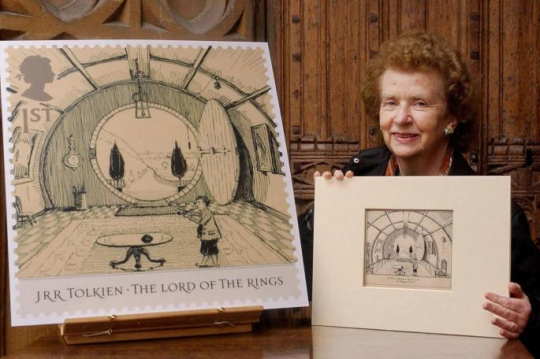
I was curious about something, because with the light of the Amazon announcements, I realized that as a fandom, we treat Christopher, Tolkien’s 2nd youngest child, like he’s a second JRR Tolkien–and don’t get me wrong, I love his work with the Histories, but I realized a major error in our fandom as well.
For all our talk of “but what about women in Tolkien’s works” I realized that there are no search results for his only daughter and youngest of his children. Not on tumblr at least.She’s not devoid of interaction, either, as she has written articles, given talks, and supported general fanworks (such as the Tolkien Ensemble).
She co-published the Tolkien Family Album, with her older brother, John (now deceased).
Why does it bother me so much that she has no search results, despite also the severe irony of “We only care about his surviving son, and not at all his only daughter, who her parents had long hoped for.”? Because all of his children are extremely crucial to his work, and not just his sons.
Frodo is named after her stuffed bear (Bingo Bolger-Baggins), which is highly delightful to me. He eventually altered the name, obviously, to Frodo.
She attends the Oxonmoots frequently.
She has a BA degree in English and worked as a social worker. (Hence why she isn’t so “famous” as her older brother.)
She is a member of the Tolkien Society (last I checked, honorary VP).
As Tolkien’s only daughter, Priscilla has noted her father’s “complete belief in higher education for girls; never in my early life or since did I feel that any difference was made between me and my brothers, so far as our educational needs and opportunities were concerned.” [x]
She typed out some of the early chapters of Lord of the Rings for her father (around the age of 14).
She is one of the founding members of the Tolkien Trust, along with her three brothers.
My point isn’t to devalue Christopher at all, but rather to highlight that while the brothers are important to Tolkien’s works, so was his daughter and for some reason, at least among the American fandom, I almost always see Christopher the only mentioned surviving Tolkien when Priscilla is still alive and active. I get why we don’t have search results for John Francis Reuel Tolkien (his name is so similar to JRR’s, obviously), but you do have results for Michael Tolkien (one tagged post, it seems, but still far more than Priscilla has; she doesn’t even have general Tolkien posts pop up for her as her brothers do).
I’d also like to point out that while Christopher is no longer a board officer of the Tolkien Estate, his younger sister is. Just because she didn’t write the Histories doesn’t mean that she doesn’t care about her father’s work.
“We’re the most useless race. We cannot do anything. When the camera’s off. I mean, the state of us. We’re all just half baked and dead by the side of the set.”

 There's a Mirror on the Wall