Realistic Stuttering: “Sorry, I uh… I didn’t mean- I didn’t mean to do that…”
When people stutter, they usually reword what they’re saying as they speak, and subconsciously insert “filler words” such as “uh, like, you know,” and etc.
*puts on speech therapist hat*
ACTUALLY! It depends on why they are stuttering.
A Nervous Stutter results in what is called Mazing, or rewording the sentence. That is the classic “I, um… well I… look it’s just that… so we…” that @hellishhues is talking about. When someone is mazing their words you’re seeing a form of Speech Apraxia where the brain is having trouble forming verbal speech. This can be brought on by brain damage, memory loss, anxiety, nerves, and several other things.
The root cause of a nervous stutter is a disconnect between the mouth and the brain.
With this you will also sometimes see the classic “S-s-s-sorry…” especially if the person has been training to speak clearly and is now at a point of fatigue or stress where they are not mentally capable of forming the words.
The other kind of stutter is a Physical Stutter, sometimes referred to as slurring, and another facet of Speech Apraxia. This stutter is caused when the muscles of the mouth, tongue, and throat are physically unable to form certain sounds. This is most often seen in the very young and victims of brain trauma.
Sounds are acquired at different ages, so a 2-year-old will probably not be able to clearly pronounce certain words (which is why toddler sound so off when they’re written with developed dialogue). These mis-pronunciations are sometimes referred to as lisping, but only if the sounds are run together. If the person starts and restarts the sound because they got it wrong, it can also sound like the classic sound stutter.
But it all depends on why the character is stuttering!
Do they have Speech Apraxia, Audio Processing Disorder, muscle dysfunction, or another medical reason to stutter? (1)
Are they stuttering because of anxiety, stress, or fatigue? (2)
Does the stutter stem from intoxication or blood loss? (3)
All of those will sound different!
1 – Will have mazing, repeated sound stutters, and be the classic stutter that annoys OP.
2 – This is where you’ll see the repetition stutter, mazing, rephrasing, and filler words.
3 – This is where you are more likely to see starts and stops and slurring of words.
My mum has apraxia and I just wanted to say that’s one of the most concise and clear ways I’ve seen it explained, thank you!
Apparently concentrated Kool-Aid can be used as a pretty effective leather dye.
I was making a drink while cutting the snaps off some new straps for my pauldrons and I got curious, so I tried it, thinking, “ok even if this works, it will just wash out.”
Nope.
It took the “dye” (undiluted) in about 3 seconds. After drying for about an hour and a half, it would not wash off in the hottest tap-water. It would not wash out after soaking for 30 minutes. It did not wash out until I BOILED it, and even then, only by a tiny bit and it gave it a weathered look that was kind of cool. Add some waterproofing and I’d wager it would survive even that.
That rich red is only one application too. Plus it smells great, lol.
So there you go, cheap, fruity smelling leather dye in all the colors Kool-Aid has to offer.
WELL THEN!
this may be important to some of my followers *and certainly not just getting reblogged because of my costuming and my boyfriends desire for leather armor*
When I was in middle school we used to use it to dye our hair. Potent stuff.
If you’re dying anything with kool-aid it’s best to use SUGAR-FREE ones otherwise the thing you’re dying might get all sticky
the flavor only packets where you are supposed add sugar are the best. they will dye any natural fiber: leather, wool, cotton, hair, flax, jute, silk and so forth. heat the dye water so it is more potent. let dry then rinse excess out in cold water. there’s a whole system to this.
Oh my god
This will prove very useful for any future cosplays I wanna do.
A long time ago an anon asked my thoughts about drawing backgrounds, so I finally got around to putting this together. It’s more prop-centric, but it still represents my philosophy to backgrounds.
I’ll try to do something more about drawing actual background spaces in the future! Please let me know what you think, if anything is unclear, or if you have suggestions for other tutorials you might find helpful!
This is a video about how people used to walk in the middle ages, and how it changed around the 1500s when people started wearing a different kind of shoes.
the modern heel striker vs. the medieval ball strider
This is how I was taught to take steps in winterguard and colorguard. The people with the instruments did a rolling heel-step instead, because it would preserve the clarity of playing a musical note while moving.
It’s probably relevant that winterguard is usually performed barefoot or with soft footwear with no heel support.
Also, runners – especially long-distance runners – are usually taught not to heel-strike. Instead the ideal place to “hit the road” is neither the ball nor the heel – it’s the middle of the foot.
Short distance runners usually do ball-strike because it’s faster, for many of the reasons described in that video. You’re leaning forwards more so you can use gravity to help propel you forward, and you’re using more muscles in your legs. Heel-striking usually happens because your steps are too large.
In ballroom dance, too, you wear shoes with very soft soles and glide around on the balls of your feet.
I’m looking at this from a writer PoV – it’s fascinating to know about, because it influences the way people move when fighting.
Not just sliding, gliding footwork thanks to soles with much lower grip than modern athletic footwear, but “poise” in both senses – “having poise” as in looking graceful, and “being poised” as in ready for quick movement.
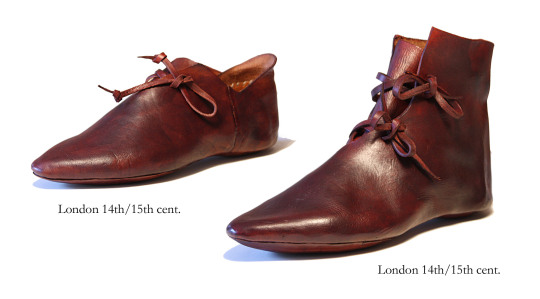
For reference, a clearer view of what turnshoes look like.
Rather than an infodump lecture on how the characters are walking on the balls of their feet in soft shoes, show what effect it has on the way they move, and the way they sound – much quieter than in modern shoes. Maybe contrast that to the first time they have to wear something heavier, as disguise, uniform, formal dress, foreign costume etc.
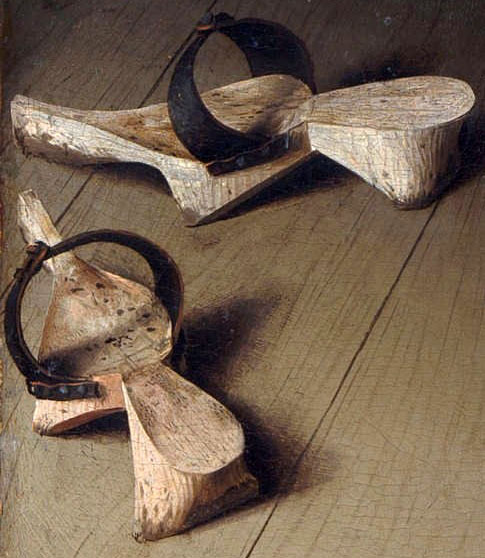
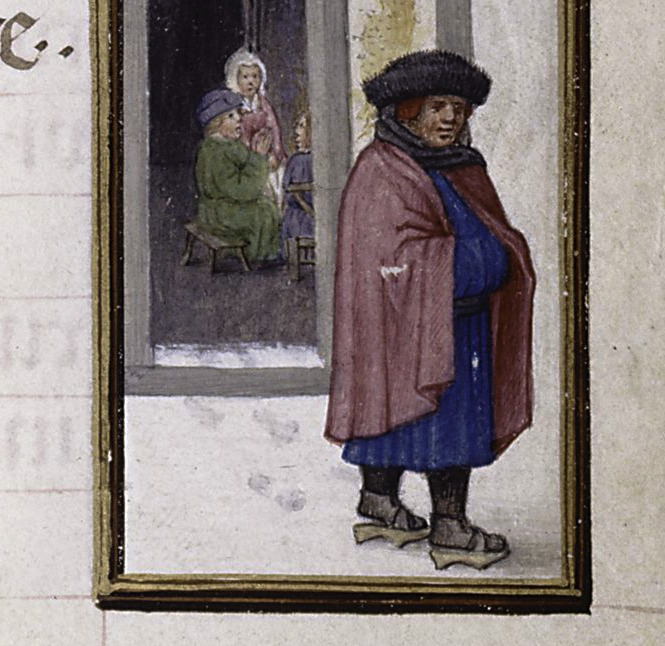
Roland Warzecha also mentioned pattens, wooden outdoor “under-shoes”.
A couple of years ago I reblogged a post about sabots (clogs, wooden shoes in general and by extension, pattens) in which I wrote this:
It’s worth remembering that pedestrians going to and fro in a medieval
town (especially in wet or snowy weather) might have been surprisingly
noisy, and that people who went out of their way to be quiet, whether or
not they were dressed all in black, might have been regarded with
suspicion…
“We Wear Culture” is a collaboration between Google and more than 180 museums, schools, fashion institutions, and other organizations from all parts of the globe. It’s part of Google’s Arts & Culture platform, which is digitizing the world’s cultural treasures, and functions as a searchable guide to a collective archive of some 30,000 fashion pieces that puts “three millennia of fashion at your fingertips,” Google says.
But it isn’t just a database. Google has worked with curators to create more than 450 exhibits on different topics—say, how the cheongsam changed the way Chinese women dress—making the site an endlessly entertaining, educational portal filled with stunning imagery touching on everything from modern Japanese streetwear to the clothes worn at the court of Versailles.
i can already tell this has made writing for historical fandoms – the worst part of which, for me, is absofuckinglutely hands-down the clothing – much easier.
So a while back I remembered reading(and at this point I don’t remember if it was from a fic, or a headcanon) about padawans having coloured threads wrapped around their braids to signify certain things or events that have happened in their lives.
Wound up coming up with this. No pun intended. Feel free to use it!
RED Light Red – Joy, passion, sensitivity. – Given to those who are especially sensative in the living force. Dark Red – Leadership, Courage. – Given to those who take their places as born leaders. Pink – Friendship, love. – Given to those who’s hearts are open to others. Brown – Stability – Given to those who are built like rocks in the force.
ORANGE Dark Orange – Diplomacy – Given to those who have learned the art of lying under duress and keeping ones tongue in check. Red-Orange – Passion, Strength, Endurance- Given to those who do well in saber classes and hand to hand combat training. Gold – Illumination, Wisdom – Given to those who do well in their classes.
YELLOW Dull Yellow – Caution – Given to those who plan their thoughts out before they leap into action. Light Yellow – Honor, Loyalty – Given to those who exhibit these qualities.
GREEN Dark Green – Ambition – Given to those who are eager to learn, often paired with the colour gold. Yellow-Green – Illness – Given to those who are recovering from illness.
BLUE Light Blue – Health, healing, softness – Often given to those who are strong in the healing arts and will go on to become Jedi Healers. Aqua – Emotional healing – Given to those who are in the midst of overcoming a mental hardship, a reminder to treat this padawan learner more gently. Dark Blue – Power – Given to those strong in the force.
PURPLE Light Purple – Independence, Creativity – Given to those who are good at solving problems, often in a unique way. Dark Purple – Trauma and Hardship – A permanent marker on the braid. Given to those who have experienced trauma, both mental and physical. A rare colour.
WHITE White – The first coloured thread wrapped around a new padawan braid. The colour of innocence and purity it signifies that the padawan is in the first stage of becoming a Jedi.
BLACK Black – The symbol of grief. Often accompanied by Dark Purple and aqua. A black thread signifies deep personal loss.




 There's a Mirror on the Wall