Tansy. It’s lovely, and forms a neat clump, and then seeds itself around your garden with about seven million tiny seeds, 150% of which germinate. Please help, I’m drowning in tansy over here.
Iris. Old fashioned iris, to be specific. Orris root, dried, is used to fix perfumes in potpourri and perfumery.
Soapwort.
Many old-fashioned roses, which will sucker all over the place into an impenetrable thorn hedge. (My Goal around the yard, and why I planted Hansa, which is doing a lovely job of it. Also, tasty hips and flowers.)
Zucchini. Any squash, to be fair.
Daylilies.
(All parts edible, buds and root bulbs particularly tasty. Form neat clumps and will outlive you, your house, and possibly the human race)
Hollyhock. Decorative and edible. Ground root is a good dress for bruises, swellings, and ulcers.
Ostrich fern. Loves shady damp spots like Genghis Khan likes conquering, and the fiddleheads in spring are absolutely delicious.
Wild grape.
Chives.
Wormwood; similar situation to the tansy. Please send help.
Fennel and dill, which, if you let go to seed, will seed themselves like tansy.
Violets; delicious and indestructible.
Yarrow.
Cucumbers ARE a squash, btw.
Note to self: plant chives in the center of the garden this year.
(Because I don’t know what to do with some of the rest, it’s a low garden and all food stuffs, and squash are not this year damnit after last year’s too many cucumbers to eat them all. Also, yarrow is a little bastard that is never allowed in my garden again because around here it outcompetes mint, and I already have a very persistant enemy in the ground ivy.)
2 loads laundry – first load is done and folded, second load is in the dryer
Feed cat in the morning (kibble) – done – and the evening (gooshy food)
Feed me (so far, breakfast and half a snack – second half of snack is… not as edible as assumed when purchased).
Dressed – before I could do laundry, so done – and bed set for daytime use – did that between loads of laundry.
Something creative. Or more than one something. – current count, one braid off the set. Contemplating setting one or two more of the bricks for the defining border for my little garden.
Something writing related (writing, rewriting, research, or spreadsheet of doom).
House plants inside (3 begonias, a prayer plant, a spider plant, a rosemary, a jade tree*, and a fuck if I know** but it only dies if it gets too much sunlight combined with too much water; total of 8 plants) – 5/8 inside. The other three wait until dad gets home because the rosemary pot is just too large to do alone, and the jade and the other thing require two people just for the pot, and we have to move the tray separately. I am fairly certain that they probably shouldn’t be moved in general, but no, all the plants go outside for the summer, so we have to move next-size-down-to-small-tree-pots twice a year.
*This thing is the surviving tree of three, one of which got ate by a deer something a little over a decade ago. It also got severely nibbled on by said deer, to the point we were just glad we’d had the third jade elsewhere. Except, no, this thing has no intention of dying. When it and the other survivor both seemed to catch some sort of rot, the other one died. This one said fuck you, dropped several branches, and a pot full of babies, and shook itself off and kept going. That was three pot sizes and a little over a decade ago.
We haven’t been able to get any of the babies going outside the pot for very long, either, so.
**Leaves are vaguely arrow-shaped, but it’s not arrowleaf as far as I can tell. It does seem to like its roots being wet, but only if it’s had a chance to grow them through soil into water underneath. Wet soil is apparently horrible. And too much direct sunlight tends to yellow the leaves and stunt the year’s growth. Thing is in a pot the same size of the jade, and has tried to sneak out of it two years running. I’m thinking that once the bathroom is renovated, I’m going to build a space for it where I can put an even larger (and not so round) pot for it to grow all over. It shouldn’t get too much direct sunlight in there, and I can water it regularly, and I’ll have a nice plant in my apartment.
Although first I should probably positively identify it and make sure it won’t kill the cat.
So my Grandma apparently is running a plant hospital and rehabilitation center. She can get anything to grow abundantly, so in the past few decades people have literally started dropping off sick and dying plants to her and she would nurse them back to health and return them. She only charges a single clipping from each of the plants she nurses. 🌱🌿🍃I’m so proud of my Plant Doctor Grandma! 😌
This is amazing! Does she take notes of her work?
Yes she does. She has a whole journal that details care for certain diseases and plants. She takes it so seriously.
Does she share her notes at all? I want to get better at recognizing the frailties of plants in different conditions and if they are public at all I would love to read your grandmother’s work.
I will to her about getting her plant research published. She has the funniest notes in there too. Reminders about which plants belong to who, Recipes for natural bug-be-gone, and elaborate descriptions of blooms and even some pressed flowers in there. She’s so important in our community and she also grows sugar cane and vegetables she just gives away.
This is incredible.
She says she has over 250 potted “tenants” at her home right now. Between 30 to 40 belong to other people and she’s just nursing them. And countless “permanent residents” in the ground.
So, can we like, get her a show or something? Because she seems so awesome
Building a treehouse is the biggest insult to a tree. “I killed your friend, here hold him.”
“Friend”
Its more of I killed a potential enemy. Hold his dismembered corpse in victory.
Plants don’t wage war
Ever heard of blackberries?
Yes, plants do wage war
Mint and strawberries, too. They need to be quarantined or they will kill basically everything else.
I planted mint in the ground 2 years ago.
It’s currently fighting a bitter battle to the death against the raspberries attempting to invade from the east while trying to annex the patio.
Could go either way at this point TBH. Unless, of course, I take a shovel and the blowtorch out there and battle both back to within their original boundaries.
And anyone wondering if a blowtorch is overkill for weeding back mint has never actually planted mint.
This post did not go where I expected it to.
Our garden plot at my childhood home slowly got overrun by wild blackberries after we stopped managing it while my sister and I were in nursing school. And by overrun I mean it was like a 4 foot tall thicket of wild blackberries. It hadn’t been touched by humans in at least 4 years. I started the ultimately futile task of trying to clear this plot with a machete and discovered to my amazement a patch of mint several feet across underneath the canopy of blackberry, still fighting the good fight all those years later.
Ultimately it took two jars of homemade napalm and some creative fire placement to clear that patch but I damn sure saved that patch of mint. It earned the right to be there.
Yall mother fuckers don’t even talk unless you’ve had to wage war on kudzu (it’s an ivy strain directly from Hell) that shit doesn’t just wage war with other plants, it wages war with all living things on planet earth. It’s some gnarly ass Blood for the Blood God, Chlorophyll for the Chlorophyll Throne demon weed.
Can second the comments of Kudzu.
I forget where I read it but there’s this one tree that creates an extremely flammable substance that’s in both the bark and leaves. Dead trees become torches and crushed up leaves become dust-incendiary, all while the plant’s seeds are Giant Redwood levels of resilient to open flame. IE it has a goddamn scorched earth policy. It’s even more badass than plants that use toxins to starve other plants.
I’d like to third the comments on Kudzu. These are the battlefields:
See those weird pillars? Those were trees. See that strange lump in the middle? That was a house. Everything green you see in this photo is kudzu.
One house I lived in had a gorge full of kudzu next to it. You could practically watch it grow, it grew so fast. I spent a lot of time cutting it back and pulling out what I could, and that was just barely enough to keep it from creeping out of the gorge and across our lawn.
The gorge? Would take napalm and a fuck ton of luck. I don’t think there was a house down there, but it greatly resembled that picture above.
I am so glad we don’t have that shit in the current neighborhood.
(Now, mint and strawberries on the other hand? I have both. In the same garden. The strawberries I’m just glad have survived this time. The mint? It’s new, but it’ll be fine. It always is, unless I’m foolish enough to put it in a pot.
Ground ivy, however, is another damned menace that can stay the hell out of my garden. And I can’t go weed it properly for a week. *grumbles* Stupid meds.)
Hi, its me again, the annoying plant scientist who spends way more time thinking about Cardassians than is probably healthy. In my previous posts on Hebitian and Cardassian agriculture, I discussed what type of agronomic systems those societies might use. But I didn’t really discuss what KINDS of plants might grow on Cardassia.
Obviously, I needed to rectify that oversight.
Its been hypothesized by the fandom (i love you all) that Cardassians are similar to a class of extinct earth creatures known as therapsids. The therapsids have characteristics of both mammals and reptiles – similar to Cardassians, and Cardassian voles. Thus, I thought, hey lets look at the plants that exist in the same fossil strata as therapsids (Permian Era, for those who would like to do their own research) and extrapolate that Cardassian plant life might look like that.
First, I’d imagine thick swampy rainforests made of giant plants similar to clubmosses, quillworts and horsetails.
These plants don’t bear seeds, instead they produce spores in large cone like structures. Also, they have green trunks, made up of leaf pads (scars from where large leaves fell off). They’d have few branches – only a little branching at the top of the plants.
Its my hypothesis that the original jungle like vegetation on Cardassia was primarily made up of these plants. Hebitians might have bred the plants to have edible cones, leaves or rhizomes (underground stems – think potatoes). Since the spores of these plants tend to contain oil (in fact they’re highly flammable), early Hebitians might have bred plants to grow larger spores, with higher oil content.
Assuming that Cardassian plants, like earth plants, experience an alternation of generations, and assuming their plants reproduced in a similar manner, these plantlets would have needed a wet environment to allow their antheridia to swim to the archegonia (these are the haploid generation plants). Thus, they would have been some of the first casualties of the devastating climate change on Cardassia.
However, they still exist on the Ba’aten Penninsula, in some private gardens, and in the large botanical institutes.
The Cardassian/Hebitian diet changed drastically after the climate change, as these plants were no longer available. Instead, Cardassians switched to a more meat/grain heavy diet – based on the plants that had once only grown on the drier areas of Cardassia – and the animals also found there.
I don’t have any strong headcanons about the dryland plants of Cardassia, so if people wanna contribute, feel free! (Just let me knooowww about them.)
A team of scientists, including UC Riverside assistant professor Juan Pablo Giraldo, have transformed plants into sensors that detect explosives.
The spinach plants were designed to sense chemical compounds known as
nitroaromatics, which are often used in landmines and other explosives. A paper about the research was published in the journal Nature Materials.
This research has a lot of potential uses. Plants embedded with the sensors could detect explosives, harmful airborne pollutants and plant health for farming.
“In a way, we are showing that we can turn plants into solar powered
technology that report to humans what they are experiencing in the
environment,” said Giraldo.
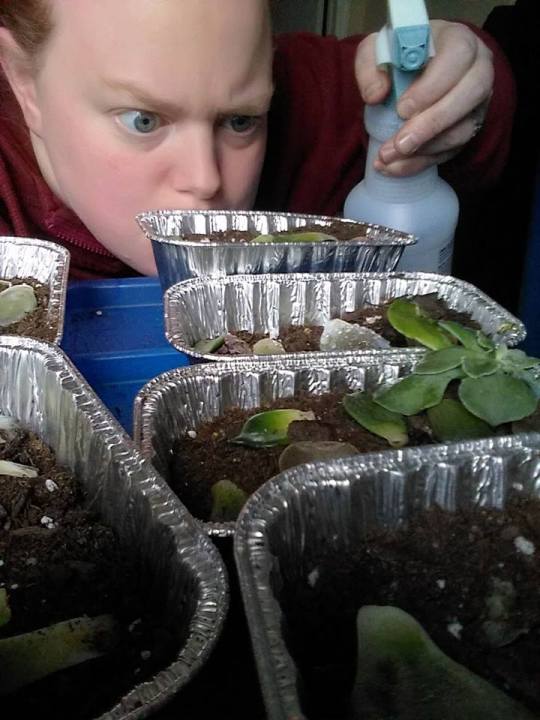
So I went to Ikea today, and while I managed to resist the lure of the giant shark, I did not make it out without impulse buying a tiny succulent
Given that I also just got locked out my apartment going to rescue said tiny succulent from my car, I’d like to keep them alive.
Science/garden/plant tumblr, any suggestions for keeping my new plant friend alive and well (it’s a succulent Gasteria according to the label if that matters. Apparently these things are sometimes known as Lawyers tongues? That’s the best thing I’ve ever heard)?
Gasteria is related to the aloes! Also, it’s flowers look like little pink stomachs hanging off a stem (hence the name).
– Most succulents like strong sunlight, but aloes and Gasteria do okay with some shade. Like, they don’t need direct sunlight all day long. If you see some leaves getting yellow patches (usually on the side the sun hits), that’s too much sun.
– Good drainage! Make sure that the pot has holes at the bottom. When you repot, it’s a thing to get like… Styrofoam packing peanuts and put a layer at the bottom of the pot, to help drainage. Also, repot with 25% horticultural sand (I think mum used to do 50/50 orchard potting mix and sand, but for my aloes I do like… compost mix, some potting mix, and some sand).
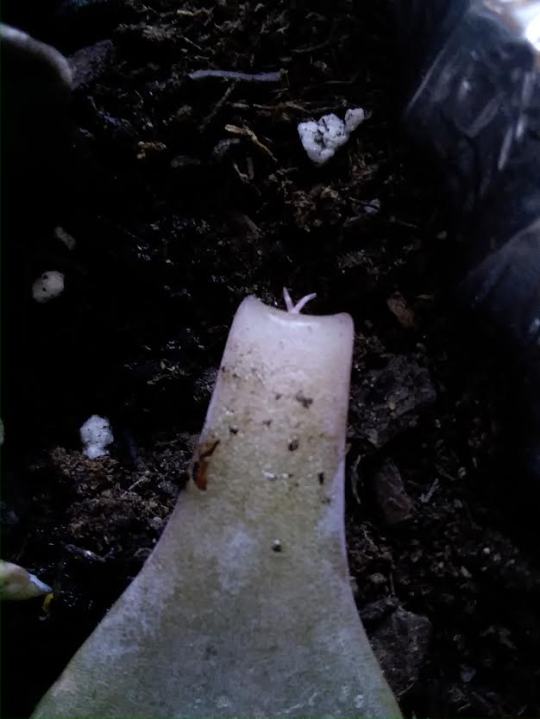
– Repotting! Once a year! Aloes et al regrow roots, so if you don’t repot and clear out dead roots it will eventually get crowded in the pot. (But if it’s a tiny succulent and you put it in a big pot… Lbr you could leave it way longer.) I actually never remember to do the roots with my aloe, I just split it into multiple pots when it looks crowded. They naturally propagate (new little plants pop up on the sides), and it’s easy to separate them into clusters or indiv plants.
– Watering. Don’t over-water! In summer, a generous water once a week will do. In winter, that can go down to every month. Try not to run water along the leaves to the centre of the plant, as excessive moisture there leads to rot.
– If you want flowers, you can put some liquid fertiliser on it in spring and that’ll help (use half-strength or less. Too much rich food can make them sick).
“For thousands of years, Judean date palm trees were one of the most recognizable and welcome sights for people living in the Middle East — widely cultivated throughout the region for their sweet fruit, and for the cool shade they offered from the blazing desert sun.
From its founding some 3,000 years ago, to the dawn of the Common Era, the trees became a staple crop in the Kingdom of Judea, even garnering several shout-outs in the Old Testament. Judean palm trees would come to serve as one of the kingdom’s chief symbols of good fortune; King David named his daughter, Tamar, after the plant’s name in Hebrew.
By the time the Roman Empire sought to usurp control of the kingdom in 70 AD, broad forests of these trees flourished as a staple crop to the Judean economy — a fact that made them a prime resource for the invading army to destroy. Sadly, around the year 500 AD, the once plentiful palm had been completely wiped out, driven to extinction for the sake of conquest.
In the centuries that followed, first-hand knowledge of the tree slipped from memory to legend. Up until recently, that is.
During excavations at the site of Herod the Great’s palace in Israel in the early 1960’s, archeologists unearthed a small stockpile of seeds stowed in a clay jar dating back 2,000 years. For the next four decades, the ancient seeds were kept in a drawer at Tel Aviv’s Bar-Ilan University. But then, in 2005, botanical researcher Elaine Solowey decided to plant one and see what, if anything, would sprout.
“I assumed the food in the seed would be no good after all that time. How could it be?“ said Solowey. She was soon proven wrong.
Today, the living archeological treasure continues to grow and thrive; In 2011, it even produced its first flower — a heartening sign that the ancient survivor was eager to reproduce. It has been proposed that the tree be cross-bred with closely related palm types, but it would likely take years for it to begin producing any of its famed fruits. Meanwhile, Solowey is working to revive other age-old trees from their long dormancy.”
Here’s a ten year update. The scientist, Elaine Solowey, has germinated and grown other ancient date palm seeds and there are a couple of female plants that Methuselah could pollinate.





 There's a Mirror on the Wall