I love how “because Reasons” can mean either “the reason is so obvious I shouldn’t need to explain it,” or “there is no valid reason for this but it’s happening.”
See, this kind of thing is what I love about an open askbox with no specific topic requirements, because this fascinates me. I tend to think no, but part of that is because hot dog buns are typically jointed, so they’re more like one foldy piece of bread than two, but… I don’t know. They don’t feel sandwich-like to me, I guess.
Counterpoint: heroes are on jointed bread and they’re definitely sandwiches.
hot dog is not sammich because it is *a thing* in breads instead of *stuff* in breads.
Bullshit. Is a peanut butter sandwich not a sandwich if you don’t put anything else on?
peanut butter is stuff though? like, *a* hot dog is one self contained thing that comes in a pre-determined size, but peanut butter is a continuous mass. you put A hot dog in a bun, you put SOME peanut butter on bread.
but if you put a single slice of ham on bread, it’s still a ham sandwich. CHECKMATE ATHEISTS.
A HAM SLICE IS STUFF BECAUSE IT’S FLAT.
A HOTDOG IS A THING BECAUSE IT’S ROUND.
if you put a tomato between bread, that would not be a sandwich, that would be fucked up. you have to slice the tomato and put a slice in. then it’s a sandwich.
so if you slice the hotdog and put it back in the bun it’s a sandwich?
the bun would make the hotdog round again, so no. but if you sliced the hotdog and put it between flatter bread then yes.
behold: an inarguable hotdog sandwich
ohhhhh? then WHAT IS THIS
*touchdown dance*
that’s clearly a fucking sandwich, smartass. it’s got sliced components and is horizontal. i’m talking about if you took a hot dog, sliced it in half, and put both slices back in the bun, it would not magically be a sandwich because the slices would move back into approximately cylindrical hotdog configuration. this like how if you take a slice of sandwich bread and put it around a whole hotdog, it becomes a hotdog bun and the hotdog is still not a sandwich.
on a tangent, no matter how sliced and sandwichy the components, if they were put in a taco shell, they would stop being sandwichy and just be a (gross) taco.
WHAT IF YOU PUT FLAT THINGS BETWEEN TWO FLAT TORTILLAS WHAT WOULD THAT BE A SANDWICH OR A QUESADILLA OR A FAIL TACO OR
THIS IS EXCITING
THIS IS SCIENCE
THIS IS EXCITING. Everyone pretty much agrees that a sandwich is edible stuff between two breads. Our cultural definition is coherent so far. littlepinkbeast further requires that the edible contents be stuff-y, rather than thing-y. roach’s definition posits that thing-like stuff is round, and stuff-ish stuff is flat. jumpingjacktrash and aetherbox raise the point that sometimes the type of bread surrounding the contents ALSO changes the name/definition of the sandwich: fr’ex, taco, pita, quesadilla (which must contain cheese, but what if it is IMPROPER CHEESE, like blue or cottage?), or naan or sub or gyro.
And I ask: How sweet can it be before it is no longer considered a sandwich? Because I have had WAFFLE SANDWICHES that were absolutely sandwiches, but once you add nutella and whipped cream to the bananas, they shade into tiramisu territory and become a dessert.
Also, I’m pretty sure that nothing wrapped in a crepe is a sandwich, but does this also apply to other thin wraps like tortillas? Must it be leavened breadstuff to count as a sandwich?
and what about when the outsidey bits aren’t breadstuff? what about peanut butter between two slices of apple, is that a sandwich? my brain says no but my heart says yes.
a hot dog is obviously a taco. this thread is bananas
I would honestly posit we need to look at “sandwich” as at minimum a genus and at maximum probably a phylum. We could call “sandwich” a family and then move that “sausage roll” is the genus and that hot dog is a species of sausage roll, a genus that would also include things like brats, sausage and peppers, and other sausage sandwiches specifically served on sausage rolls. Which means that the family of sandwich can also include a genus for flat sausage sandwiches like knoblewurst or bologna, both of which are technically sausages in construction but are served on sliced bread, which are then not to be confused with the genus “hero” which would be any sliced item sandwich on a hinged roll with included species being “cheesesteaks” and “grinders”.
But if I asked for a hot dog sandwich, I would receive a sliced hot dog, grilled between two slices of bread, not an in tact jot dog on a bun
And as a native Philadelphian I van say that although I do not identify hoagies and cheese steaks as sandwiches, I have heard the language “cheese steak sandwich”
That being said is a pita filled with stuff a sandwich?
See I don’t think anyone would ever order a “hot dog sandwich”. So maybe sandwich is not a family but more of an order? They phylum then would be street food, class “handheld”, order “sandwich”, which then gives was to various suborders. So all street foods that can be handheld and lets say served in a carbohydrate shell is of the order of sandwich, when then can fracture into suborders of things like: sausage rolls (hot dogs, brats, sausage and peppers, etc), heroes/hoagies (cheesesteaks, grinders, etc), pockets (pita/shawarma not gyro, arepas, pupusas, bun style bao, etc), and folded (handheld tortilla sandwiches like tacos/quesadillas/burritos, gyros, and open style bao, etc).
Idk but I do think biological nomenclature is the way to dig into the question.
I think we’re wrestling with a definition composed of the thing itself when really it’s a lingual issue. A sandwich is no one thing; “sandwich” is a descriptor attached to the contents only when further specificity is needed.
I always figured a hot dog wasn’t called a sandwich purely because saying “sandwich” was unnecessary. “Hot dog” is a singular descriptor which illustrates only one item of food, the same way “hamburger” and “italian beef” and “po boy” might be sandwiches but are never called sandwiches because they only describe one thing (though in the case of the po boy it might be appended to “chicken” or “shrimp” or similar to describe the contents as well as the method of preparation and presentation). “Grilled cheese” can go sandwich or not, but most people I know don’t bother attaching “sandwich” to it unless they, IDK, live in Halloumi country.
You can’t just order A Ham, A Peanut Butter, A Chicken, A Tuna Salad, and expect to get a sandwich, because those terms refer to one thing which can be presented in multiple formats: a cured ham, sliced ham, deli ham, et cetera. “PB&J” is a good illustration of this because “peanut butter” can be served a variety of ways but “peanut butter and jelly” refers to a specific foodstuff that only comes ready to eat one way, on bread. (Yes yes, I know they make jelly-streaked peanut butter that you can eat with a spoon, but because we are a nation of shame, we eat this only in private and thus don’t have a “menu” name for it.)
The upshot is that a hot dog fits the definition of a sandwich, and could be considered one, but is not called a sandwich because “hot dog” requires no further specificity.
I welcome challenges to the linguistic analysis of sandwich versus hot dog, however.
but what the fuck is wrong with the rest of this country?
the devil is beating his wife? Christ almighty it’s a sunshower what
What the actual fuck.
gets philly, jersey city, and fucking newark
well they’re mostly right
I got 2 places in fucking texas, what
Detroit, MI, Grand Rapids, MI and Toledo, OH
I’m from Flint, so that’s about as close as you can possibly get.
I’m going to have to do this several times for an accurate gauge, because it only allows one answer to any question, and my usage of words covers several answers, dependent on context and audience.
today I learned that there is a word firangi, from Persian, which described europeans (it originally derived from “Frank”). the word traveled to China as folangji, originally used to describe portugese traders, and to India as Hindi/Urdu “firangi” or “feringhee” to describe (usually white) foreigners, who originally came to India to trade.
So either one of the star trek writers was aware of this word that is tied to exploitative foreign traders in multiple languages when they named their super-capitalist aliens the “Ferengi”, or this is one of the biggest coincidences I have ever seen.
When I was beginning to discover languages, I had a romanticized view of words like “speak” and “fluency”. But then I realized that you can be nominally fluent in a language and still struggle to understand parts of it. English is my first language, but what I really spoke was a hybrid of teenage slang and Manhattan-ese. When I listen to my father, a lawyer, talk to other lawyers, his words sound as foreign to me as Finnish. I certainly couldn’t read Shakespeare without a dictionary, and I’d be equally helpless in a room with Jamaicans or Cajuns. Yet all of us “speak English.”
My linguistics teacher, a native of Poland, speaks better English than I do and seems right at home peppering his speech with terms like “epenthetic schwa” and “voiceless alveolar stops”. Yet the other day, it came up that he’d never heard the word “tethered”. Does that mean he doesn’t “speak” English? If the standard of speaking a language is to know every word — to feel equally at home debating nuclear fission and classical music — then hardly anyone is fluent in their own native tongues.
IF IT HAS BEEN A VERY LONG DAY, YOU ARE ‘WEARY’. IF SOMEONE IS ACTING IN A WAY THAT MAKES YOU SUSPICIOUS, YOU ARE ‘WARY’.
ALL IN ‘DUE’ TIME, NOT ‘DO’ TIME
‘PER SE’ NOT ‘PER SAY’
THANK YOU
BREATHE – THE VERB FORM IN PRESENT TENSE
BREATH – THE NOUN FORM
THEY ARE NOT INTERCHANGEABLE
WANDER – TO WALK ABOUT AIMLESSLY
WONDER – TO THINK OF IN A DREAMLIKE AND/OR WISTFUL MANNER
THEY ARE NOT INTERCHANGEABLE (but one’s mind can wander)
DEFIANT – RESISTANT DEFINITE – CERTAIN
WANTON – DELIBERATE AND UNPROVOKED ACTION (ALSO AN ARCHAIC TERM FOR A PROMISCUOUS WOMAN)
WONTON – IT’S A DUMPLING THAT’S ALL IT IS IT’S A FUCKING DUMPLING
BAWL- TO SOB/CRY
BALL- A FUCKING BALL
YOU CANNOT “BALL” YOUR EYES OUT
AND FOR FUCK’S SAKE, IT’S NOT “SIKE”; IT’S “PSYCH”. AS IN “I PSYCHED YOU OUT”; BECAUSE YOU MOMENTARILY MADE SOMEONE BELIEVE SOMETHING THAT WASN’T TRUE.
THANK YOU.
*slams reblog*
IT’S ‘MIGHT AS WELL’. ‘MIND AS WELL’ DOES NOT MAKE GRAMMATICAL SENSE.
SHOULD OF IS WHAT IT SOUNDS LIKE, BUT SPELLING IT THAT WAY MAKES NO SENSE.
CANON is what is official for the work
a CANNON goes BOOM
Something is said ALOUD as in OUT LOUD
But something is ALLOWED or PERMITTED to do something
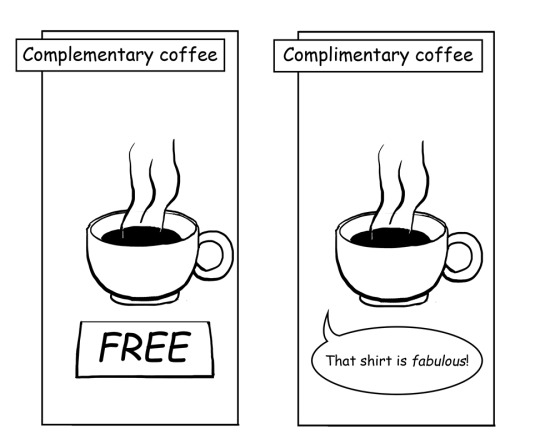
That coffee one is INCORRECT. “Complimentary” is the correct spelling in both cases.
“Complementary” means two things go well together. So the image should be if cream or a pastry or something.
COMPLIMENT is when someone says something nice about a thing or person.
COMPLEMENT is when e.g. a well-chosen tie improves the look of a suit.
COMPLEMENT is the crew of a ship, staff of a hotel etc. (The complement’s healthy tan complemented their dress whites and earned a compliment from the inspecting admiral.)
TO BREACH is to break through something like a wall, making a BREACH.
TO BREACH is what a whale does as it breaks the surface of the ocean.
BREACH of contract is when someone breaks agreed terms.
BREACH of the peace is a low-level criminal offence.
BREECH of a piece is the rear end of a gun-barrel where the ammunition goes in.
BREECH BIRTH is being born bottom-foremost (a BREACH birth is what an Alien Xenomorph does…)
BREECHES are
uniform, court or period
trousery things which go tight or end at the knee.
PEAL is what bells do in celebration. Thunder and laughter do it too.
PEEL is outer rind, usually of fruit; TO PEEL is to remove it.
TO PEEL OFF can be done with clothes, or facial masks, but is also what fighter planes do when breaking formation for attack or landing.
PEELER is a policeman; like “Bobby”, it comes from Sir Robert Peel, the founder of the force.
PEEL tower is a fortified building on the English/Scottish Border. Sometimes spelt PELE like the footballer, but not pronounced that way.
TOLL is what bells do at funerals.
TOLL is a charge paid to use a stretch of motorway, or cross a bridge. (Or cross a river, and then it’s two coins, one on each eye.)
REIN is a leather strap to control horses; usually plural, REINS, at least one for each side.
TO REIN IN is (literally) to slow down a horse, or (figuratively) to restrict someone’s behaviour.
TO TAKE THE REINS is to take control, except if you’re Tony Stark…
TO REIGN is to rule as Royalty.
It’s also a noun – the REIGN of Elizabeth II began in 1952, but on the day she officially TOOK THE REINS the weather was bad and there was RAIN.
The English language is a never-ending source of confusion from which no spell-checker will save you.
when did tumblr collectively decide not to use punctuation like when did this happen why is this a thing
it just looks so smooth I mean look at this sentence flow like a jungle river
ACTUALLY
This is really exciting, linguistically speaking.
Because it’s not true that Tumblr never uses punctuation. But it is true that lack of punctuation has become, itself, a form of punctuation. On Tumblr the lack of punctuation in multisentence-long posts creates the function of rhetorical speech, or speech that is not intended to have an answer, usually in the form of a question. Consider the following two potential posts. Each individual line should be taken as a post:
ugh is there any particular reason people at work have to take these massive handfuls of sauce packets they know they’re not going to use like god put that back we have to pay for that stuff
Ugh. Is there any particular reason people at work have to take these massive handfuls of sauce packets they know they’re not going to use? Like god, put that back. We have to pay for that stuff.
In your head, those two potential posts sound totally different. In the first one I’m ranting about work, and this requires no answer. The second may actually engage you to give an answer about hoarding sauce packets. And if you answer the first post, you will likely do so in the same style.
Here’s what makes this exciting: the English language has no actual punctuation for rhetorical speech–that is, there are no special marks that specifically indicate “this speech is in the abstract, and requires no answer.” Not only that, it never has. The first written record of English (actually proto-English, predating even Old English) dates to the 400s CE, so we’re talking about 1600 years of having absolutely no marker whatsoever for rhetorical speech.
A group of teens and young adults on a blogging website literally reshaped a deficit a millennium and a half old in our language to fit their language needs. More! This group has agreed on a more or less universal standard for these new rules, which fits the definition of “language.” Which is to say Tumblr English is its own actual, real, separate dialect of the English language, and because it is spoken by people worldwide who have introduced concepts from their own languages into it, it may qualify as a written form of pidgin.
Tumblr English should literally be treated as its own language, because it does not follow the rules of any form of formal written English, and yet it does have its own consistent internal rules. If you don’t think that’s cool as fuck then I don’t even know what to tell you.
i love this post
This is super cool!
Also idk if this has any relevance whatsoever but if you wanna have an argument inside one tag you cannot have commas in it so that’s a real existing constraint that has forced tumblrites to construct commaless sentences and perhaps this has helped in adopting the custom into posts as well ok I have no idea if this is what’s happened just I think it’s a reasonable assumption there might be a connection
You have to make a new word by changing only one letter of the last word.
Dirt
Dire
Dare
Bare
Bard
Card
Care
Mare
Male
Made
Mode
Code
Cone
Core
Cord
Lord
Lore
Lyre
Pyre
Pare
part
Fart
farm
Fare
Fore
Sore
Sort
Soft
Sift
silt!
silk
Milk
Mill
Mull
Mule
Male
Mile
Pile
Pill
Kill
Bill
bull
ball
Call
Cull
Cult
Colt
Bolt
Dolt
doll
Roll
Role
Rule
Rude
Dude
Dune
Done
Tone
Bone
Bore
Bole
Apart from being based on naïve and simplistic ideas about how language works, the other big problem with the ‘women, stop undermining yourselves’ approach is that it presupposes a deficit model of women’s language-use. If women use the word ‘sorry’ more than men (and by the way, that’s a genuine ‘if’: I’m not aware of any compelling evidence they do), that can only mean that women are over-using ‘sorry’, apologizing when it isn’t necessary or appropriate. The alternative interpretation—that men are under-using ‘sorry’ because they don’t always apologise when the circumstances demand it —is surely no less logical or plausible, but somehow it never comes up. As I said back in the summer, the assumption is always that ‘a woman’s place is in the wrong’.
I think this is a really important point. Women are consistently disadvantaged in relation to men by the kinds of characteristics which constitute traditional models of femininity. But this doesn’t undermine the fact that many of these ‘feminine’ characteristics – care, humility, altruism, and co-operation over competition – are actually also virtuous, and I think that a decent feminist critique of gender relations needs to appreciate this.
Women are disadvantaged because in many cases guys are taught to be shitty people who exploit the virtue of others as a weakness.
More Grammar Stuff (honestly, these forums are really a treasure trove of info)
As for your question about ‘Ne gev’, I think that should work just fine! Ne, n’, nu’, and nu (really, it depends on ease of pronunciation, and ‘ne’ seems to work best to me) can be used to create the negative of a noun OR a verb.
There’s also the example of “ne shab’rud’ni” which translates to “Don’t mess with me.” That uses ne!
Also, a few other people that I think would be good to pick the brains of regarding Mando’a would be:






 There's a Mirror on the Wall