Speaking of linguistics, there’s one particular linguistic tick that I think clearly separates Baby Boomers from Millennials: how we reply when someone says “thank you.”
You almost never hear a Millennial say “you’re welcome.” At least not when someone thanks them. It just isn’t done. Not because Millenials are ingrates lacking all manners, but because the polite response is “No problem.” Millennials only use “you’re welcome” sarcastically when they haven’t been thanked or when something has been taken from/done to them without their consent. It’s a phrase that’s used to point out someone else’s rudeness. A Millenial would typically be fairly uncomfortable saying “you’re welcome” as an acknowledgement of genuine thanks because the phrase is only ever used disengenuously.
Baby Boomers, however, get really miffed if someone says “no problem” in response to being thanked. From their perspective, saying “no problem” means that whatever they’re thanking someone for was in fact a problem, but the other person did it anyway as a personal favor. To them “You’re welcome” is the standard polite response.
“You’re welcome” means to Millennials what “no problem” means to Baby Boomers, and vice versa.The two phrases have converse meanings to the different age sets. I’m not sure exactly where this line gets drawn, but it’s somewhere in the middle of Gen X. This is a real pain in the ass if you work in customer service because everyone thinks that everyone else is being rude when they’re really being polite in their own language.
Something interesting to note is also the more literal meaning behind these two phrases and how they themselves differ and oppose each other
‘No problem’, coming from a millenials mouth, within the context of helping someone – whether it be holding a door open/picking up something someone may have dropped/ect. – and, naturally, being thanked for it, implies that the kind gesture was indeed, not a problem, that it was just the thing to do, that they were happy to help and that no thanks was really necessary.
While a Baby Boomer’s ‘You’re welcome’ in contrast, says something miles different, it actually highlights the fact that the person went out of their way to help someone; almost brings attention to it in a way, saying ‘Yeah, I helped you, I did you this favor I accept your thanks.’ which, malicious intent or not, is strikingly different than the millennial downplay of their act of kindness for the sake of helping someone.
I know discourse is the word of choice in fandom nowadays but I kind of wish we would have stuck with “fandom wank” because it carries the implication that the anger involved culminated into effectively nothing and that the act was wholeheartedly masturbatory in nature rather than for any greater cause.
I saw this post about an hour after I saw a post that said, essentially, “There should be a word for that thing where [exactly describes ‘squeeing’].”
I feel like the time has come to produce something like this:
God, I want this to be real.
I NEED IT
Let’s do it.
That could be very useful. I might actually be able to keep up with changing terminology.
Despite people in Canada/New England feeling a strong pride and sense of ownership surrounding moose,Europeans have the exact same moose. English speakers completely fucked up the naming conventions for the animal because we fuck EVERYTHING up.
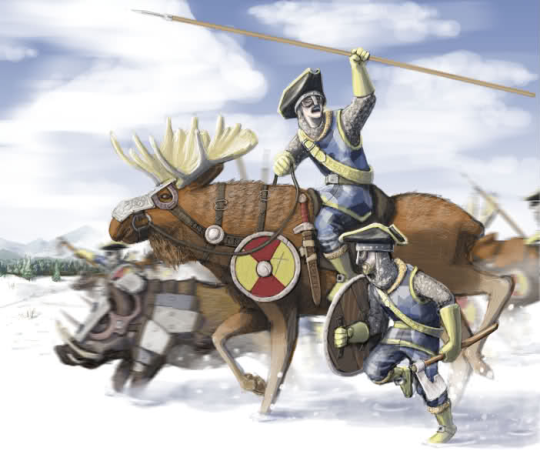
The Eurasian elk is the exact same animal as the moose. It is Alces alces. Here is a depiction of a Swedish soldier riding a moose into war in the 1700s.
Figure 1. The Swedish army used moose as cavalry animals at various points in history. I don’t know what the armored boar is all about.
However, the English caused a lot of confusion by originally calling it an “elk.” This comes from the older English word eolc/eolh, which shares roots with elhaz/algiz, which, if you know your runes, is the antler-looking rune ᛉ.
So the English had moose, they just called them elks. But there haven’t been any moose in the UK since the Bronze Age, so the English just started using the word “elk” to apply to “really big deer” – and they forgot that there was a specific animal they used to call “elk.”
Today, modern people from the United Kingdom have overwritten their own understanding of “elk” with Elk (USA), which are wapiti (Cervus canadensis).
This is a wapiti, which everyone calls “elk” now:
Figure 2. The wapiti, or elk
(Cervus canadensis)
“Hmmmmmmm,” British people may be saying right now. “That is a vaguely familiar animal. I feel like that is a STAG. I feel like it needs to be selling me a bottle of whiskey.”
YES. The wapiti is very similar to the UK’s red deer. This is what UK people call a “stag” :
Figure 3. A stag, or British red deer (Cervus elaphus) – actually slightly less red than the wapiti.
The explanation for this is that the UK colonizers found the wapiti in the USA, but the problem was that red deer were rarely seen by the common people at that time, so they thought they were Unusually Big Deer. And so the colonizing bastards said “Hey, what are these, Nigel?” and Nigel was like “IDK, stags?” and they were like “Yeah but they look really big, don’t they?” and Nigel was like “well, what about calling them big deer, then” and they called them “elk” which at that point had come to mean “big deer” in English.
Cervus elaphus (name meaning: deer deer) and Cervus canadensis (name meaning: Canadian deer) are very similar animals, and many people muddy the waters by calling Cervus elaphus an“elk.” The word ran all around the world, and American influence meant that it is losing its own definition in its own land.
Cervus canadensis
are also found in Asia, where the subspecies are called wapiti, from the Shawnee word meaning “white rump.” This is to prevent confusion. If you see one in Mongolia, you must properly call it a “Canadian deer, aka ‘white butt,’ from the indigenous North American word” to prevent this kind of confusion.
Figure 4. The global range of
Cervus canadensis, the wapiti, or elk.
Okay. Enough about what happened to the word “elk”. The point is that other European countries have reasonable amounts of moose, which they call elk. The “Eurasian elk” is Alces alces, the moose.
Figure 5. A Swedish army representative wearing Swedish flags and riding a Swedish moose. ALSO, SOMEHOW, THE MOST CANADIAN THING EVER
So when the English settlers colonized Canada and New England, they continued their long history of fucking the fuck up. But in the middle of this, they saw Eurasian elks, had no idea what they were, and went with the local Algonquin word “moose.”
They also called the same moose “elk” at the same time, and went into a slight confusion where they tried to differentiate them into “grey moose” and “black moose” and “black elk,” but when the dust settled, the world was left with British-colonizers-turned-Americans applying random names to everything, and winning. Wapiti are now called elk, and now red deer are also kind of elk. Eurasian elk are now moose. Wikipedia attempts to explain the moose fuckups here and the elk fuckups here.
The word “moose” is Algonquin in origin. This is why it doesn’t pluralize like English words do. In English, the plural of “goose” is “geese” and thus many people feel that the plural of “moose” should be “meese.” However, “moose” is not an English word. If you wanted to treat it as one, you could remember that moose are hoofed animals of a specific class, and you could follow the rules already laid down for moose relatives: The English plural of elk is elk. The English plural of deer is deer. The English plural of sheep is sheep. You can call multiple moose “meese” if you want to. But that’s why it is the way it is.
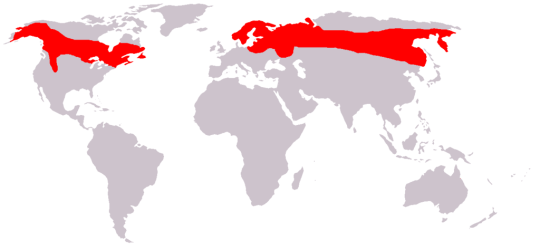
Figure 6. The global range of moose, or Eurasian elk.
So there you have it. Moose are an important, scary and hilarious part of Canadian/New Englander culture, but they aren’t just ours – we share them with Eurasian cultures too.
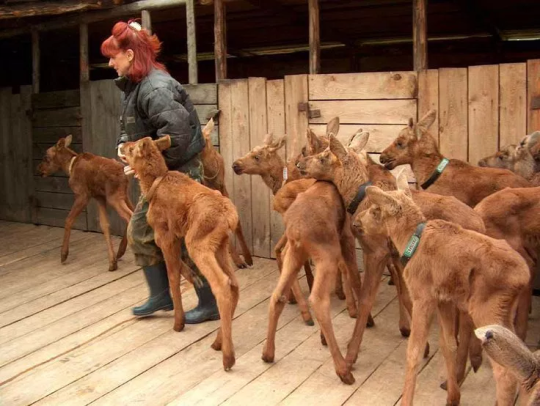
Figure 7: a Russian moose farmer with a promising crop
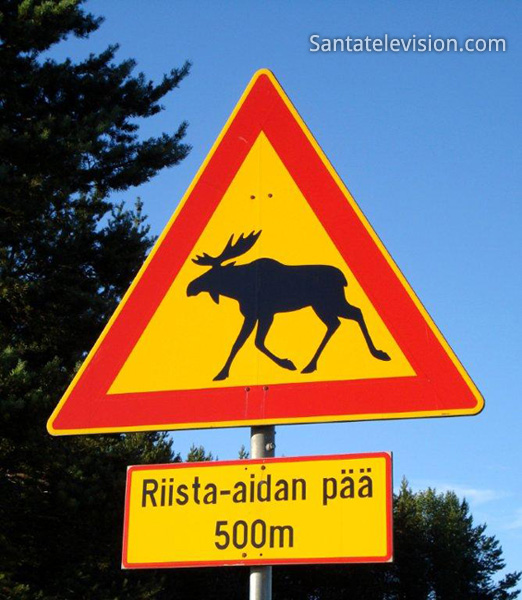
Figure 8: Finnish people provide a dark warning. “Hirvikolari” is a specific Finnish word describing a road accident involving a moose. There are many dashcam videos of hirvikolari on the Internet.
And now think about all the amazing Moose News you have access to now! You can now enjoy stories of moose destruction, mayhem and general fuckery SO MUCH MORE when you realize they aren’t about deer:
Figure 9: every line of this story is perfect?
Actually, you know what?
That’s still the most Canadian thing ever.
As someone born in Northern Canada, I vote we adopt “hirvikolari” post haste.
Oh wow. I had no idea Moose was an algonquin word. That’s really really cool. 😀
These sort of lists always remind me of my dad’s story from working at Boeing in the 1960s, when a British engineer accidently caused an international incident by asking the young woman at the supply desk for a rubber.
If you really want to help people who have been victims/survivors of abuse and/or people with mental illness, please give a little more effort to how you speak.
‘You don’t deserve to be treated poorly’ > ‘Don’t let people treat you poorly’
‘You haven’t done anything you need to apologize for, it’s okay’ > ‘Stop saying sorry all the time, you didn’t do anything wrong’
‘They were trying to get into your head, it’s not your fault that they succeeded’ > ‘No one can make you feel inferior without your consent’
Please focus more on validating, supporting and reminding people that they deserve better than the way they were treated, and the way they think about themselves. Please stop spreading the idea that guilt, shame, insecurity and maltreatment are things people bring upon themselves.
You’re not helping people if you blame them for feeling the perfectly natural emotions that come from trauma and mental illness. Nobody ‘lets’ bad things happen to them. Nobody ‘chooses’ to be hurt or ashamed.
Saving the thorn from obscurity Is surely a laudable aim But if this letter deserves our praise The eth should receive the same.
The scribes of the Anglo-Saxons interchanged the eth and thorn until the first one fell from use and the second was left forlorn,
But for the modern Icelander their roles are more defined and could improve our English texts if we were so inclined.
The thorn (Þ, þ) denotes a voiceless dental fricative as in the English ‘think’ or ‘thresh’ but not the ‘th’ in ‘hither,’ whereas the eth (Ð, ð) is a voiced dental fricative perfect for ‘this’ and ‘that’ and most especially for ‘thither.’
So I propose ðey boþ be used in the Icelandic manner; ðen students won’t be loaþ to learn our spelling and our grammar.
To þink we’ve never fixed ðis mess is really quite astounding. One letter cluster for two sounds? Ðat’s damnably confounding!
What’s throwing me off about galactic polyglotism is that most Star Wars characters will hold a conversation not in Galactic Basic Standard, which seems like it’d be a lingua franca, but solely in their native language. For example, Han Solo talks to smugglers in Galactic Basic while they respond to him in their own language (ex. Chewbacca, Greedo, and the Kanjiklub). Not everyone does this, like when Rey yells at that guy trying to kidnap BB-8 in his own language, but lopsided conversations seem to be pretty common in what I’ve seen (but note that I haven’t seen the prequels in years and am not familiar with the Extended Universe).
In some cases, it can make sense. Vocal cords generally can’t bleep with the same electronic quality of a droid, and assuming it is/was too expensive and difficult to get a full voice synthesizer on a droid, I can explain away the lopsided Basic/Galactic Standard conversations of the droids and other languages that are simply too different to reproduce. But many of the languages of Star Wars are spoken by human voice actors (like Huttese) or are actual Earth languages (Greedo apparently speaks broken Quechua). Characters will learn enough of a foreign language to understand it with no apparent misunderstandings and could likely reproduce it themselves…so why don’t they? Is linguistic snobbery just common in most space cultures?
Are there any real-world examples of bilingual earthlings speaking to each other in their respective languages? Also, how do these characters learn these languages? Picking up related trade languages through work is one thing, but learning multiple vastly(?) different tongues to such conversational levels is quite a challenge. Mostly, though, I’m just bothered by Rey understanding Wookieese when there are seemingly no Wookies or schools on Jakku to learn it from.
(tl;dr who are these aliens and where can I acquire their mad language-learning skills)
Edit: Okay, so this post has gotten a few dozen notes, which is a few dozen more than I expected, so I thought I should add the suggestions I’ve gotten from an anon and from twitter.
Edit 2: An actual sociolinguist has begun researching Star Wars multilingualism as well! He seems to have the same problem I had, one that I forgot to get across in the original post (and that multiple bilinguals have pointed out)–while two-language conversations due to differences in listening/speaking capabilities certainly happen on Earth, often frequently within families or communities, they generally aren’t seen on the scale that they are in the films. Quote from the article:
Might two bilinguals use one language and another back and forth, each only speaking one but understanding both? Sure. Is that what usually happens? No. If the multilingualism of Star Wars was more like multilingualism on earth, things would look a lot different. Greedo and Han would use both their mutually understood languages to insult and threaten each other. We might overhear stormtroopers speaking the language of the planet where they both trained together, then switching to a standard Basic to speak to a commanding officer. In a city like Mos Eisley, a hub of people from diverse planets and species, it would be easy to find conversations where people flexibly drew on multiple ways of communicating as best served their needs and the specific situation. Instead, no major character ever speaks more than one language in one conversation.
[…] What I’m pointing to is not just an internal inconsistency with respect to how languages work in Star Wars (though I saw plenty of that too). The multilingualism of the films is huge, but shallow. It’s a familiar issue for sociolinguists: multilingualism from a monolingual perspective. The fact that only some of the languages are subtitled is an indication of how weird this is.
Edit 3:
Cross-blogging since I know some folks here have mentioned this very issue.
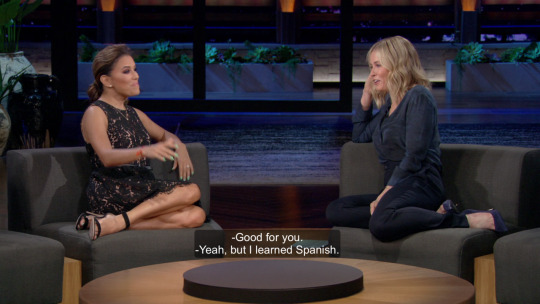
“When I was growing up, my parents spoke to each other in Spanish, but they didn’t speak to us in Spanish because they were told not to. In school we weren’t allowed to speak it.”
and also???
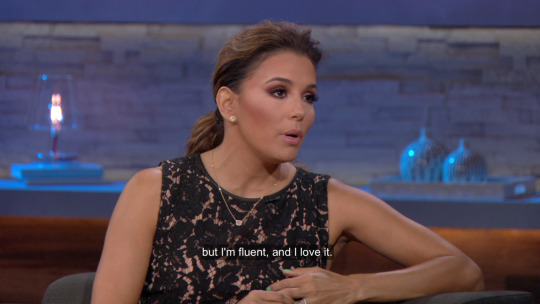
“… But America is the only country that promotes monolingualism. Here it’s English, English, English. Every other country makes their children learn a second language very early on. So as my political and social activism grew, I was like, ‘I really need to learn Spanish.’ So I did.“
idk how many people i’ve known growing up in texas whose parents speak fluent spanish but they don’t speak a lick solely because their parents were afraid or told not to teach their children. it’s unspeakably common and doesn’t in any way shape or form diminish someone’s claim to or pride in their heritage.
fuck that guy. you go eva.
lack of intergenerational language exchange is one of the leading causes of language death for endangered and indigenous languages because of this culture of shame attached to “lesser” coded languages so frankly if yr mocking people for not speaking their mother tongue without taking the colonial reasons for this into account, you’re an ignorant prick and you can go fuck yourself like
I’m genetically German, Scots, and Irish. The only word of German I got from my family: Verboten. Forbidden. Because despite being here prior to the Civil War, and my Great Grandfather working towards being a Senator (he made it in the 30′s), speaking our original language was ‘suspicious’ and ‘possibly seditious’ during WWI, so we killed it in our line to stay safe while my other Great Grandpa was off in the US Armed Forces getting hit with mustard gas so bad he woke up in a body bag with a tag on his toe. He asked his family to never speak German before he left. He didn’t want to come home and find them dead. I know more Choctaw from my family than German, because our in-law adoption thing made us the perfect hiding spot for a culture that was being destroyed. It’s called Ethnocide. And America is best at it.
No one is sure why it happens, though the wisest masters will simply say ‘The Force’ and leave it at that. Obi-Wan hasn’t thought about it in ages when Anakin finally asks him about it.
“Master… if all the force sensitives come to the Temple as babies, how do they develop all these different ways of talking?” Anakin asks. It’s only been a few months since he had started his apprenticeship. Obi-Wan and he had been spending a great deal of time at temple, bringing Anakin’s education up to date.
“Different ways of speaking? You mean our accents?” Obi-wan asks him, coming to sit beside Anakin on the old couch. A scent hits his nose when he lands on it and Obi-wan swore it still smelled like Qui-Gon, but he doesn’t dwell on that thought.
“Yeah, I mean I get why I sound different… Mine’s the usual slave accent on Tattooine… I’m working on refining it.” He admits, flushing a bit and Obi-Wan finds himself reaching out, ruffling the boys hair.
“And a fine job you’re doing, but there is nothing wrong with the way you speak, Well… except the crass Huttese.” He says and shares a smile with his Padawan. Anakin grins at him. He’d been teaching Obi-Wan Huttese. It was a language Obi-Wan had often wanted to learn and it helped Anakin feel more comfortable and steady, particularly since he was behind in so many subjects. OBi-wan was behind on his Huttese, so it put them on a better footing.
“I suppose that most of us seem to pick up the accents of our homeworld.” Obi-wan says. Anakin blinks at him and frowns.
“But, most of you haven’t been there since you were babies.” He points out.
“No, that’s true, but regardless, our earliest memories are from there. They’re of our parents speaking to us as babies, or the people speaking around us. Even if we don’t remember; we pick these things up. As force sensitives we often absorb things, like language, differently.” Obi-wan pauses taking a breath. “Most of us also learn our native language alongside basic, and a few other languages besides, when we’re in the Creche. That likely contributes to it as well.” Obi-Wan tilts his head, remembering.
“When I was your age, still an initiate, I asked a very similar question of a Young Padawan Windu.” Obi-wan tells him and smiles when Anakin makes a face; trying to do age calculations. “And he said to me something interesting. He said ‘I think that many Jedi make sure their accents develop as a way to honor where they came from.’ Then in typical Mace fashion, he wondered off, mysteriously. But I’ve always liked that thought.” He says. Anakin’s frowning now, a mixture of frustrated and sad. The boy still projected his emotions everywhere he went.
“But I don’t really want to honor where I came from.” Anakin says unhappily and Obi-wan looks the boy over, feeling a little helpless. He takes a deep breath and for a moment everything smells earth and green before it’s gone again. It gives him an idea.
“Well, in your case, perhaps don’t honor the place. Honor the people there. Those with accents like yours. Those you cared for.” Obi-wan didn’t know their names, and he needed to learn, but today was not the day to deal with attachments(Obi-wan wasn’t keen on depriving the boy of anything, honestly). Anakin would be thinking of the names. Obi-wan smiles when Anakin starts to smile and looks up at Obi-wan.
“Okay… I like that.” He says and then he hops up off the couch, “I can I go down to the hanger?” He asks him.
“Of course, Anakin. Make sure not to start helping until they let you this time though?” Obi-wan offers with small smirk.
Anakin just shrugs carelessly. “But I made it better.” He says and heads out the door. “See you at dinner, Master.”
“Always on the move.” Obi-wan mutters to himself and then finds himself thinking of his own accent. He could barely remember his parents, his brother. But were their accents like his? For some reason… he couldn’t being their voices to mind at all. He looks around the room and all all of his, and Qui-Gon’s(he couldn’t box it up yet, he kept trying), and now Anakin’s things and feels terribly alone.







 There's a Mirror on the Wall