thebibliosphere:

bluebladesoftime:

thebibliosphere:

seals-cats-and-random-stuff:

thebibliosphere:

only-in-movies:

thebibliosphere:

leafgirlinabox:

thebibliosphere:

leafgirlinabox:

thebibliosphere:

Word is arguing with me that “theirselves*” is not a word, but the Scottish part of my brain is refusing to give it up. I have been using that word since I was knee high to a splinter, it makes sense in my head, but I know someone would bitch about it as a grammatical error or some such if I used it in Phangs.

Which is unfortunate, cause as it would turn out, I’ve used it. A lot.

*themselves just doesn’t have the same meaning? Don’t ask I don’t know. It’s likely a colloquial thing.

I get it, you want a possessive pronoun instead of an objective one?

YES, thank you I’ve been trying to pin it down and sitting here just saying the word over and over trying to figure out why it feels right.

There is a slight semantic difference! You’ll see people claim that ‘theirself’ is technically incorrect grammar but that’s prescriptivist talk. If there’s a hole in the lexicon someone will fill it 😉

I mean it’s already there, it exists in Scottish dialect. I just know I’ll likely get schtick for putting it in a book, or some pedant will pick up on it and leave a remark about it not being “proper English”, which no, it’s not. But I feel it should be. It fills a gap, as you say. And language ought to change with the times.

Huh. I’d never realised I used theirselves until this very moment. It’s a real word dang it!

Right?! It wasn’t until it got pointed out to me and I had to run stuff through Word to fix something that I was like “what do you mean that’s not a word, it is too a bloody word!”

I also only recently discovered that “outwith” isn’t a word outside of Scotland…that might have been one of your revelations too but I can’t remember. Either way, the rest of English is missing out.

It’s fucking what now?

But…but it’s such a good word… what do people say instead? Outside? Without? … but they don’t have the same inherent meaning.

Oh well. Fuckit.

Sorry Phangs readers, but you’re about to get a crash course in learning Scots dialect. Hold onto yer bunnets.

how would someone use ‘outwith’, what’s it mean?

“Outwith the norm” or “outwith his expectations”.

Which I suppose “outside” would work, but it feels janky on my tongue to say that. I’ve always used outwith when talking about like thingy-things like experiences or perceptions, while outside is reserved for real physical things like “you’ve parked outside the line” or “he’s outside the house”, though I dare day there’s some folk use “outwith” for those too.

Huh. Those two phrases make absolute sense to me, but I suspect not in the same way they make sense to you? Especially since I’m kinda expecting a space between “out” and “with”, and my brain is insisting that the lack of it doesn’t change the meaning (and yet, it probably does).

And if “outwith the norm” means that is is not within a range that is an expected set for whatever is being spoken of, I’d probably be using “out of the norm” myself. IF I’m picking up the definition of outwith in that context correctly.

“Outwith his expectations” … I think “not among his expectations” might be the way I’d phrase it? Or “not what he expected”? (I mean, “outside his expectations” might be a technically correct phrase, but to me it sounds clunky and off.)

Which is more words and more syllables, and might not actually quite hit the same context, since I’m not actually sure I’m picking up the context correctly (which to me is more me having a bad morning with figuring shit out because I got woken up early by noise that very nearly started my day with a meltdown than any lacking in your explaination).

And probably most of the time where you’d use outwith, I’m using an entirely different phrase, and trying to figure it out is all about me trying to figure out if I have the context clues right, ‘cause that helps being able to communicate. (And context clues in words are so much easier than some other context clues, dear fuck.)

Edit: Continued to read further in posts, and context was provided! And I did miss some context clues, and that’s ok, ‘cause I began from limited context. (Then kept looking to see if there were more, ‘cause of course I’m going to see if there’s more information.)

98rainbow:

dragonfoxkid:

thejusticethatissocial:

lehaaz:

GOFUNDME: SAVE OUR NAVAJO LANGUAGE

“I never learned my Navajo language and I was never inspired to learn it.  As I got older, I realized how valuable our language is to the livelihood of our Navajo Nation. ” -Dr. Shawna L. Begay

Our Navajo or Diné language is in danger of becoming extinct.  Help us create and develop the first Navajo-English educational media TV puppet show, “Diné Bí Ná’álkid Time” which means ‘The Navajo Movie Time.’  It will inspire and teach our youth basic language skills using media as a technology tool. Parents, grandparents, children and grandkids can learn to speak Navajo  fluently together within their own homes.

Long-time friends and educators, Dr. Shawna L. Begay and Charmaine Jackson have teamed up to create this new TV pilot for an all-ages audience or for anyone who wants to learn the Navajo language.  

With your support, it’ll be the first educational Navajo and English puppet show that will teach and preserve the Navajo language and culture through digital media.

After several years of extensive research on the Navajo Nation, Dr. Begay recently completed her PhD from the University of Nevada-Las Vegas with her doctorate thesis, ‘Developing A Navajo Media Guide: A Community Perspective.’ As project director, she quickly realized she was a pioneer on the topic.

“When I decided what topic to study I realized there existed very little research in Indigenous educational media, especially with our Navajo people,” stated Dr. Begay.  “As Navajo people, we have our own learning objectives and Navajo way of knowing is completely different for Euro-Western schooling.  I decided that I had to research and develop our own curriculum guide that is meant to teach Navajo through media.”

Dr. Begay and Jackson, co-writers of the show, developed the first 3-puppet characters and plan for many more. The pilot features Nanabah-a young Navajo girl, Gáh (Rabbit) and Dlǫ̀ǫ̀ (Prairie Dog) who will go on endless adventures learning about language, gardening, the environment and the importance of family values. Nanabah is fluent in Navajo and likes to teach children about life on the reservation with her animal friends and special guests.  Children who want to learn Navajo will also be an important part of the show by interacting with Nanabah, her friends and storyline.

Dr. Begay’s research concluded there exists very little research in the area of Indigenous educational media. Currently media is a very powerful tool that can be used to teach. She is cognizant of the digital age we live in and the opportunities to utilize media to revitalize the Navajo language.  

“Star Wars and Finding Nemo,” dubbed in Navajo, was a great place to start and it has garnered national exposure of our language. However, we need a show based on our own Navajo learning principals our ancestors set out for us to learn and live by. I don’t think a non-Navajo, non-Native or non-Indigenous person can do that for us, nor should they.  We, as Navajo, need to produce this show ourselves, if we are to be truly sovereign,” added Dr. Begay.

Both educators, Dr. Begay and Jackson, of Naalkid Productions have been talking about this educational language project for about the past four years and still have a long way to go to finance their dream.

“With the support of Navajo TV Anchor Colton Shone, our team of Navajo artists, filmmakers, family and friends, this video pilot is a huge step forward,” said Jackson.  “Our journey has just begun and the big next step is finding financial support to create a whole new puppet TV series.”

We aim to raise $50,000 with this project which will allow us to continue with pre-production and production aspects of making this digital media project become a reality.  We need your help to save our language by teaching Navajo to our future generations.

Pre-Production:
-Script writing for the pilot show
-Puppet Development/Creation
-Casting for puppeteers and other talent that will be on screen
-Hiring of all key cast and crew

Production:
-Locations and permits
-Rental of Studio space
-Equipment: cameras, sound, lights, etc.
-Cast and Crew budget

Despite all the notes on this post, they’re still at $13,155 of their $50,000 goal. 

Please keeping sharing and donate if you can! 

what it sits at as of 07/27/18

GoFundMe as of 09/01/2018 Currently: $35,912 of $50,000 goal

dracaspina:

goodticklebrain:

For some reason, I thought it would be good to do a comic about archaic English grammar. Just roll with it, could you?

It takes a very special sort of person to follow a stick figure Shakespeare webcomic in the first place, so I’m sure most of you already knew this, but I just wanted to spread the word, as I love following the “you” and “thou” usage in Shakespeare’s plays.

If you want a more coherent overview of the you/thou thing, check out this page on Shakespeare’s Words for a more informed viewpoint, plus a lot of cool examples of it in action.

I remember the use of “thee” and “thou” being explained as the same way a formal person would use first names.

Children and close family members get the “thee”s (addressed by first name). And everyone else gets “you” (as opposed to Mr., Ms., or Miss.)

@deadcatwithaflamethrower – language porn!

imyourliquor-youremypoison:

astronomifier:

rachelhaimowitz:

obsessionisaperfume:

deadcatwithaflamethrower:

queensimia:

palavenblues:

holy shit there is a name for it

Well damn. Explains a lot.

Suddenly I understand some of my fan base a LOT better.  That is Awesome. 

“holy shit there is a name for it” was my reaction before I even scrolled down to the comments.

I just need to keep reblogging this because I cannot even begin to tell you how profound a feeling of YES and THIS and THERE IS A WORD FOR ME OMG I get every time I see this, and I hope it helps others too.

seriously, anytime you see a post with a comment saying “theres a name for it?!” reblog that post because even if it doesnt apply to you any of your followers could be waiting for that revelation.

i was waiting for that revelation

please… if you’re going to attempt to speak in “old” english

thebibliosphere:

rosslynpaladin:

alpacamyhedgehog:

tharook:

ayellowbirds:

theliteraryarchitect:

veryrarelystable:

gehayi:

lukas-langs:

THOU is the subject (Thou art…)
THEE is the object (I look at thee)
THY is for words beginning in a consonant (Thy dog)
THINE is for words beginning in a vowel (Thine eyes)

this has been a psa

Also, because H was sometimes treated as a vowel when the grammar rules for thou/thee/thy/thine were formed,THINE can also be used for words beginning with H. For example, both “thy heart” and “thine heart” appear in Elizabethan poetry.

For consistency, however, if you’re saying “thine eyes”, make sure you also say “mine eyes” instead of “my eyes”.

Further to the PSA:

Thou/thee/thine is SINGULAR ONLY.

Verbs with “thou” end in -st or -est: thou canst, thou hast, thou dost, thou goest.  Exception: the verbs will, shall, are, and were, which add only -t: thou wilt, thou shalt, thou art, thou wert.

Only in the indicative, though – when saying how things are (“Thou hast a big nose”).  Not in the subjunctive, saying how things might be (“If thou go there…”) nor in the imperative, making instructions or requests (“Go thou there”).

The -eth or -th ending on verbs is EXACTLY EQUIVALENT TO THE -(e)s ENDING IN MODERN ENGLISH.

I go, thou goest, she goeth, we go, ye go, they go.

If you wouldn’t say “goes” in modern English, don’t say “goeth” in Shakespearean English.

“Goeth and getteth me a coffee” NO.  KILL IT WITH FIRE.

Usually with an imperative you put the pronoun immediately after the verb, at least once in the sentence (“Go thou” / “Go ye”).

YE is the subject (Ye are…).  YOU is the object.

Ye/you/your is both for PLURALS and for DEFERENCE, as vous in French.

There’s more, but that’ll do for now.

Oh wow. Reblogging for reference.

i haven’t had my coffee yet, so all i can think of when i read through this is: 

th’ain’t

th’dstn’t’ve

AND ANOTHER THING
“thee/thou/thy” is informal
“ye/you/your” is formal
Also also…all of this is NOT Old English but is actually referred to as Early Modern English. If you were speaking Old English, it would sound closer to German.

^That.

And IT’S NOT MORE FORMAL to use THEE.

if you address someone you should use Thee or Ye (sometime used as the plural, sometimes it’s still Thee, rules are iffy) to as You, it’s an insult by intentional distance. If you call someone you should call You by Thee, it can be an insult via assumed intimacy. 

(This is why some religions insist on still using Thee and Thou when talking to their Father God. Many of them modernly think it makes them sound more formal, but that’s not why the usage began, or why the more linguistically aware still do it. Not because it’s more formal, but because it’s LESS formal. You wouldn’t call your own Father “You” unless you wanted to imply disowning Him.)

Anyone you’re close to or on first name terms with can be Thee. Friends, family members, etc. 

Anyone you want to point out is NOT your friend, respectfully or otherwise, is You. Which is why the King is still Your Majesty. You are decidedly not his friend unless you know each other really well. (See “Henry V”. If you can also call Henry by Harry or Hal, you can probably call him Thee.

One more note! “Ye Olde- as you see on shop signs is not prounounced Yee. There’s a character called a Thorn  that was going out of style and being replaced by a curly thing that looks like a Y and IS NOT. It’s pronounced Th. THe olde apothecary shoppe. Not Ye Olde. That itself promptly went out of style as well but the error remains almost traditional.

and I am not addressing claims that I might be a vampire, lycanthrope, or other immortal just because I am fluent in Modern Middle English. 

@thebibliosphere

This whole post is a blessing because I read so much “ye olde” speak in historical stuff and everyone always gets their thee’s and thou’s wrong. Even big name authors with accuracy editors who ought to know better.

It’s more accurate to have your “poor folk” in your historical novel saying “thou” than it is to have the scholar or rich man with an education rooted in Latin, unless he’s down the pub with his mates, merry as a knave.

The whole thing just reminds me of people using Polonius’ speech in Hamlet (“to thine own self be true”), completely out of context, not realizing that the speech is intended to show Polonius as a foolish old hypocrite who enjoys dishing out council but rarely follows his own convoluted advice, which is often contradictory and falsely pious.

Which, I mean, Shakespeare often isn’t taught well outside of higher education, lets be honest. So why would they know unless they’ve studied it beyond the passing glance it gets that one year in high school before been relegated to the position of “too posh and old to be relevant” which is entirely not true.

Shakespeare is written in the language of the people, and is often more insightful and progressive than certain types of academics would like you to believe.

Is anyone interested??

noxfoxarts:

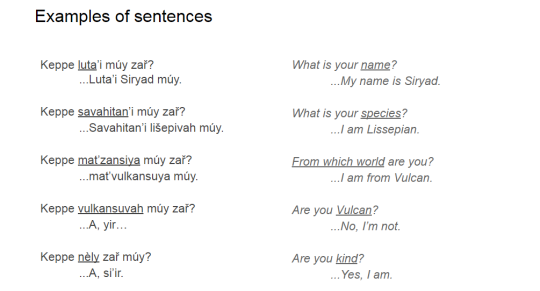
NX Kardasi is a version of Cardassian language designed for fanfic usage and based on canon Cardassian words and Cardassian culture. It relies on latin characters that can be typed easily with a keyboard set as UK Extended, and is meant to be possible to write, read and speak:

Treason, like beauty, is in the eye of the beholder.
>>

son nizakovira son sakaa̅n tuvai zadi daúm zay
[like treason, like beauty, shall its own mind]

Suffice it to say, I still have friends on Cardassia. I’m sure you’ll derive years of enjoyment trying to determine exactly who they are.
>> et’pimnetip makay, ot’kařdasiya vesalat

zemirit

va mu
[in such enough words, in Cardassia my network is continuously]
>>

zai’meŕa sonva das’ranlõu’i pasi’tenmelú zavahi ve mai’iri
[your credibility so years of fun’s to guess right which my side]

— Garak, ds9 S3E05 Second Skin

Now the question

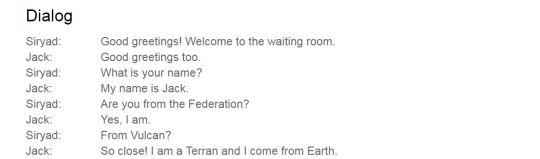
I’ve written up a doc about the grammar of this language, which, while funny and written as a guide for aliens to learn Kardasi and integrate into Cardassian society, can be a bit tough for someone who isn’t a slut for grammar. To me, that guide is a very good reference, and it’s pretty much all I need to write/translate texts in NX Kardasi, but I was planning on making lessons that would be more accessible, with typical sentences, dialogs, exercises, etc:

Thing is, I don’t feel like there’s much of an interest for this in the fandom. I don’t see much curiosity or excitement, and as such I ask myself “why should I write lessons that nobody will use?” I don’t have the drive to do things that people aren’t looking forward to.

As such, if you would like me to produce those lessons, please leave a comment on this post or reach out to me to let me know about your interest.

And whether or not you care about this, please reblog so this post might reach more people who in turn might care.


If anyone has any questions or is curious about this project, you can reach out to me anytime as well. Translation requests are also welcome.

officialqueer:

lianabrooks:

hellishues:

saltenecker:

someone in a fanfic: s-stutters in embarrassment

me, closing the tab: sorry I must go

Unrealistic Stuttering: “S-sorry I-I d-d-didn’t m-mean t-to…”

Realistic Stuttering: “Sorry, I uh… I didn’t mean- I didn’t mean to do that…”

When people stutter, they usually reword what they’re saying as they speak, and subconsciously insert “filler words” such as “uh, like, you know,” and etc.

*puts on speech therapist hat*

ACTUALLY! It depends on why they are stuttering. 

A Nervous Stutter results in what is called Mazing, or rewording the sentence. That is the classic “I, um… well I… look it’s just that… so we…” that @hellishhues is talking about. When someone is mazing their words you’re seeing a form of Speech Apraxia where the brain is having trouble forming verbal speech. This can be brought on by brain damage, memory loss, anxiety, nerves, and several other things. 

The root cause of a nervous stutter is a disconnect between the mouth and the brain. 

With this you will also sometimes see the classic “S-s-s-sorry…” especially if the person has been training to speak clearly and is now at a point of fatigue or stress where they are not mentally capable of forming the words.

The other kind of stutter is a Physical Stutter, sometimes referred to as slurring, and another facet of Speech Apraxia. This stutter is caused when the muscles of the mouth, tongue, and throat are physically unable to form certain sounds. This is most often seen in the very young and victims of brain trauma. 

Sounds are acquired at different ages, so a 2-year-old will probably not be able to clearly pronounce certain words (which is why toddler sound so off when they’re written with developed dialogue). These mis-pronunciations are sometimes referred to as lisping, but only if the sounds are run together. If the person starts and restarts the sound because they got it wrong, it can also sound like the classic sound stutter. 

But it all depends on why the character is stuttering!

Do they have Speech Apraxia, Audio Processing Disorder, muscle dysfunction, or another medical reason to stutter? (1)

Are they stuttering because of anxiety, stress, or fatigue? (2)

Does the stutter stem from intoxication or blood loss? (3)

All of those will sound different! 

1 – Will have mazing, repeated sound stutters, and be the classic stutter that annoys OP.

2 – This is where you’ll see the repetition stutter, mazing, rephrasing, and filler words.

3 – This is where you are more likely to see starts and stops and slurring of words. 

My mum has apraxia and I just wanted to say that’s one of the most concise and clear ways I’ve seen it explained, thank you!

midding

calime33:

dictionaryofobscuresorrows:

v. intr. feeling the tranquil pleasure of being near a gathering but not quite in it—hovering on
the perimeter of a campfire, chatting outside a party while others dance inside,
resting your head in the backseat of a car listening to your friends chatting up front—feeling blissfully invisible yet still fully included, safe in the knowledge that everyone is
together and everyone is okay, with all the thrill of being there without the burden of
having to be.

Wow, there’s a word for it? Cool. This is the feeling I sometimes go to local queer parties for 🙂