me: i dont like, really SHIP this ship, but the art is cute and i can get behind it theoretically even though i dont actually interpret their relationship that way and/or i prefer another ship the fandom for said ship: [is obnoxious] me: actually i hate it now
look…………….. write as much shitty fic as you want. nobody can stop you. you’re learning constantly and it’s better to write hackneyed implausible ridiculousness than it is to not write at all out of fear of fucking up. you’re good
(P.S. Devin Faraci tried to fight with me and subsequently blocked me on Twitter because I retweeted a bunch of things he’s said over he years about fan culture, which are handily quoted in this Tumblr post! Please enjoy! 😀 )
So as we all know, movie critic Devin Faraci caused a minor internet brouhaha Tuesday with a controversial piece about online fandom. “Fandom is broken” — which piggybacks off a milder but similar article published last week by the AV Club and argues that fan culture has entered an ugly phase — was largely met with solemn nods of agreement by everybody except, uh, anybody who’s actually in fandom and actually knows what the fuck fan culture is about.
The main target of the piece is fan entitlement, which Faraci believes is the result of fandom being “post-fanfic.” That is, he thinks the current state of fandom — which can be overwhelmingly polarized and activist — is a natural result of fans having so much personal autonomy over their own fanfiction and other fanworks (including fanart, fan film, fan meta, shipping, and fan theories). Consequently, they seek to have the same level of creator control over their canons, too.
Before we go any further, let’s be clear here. Some people should be told at all times that their diminishment of cultures they don’t understand only makes them look small, petty, and ridiculous. Faraci is one of those people. He has demonstrated again and again that he has only a cursory understanding of what fanworks-based fan culture is, and utterly no interest in examining it to a closer degree.
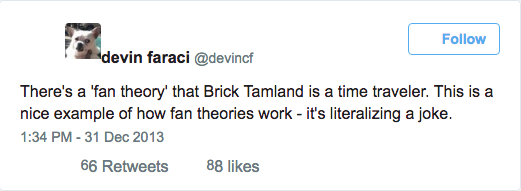
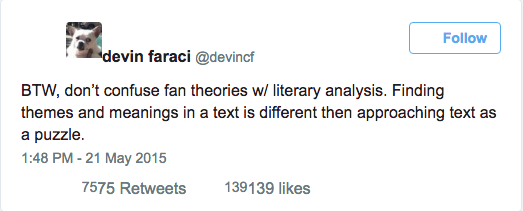
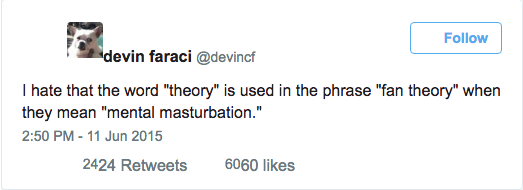
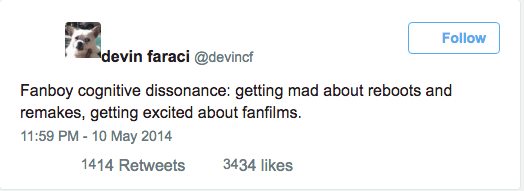
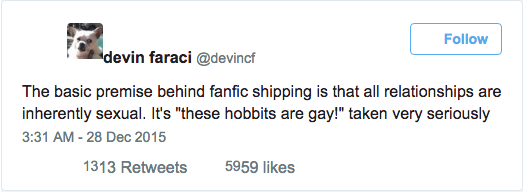
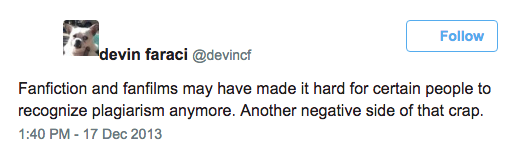
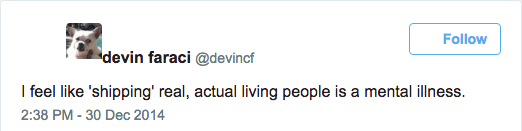
Faraci’s consistent response to fanworks and remixing in general is to be cavalierly dismissive. Please enjoy this litany of Faraci being cavalierly and unilaterally dismissive of virtually every fannish practice, from shipping to fan films to fanfiction:
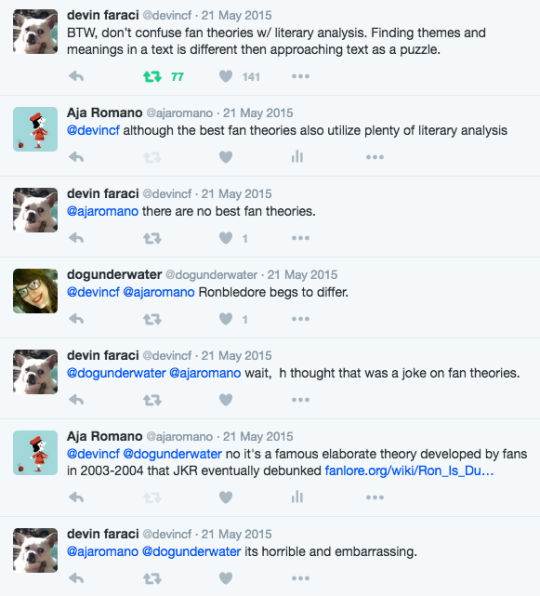
To anyone who’s spent any amount of time immersed in fan culture, Faraci’s attitudeabout fandom is unilaterally tone-deaf, laughably inaccurate, and full of hubris. He is jawdroppingly secure in his opinions, and when you attempt to suggest that fanworks are far more complex than he’s acknowledging — as I once did in a brief exchange after one of his derisive tweets about fan theories — he typically dismisses you out of hand or ignores you altogether:
And then there’s this gem:
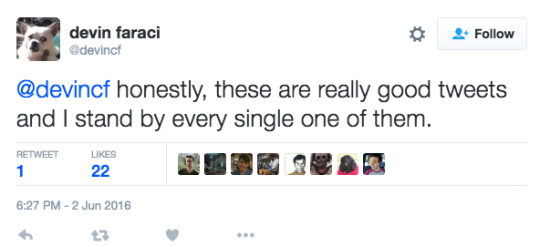
When I retweeted all of these tweets just now, Faraci responded by a) calling me out to his 40,000 followers, most of whom are apparently male and who naturally began brigading and harassing me on Twitter; b) blocking me, and c) tweeting this:
So. Now that we’ve established that Devin Faraci is a dismissive demeaning sexist shitbag and everything he says about being “concerned” about “fan entitlement” is concern trolling because he HATES fanworks and fans who create stuff and overanalyze and generally actively engage with texts, let’s move on, shall we?
First, thank you for asking. This is something I feel is important!
Second, to those who wonder where this question came from, a while back, I reblogged this, and added the comment about squicks not being the same as triggers.
So what, you ask, is a squick?
A squick is an old fandom term for something that makes you supremely uncomfortable and you absolutely do not want to read it. It can be a trope, a ship, a concept, or just an event that happens within a fic or in canon. For me, abused animals are a definite squick. I don’t like it, and will generally avoid reading any graphic descriptions of such. (That includes tumblr gif sets and such too, people! Tag that shit, will you? Even if it has a happy ending.) Another deep, deep squick of mine is infant age play. Don’t like it, don’t get it, don’t want to think about it.
Now, neither of these things are dangerous to my mental or emotional state. I have never experienced either in my life, and they do not bring about any sort of PTSD, dissociation, or spiral of depression, anxiety, etc. They are simply things I prefer not to think about in my daily life, or read about in my escapist hobbies. Therefore, theyare not triggers. Triggers are very real, very bad things for some people, and to label things we choose not to read because we find it disturbing or gross or weird is to diminish the very real danger of actual triggers.
I love the term squick. It perfectly describes the concept without assigning any negativity to the thing you dislike, or to people who do like the thing you dislike. It is something you personally do not care for and wish to avoid, simple as that.
A squick is an old fandom term
*waves walking stick in the general direction of her lawn* This.
Bring back “squick” 2k16
Squick is wonderful for many reasons, especially because it is value neutral. Being squicked by something doesn’t mean it’s gross or wrong or ~problematic~, just that you, specifically do not enjoy it and that it makes you, specifically uncomfortable to read and/or write about it.
nothing like reading fic on ff.net and livejournal and seeing “WARNING M/M SLASH DON’T LIKE DON’T READ” to really make you want to take out your wallet and throw money at ao3 and be happy to be alive in 2016 and stuff
In case some of the newer fans are curious about this history, and by new I mean within the last 10 or so years:
Once upon a time, we were required to rate all M/M as NC17, to gatekeep and hide it and to protect ALL “children” from the evil M/M snuggles. (Yes even G rated snuggling got that rating for a while.) The places that required this sort of “protections” were fueled by reactionary homophobic policies. The thing is, we internalized this hatred and phobia so hardcore that we voluntarily did these things and made these labels even when we didn’t need to (AH AGE STATEMENTS, the proformaness of it to only be topped by the disclaimers. Which were real and needed because there had been actual issues that had played out, but in reality were more about showing you to be going through the proper motions than actually doing anything that changed anything).
And it took a long time and a lot of people going “why is gay automatically for adults only? Why is it automatically labeled sexually explicit?”
And it mirrored a larger conversation going on in the world. Which was great. But the underlying issue, the sexualization and fetishization of queer relationships and people are still a thing. One of the most common worries about the sudden prolifieration of “out” people was that somehow they’d get their hands on people who didn’t want their hands. Especially children. BUT there was a definite “not in my locker room” because of genuine fear of a sexual proposition. Because somehow being queer meant you couldn’t keep it in your pants. (Well in reality, I’m sure it’s more like MEN specifically are worried other men might start treating them the way they objectify and ignore women and consent.)
Anyone else remember the insane fears about why you couldn’t let ‘gay’ people raise kids? They’re still out there of course, but this was a time when that court room battle was a sweeps week spectacle on one hour dramas.
ANYWAY.
This was all to say that these artifacts (and I recently saw someone mocking the old disclaimers that made it into AO3 b/c of how the importer works and this is all from the same era, and thank god someone explained why those disclaimers were there) are important to remember. And, I think, important to keep on those original stories. The Open Doors Committee is amazing and I love what they do, but their importing of older archives brings in more of fandom’s history and I’m glad. And I hope authors don’t change their older works because fandom history is important and with Star Trek’s 50th coming up, I’m reminded of how little we’ve written down and how that was really the nature of the secretive beast.
So the type of author’s note up there, it comes from a time when readers would clutch their pearls and be deeply homophobic in your comments. Sometimes pretending they had NO IDEA it was there till they started reading.
…aaand then there’s how the slash side dealt with het. Which is a whole OTHER post.
You can ship characters for happily ever afters, sure, you can ship them for tragically-then-happily, you can ship two or three or four or more, you can ship endless combinations of personality types and relationship dynamics
but you can also ship characters under very specific circumstances, or for a certain period of their life but not for all of it, or only in a certain universe. You might say “I ship these characters” and what you mean is you think they are fascinating together and could have a story together. That story could be any kind of story.
Sometimes it means you want them together for the rest of their lives. Sometimes it means something different than that.
I don’t know about you, but for me, “I ship it” means “There is a story in this ship and I am interested in that story.”
for me, “I ship it” means “There is a story in this ship and I am interested in that story.”







 There's a Mirror on the Wall