I got the movie for the nostalgia value. I watched it yesterday for the quippy lines, baby Chris O’Donnell, pretty men, and Tim Curry being a fantastic villain.
NOT FOR A FUCKING PLOT BUNNY.
*thumps head on nearest wall* It’s an early 90s swashbuckling film loosely based on a book that doesn’t take itself too seriously, has the only instance of one particular actor I even care about, is the movie that convinced ten year old me that men look fantastic in long hair and Chris O’Donnell should always have long curly hair (ok, he looks fine with shorter hair now, but still-baby-Chris looked wrong with short hair in the only other movie I’ve actually watched him in, and fuck if I can remember what it was other than a Batman movie).
Anyway. It’s not supposed to spawn a plot bunny with a cranky not-really-a-fae, but be equally careful about entering deals with her, because gods-touched immortal beings who aren’t exactly meant to be fully part of the world any more aren’t playing by mortal rules either. Just the ones they’ve learned to live with. (Because I know what I’m doing when writing with deities, and I’m particular about which ones I’ll offer stories up to.)
And it’s not supposed to make me contemplate an AU for a movie that is already an AU of a book. If I end up with more than a single story out of this, I’m…. actually, I don’t know what I’m going to do. Probably scream into a pillow.
Here’s one of the reasons I don’t buy the cynical interpretation that Ariel gives up her identity for a man.
This screencap comes from her introductory scene. She’s searching through a shipwreck for human artifacts–which is her passion–when suddenly she’s attacked by a shark.
While fleeing, she accidentally drops her bag full of artifacts right in the shark’s path. Without hesitating, she chooses her passion over her safety, risking her life for a dinglehopper.
The girl is an anthropologist who studies humans. That’s her passion, that’s how she spends her time…that’s her identity.
Sure, Eric is the catalyst that leads Ariel to changing her species and leaving her family–he certainly intensifies her feelings–but they’re feelings she already has, and they dictate most of her life.
If Ariel had the chance to become a human before she met Eric, everything that we know about her suggests that she probably would.
I don’t understand what’s Jewish about mother gothel… she has a typical Disney face doesn’t she? Is it the curly hair..? I mean her nose and everything else seem normal?
I’m sorry, I’m just trying to figure it out, you don’t have to answer if you don’t want to.
dark curly hair – long hooked nose – darker complexion than the blond blue eyed heroine 9and really the rest of the cast – portrayed as greedy and evil.
Lisa Edelstein is Jewish. As are Idina Menzel and Amy Winehouse, both of whom I have seen compared in looks to Gothel. Gothel’s design is a pretty clear caricature of ethnically Jewish women.
This is a pretty good contrast between Rapunzel and Gothel. Rapunzel has the “typical Disney face”:
Here’s a more close up look at her features.
The hooked nose becomes even more pronounced as she becomes “eviler.”
If you wanted to claim that there was noting out of the ordinary for Disney animation when it came to Gothel’s features, you would have to find at least one Disney princess or heroine with similar characteristics (long hooked nose and dark curly hair, etc).
But here is what we have is –
small noses that turn up at the end:
wide, flatter noses (though cheers to Disney for not putting button noses on their characters of color, although Esmerelda’s clothing design deserves another essay on Rromani stereotypes and there are some major issues with Pocahontas as well)
And then a few misc noses (again, props for Jasmine’s nose not being a button):
Apart from just the design of Gothel, there’s also the whole: “obviously ‘other’ (read Jewish) woman kidnaps the pretty blonde (read: gentile) kid to use her for ritualistic/magical purposes”
Like that right there on top ofthe aesthetic Jewish-coding is what pushed the antisemitic caricature over the top for me. It harkens back to antisemitic blood libel that claimed that Jews stole gentile children for all manner of nefarious reasons. Even when Gothel is in “mother” role to Rapunzel, she’s is shown as nagging and passive aggressive, both antisemitic stereotypes of Jewish women.
There is no one thing that makes her an antisemitic caricature, but the design, plus the storyline she plays out, plus her characterization cement the overall character as antisemitic.
Jew-coding a villain is not in itself always antisemitic when there are also Jewish coded heroes. Rapunzel does not have that.
Having a villain steal a baby for magical/ritualistic reasons is not always antisemitic as long as the villain is not Jew-coded. Rapunzel fails this as well.
Having a nagging and passive aggressive mother character is not antisemitic provided that she is not, again, coded as Jewish. Rapunzel fails once again.
Hope this helps.
EDIT: @ariminak pointed out that some of my wording made it sound like Gothel’s features only stereotypically caricatured Ashkenazi women when in fact that is not the case. I changed the language to remove that phrasing and make it clear that any ethnically Jewish women can be affected by this type of aesthetic trope. If you reblogged the old version, could you please delete it and reblog this one instead.
Spread this version so people recognize that this stuff harms all Jewish women.
I was six the first time I went to disney world. It was also the first time I met my step family in florida. See, my grandfather had three wives in his lifetime, and the third wife was the only one I ever met. She had five kids when they married, and moved to Hawaii from the Phillipines. Now jump forward, my dad’s step siblings have families of their own, including my uncle Jett, who married a native hawaiian woman, and had two beautiful daughters.
Back to that first trip to disney. I was six, my sister was ten, and our smack in the middle of that age difference was my cousin Malia at age eight. She, and her younger sister Bella, both took hula classes, because their mother wanted them to stay close to their roots, despite the distance of having moved to florida. We were all pretty young, but we knew enough that the princesses at disney world were actresses in costume.
“How cool would it be to play a princess at one of these parks?” I had said after a long day in the magic kingdom. “I wanna do that one day.”
“Who would you play?” Bella had asked.
“I don’t know. Belle maybe. She’s the only one with brown hair other than snow white, and mulan, and I could never play either of them.”
“Yeah, but you don’t really look like Belle either. Your noses are to different.” Malia had cut in, and I shrugged it off, knowing It’d never happen anyway.
“What about you guys? Who would you play?” I asked them, unaware that there was no answer to that.
“We don’t look like any of them either. There are no princesses from where we’re from.” So we all settled on the sad belief that none of us would ever get to be disney princesses.
Years pass, and I decide that one day I would help write a movie for a princess from either the phillipines, or the polynesian islands, so my cousins could become princesses. Because they held on to that dream. It might have been harder for them to let go of it, because they lived so close to disney.
Now it’s 2014, and Malia has just been hired as a dancer, at the polynesian resort at disney. She started as a swing, and in two years worked her way up to a featured dancer. It helped that she was of polynesian decent.
About a year ago it was announced that disney would be releasing a movie featuring their first polynesian princess, and my cousins & I were all excited, but none of us had high hopes. We all figured they’d make her look more like Rapunzel, the way Anna and Elsa had.
Fast forward a few months. They have just released the first look at moana.
I text my cousin as soon as I see it.
“Did you see Moana?”
“No, why?” I send her the picture above, and a minute later I get a call. “SHE LOOKS LIKE ME! I LOOK LIKE HER!” Malia is screaming into the phone with unabashed enthusiasm. She couldn’t believe that a disney princess bore such a resemblance to her.
Yesterday, 11/16/16, my cousin began her new job at disney world, and I couldn’t be happier that her dream of ten years had been realized.
This is why representation matters. This is one of many reasons why Moana is so important.
Congratulations Malia. I can’t wait to come down and say Mahalo
Gaston really is the most terrifying Disney villain because he could be anyone in the world.
Later he convinces the whole town to set up his wedding with the knowledge that the would-be bride would be thrown into it. Everyone finds his creepy-ass tactics as cute and “boys will be boys” esque. So yeah, he is terrifying.
Yeah, the truly scary thing about Beauty and the Beast isn’t that Gaston exists, but that society fucking loves him. People who deride the movie by saying it’s about Stockholm Syndrome are ignoring that it’s actually about the various ways that truly decent people get othered by society. People don’t trust the Beast because of the way he looks, which only feeds his anger issues and pushes him further away. Gaston isn’t the only one who criticizes Belle for being bookish, either; the whole town says there must be something wrong with her. And her father gets carted off to a mental asylum for being just a little eccentric.
Howard Ashman, who collaborated on the film’s score and had a huge influence on the movie’s story and themes, was a gay man who died of AIDS shortly after work on the film was completed. If you watch the film with that in mind, the message of it becomes clear. Gaston demonstrates that bullies are rewarded and beloved by society as long as they possess a certain set of characteristics, while nice people who don’t are ostracized. The love story between Belle and the Beast is about them finding solace in each other after society rejects them both.
Notice how the Beast reacts when the whole town comes for him. He’s not angry, he’s sad. He’s tired. And he almost gives up because he has nothing to live for. But then he sees that Belle has come back for him, and suddenly he does. In the original fairy tale, the Beast asks Belle to marry him every night, and the spell is broken when she accepts. In the Disney movie, he waits for her to love him, because he cannot love himself. That’s how badly being ostracized from society and told that you’re a monster all your life can fuck with your head and make you stop seeing yourself as human.
Society rewards the bullies because we’ve been brought up to believe that their victims don’t belong. That if someone doesn’t fit in, then they have to be put in their place, or destroyed. And this movie demonstrates that this line of thinking is wrong. It’s so much deeper than a standard “be yourself” message, and that’s why it’s one of my favorite Disney movies.
Yeah okay, that might have been the intended message of the movie, but the Beast is literally an abuser, he literally abuses and imprisons Belle, she tries to escape (as many abuse victims do) and ends up back with him because it’s just too scary out there without her abuser whose violence protects her.
It’s literally textbook abuse, textbook stockholm syndrome, and it’s great if you can find positive messages in that movie but please don’t hand-wave the abuse that Belle endures or the fact that her happy ending is literally her reward for loving her abuser and choosing to stay – and her reward is no longer being terrified and imprisoned.
Please don’t ignore the damaging messages in that film just because you want to talk about one of the better ones – how many young children have seen, will see Belle terrified of a controlling person with an explosive temper and zero self-control, and then see that if you just love someone like that enough they’ll turn into a kind and gentle prince?
This story might have been great if the Beast hadn’t been written as abusive. Or if he had been and Belle had succeeded in leaving. Or if her staying with him was read as tragic. But as it stands, we’re supposed to think it’s romantic that this young woman fell in love with a cruel and terrifying person who imprisoned and controlled her.
We hear too many stories like that already and if you justify the Beast’s abuse of Belle because others have rejected him, or because it’s somehow her job to love her abuser because he can’t love himself, guess what, you’re supporting one of the more popular narratives that real-life abusers use to control their victims.
No.
I’m sorry but you’re wrong.
Belle did not fall in love with her abuser.
I will not deny that Beast was abusive in the beginning. He was downright beastly. And Belle hated him. And feared him. And was disgusted by him.
And it’s only then that Belle starts to care about him.
Leading to them slowly developing a friendship and eventually “something more”.
Leading to one of the most beautiful Disney moments:
But even then, when her father is shown in the woods, Beast tells her to go and Belle goes!
She only comes back, not because “it’s just too scary out there without her abuser whose violence protects her” (that’s just ludicrous!) but because she genuinely cares about the man that the Beast became. (And she despised the monster that Gaston had become.)
The point of the story is that, over a period of time, the ‘monster’ became humanized and the ‘human’ became a monster.
YES. MOTHER. FUCKING. THIS.
I have gotten so sick and tired of people diminishing Belle’s personal power and the importance of her story by saying she only stayed with the Beast because of “Stockholm syndrome.”
This movie starts with Gaston and the Beast having basically the same entitled attitude towards the world: they feel they’re OWED whatever they want because they’re somehow superior. Belle is the catalyst and the lynchpin, and the difference in the characters of the two men becomes blatantly obvious in how they react to not getting what they want from Belle.
Gaston sulks and pouts and tries to force her to marry him, to the point that he convinces the entire village to help him plan a shotgun wedding with an unwilling bride, institutionalize her father, and even storm a castle to murder an unknown “monster,” still with the idea that with no Beast, Belle will be “his.” The most telling thing is that despite how much Gaston claims to want Belle, the moment she publicly rejects him (”He’s no monster, Gaston! YOU are!”), he immediately dismisses her as crazy and locks her in a cellar while he goes off to kill the person she actually cares about.
Beast sulks and pouts…and then makes significant changes to his behavior and his manners, both to show Belle that he cares for her and that he CAN be a better man. He changes both FOR Belle and BECAUSE of her. He pays attention to what she says, what she doesn’t like, and what makes her happy. And she’s not afraid to tell him, in no uncertain terms, exactly what he’s doing wrong.
“If you’d hold still, it wouldn’t hurt as much!” “Well, if you hadn’t run away, this wouldn’t have happened!” “If you hadn’t FRIGHTENED ME, I wouldn’t have run away!” “…..Well, YOU shouldn’t have been in the west wing!” “Well, you should learn to control your temper!”
This is not the behavior of a woman too afraid of the Beast to leave and too cowed by abuse to stand up for herself. The Beast literally shouts in her face, and she barely flinches. This is a woman in full control of her life and completely able to make her own choices. If the Beast hadn’t changed, if he’d acted like Gaston instead of demonstrating radical self-improvement, if she thought for one second that her life was truly in danger, she would have left and never come back.
She’s spent the better part of her adult life standing up to and actively shutting down an overbearing and physically intimidating man who shows immediately and repeatedly that he has no respect for her wishes or her personal space. She is not going to back down just because someone growls and blusters at her, no matter how big his teeth are.
Belle is a force to be reckoned with.
And the message here is not, “If you love someone enough, you can fix them.”
The message here is, “If they actually love you, they won’t be abusive.”
I know this is long and all, but I want to at least emphasize that last part:
“If they actually love you, they won’t be abusive.”
Talking about a movie or not, that’s huge. It’s something I certainly wish I learned much sooner
Also, Belle doesn’t stay with the Beast after the wolf attack because
“it’s just too scary out there without her abuser whose violence protects her,” she stays because he got hurt saving her life and while the only reason her life was even in danger to begin with was because he flipped his shit (a fact which she is not afraid to confront him with), she’s willing to allow him enough grace to help him in turn instead of leaving him freezing and bleeding in the middle of the woods. Because Belle is not just brave and smart, she’s also noble–noble enough to take her father’s place in captivity because she’s younger and healthier and can survive it, and noble enough to walk back into the lion’s den to help someone who needs her, even if he’s done little to deserve it up until that point.
Belle is nobody’s victim. She is the hero of her own damn story and deserves your respect.
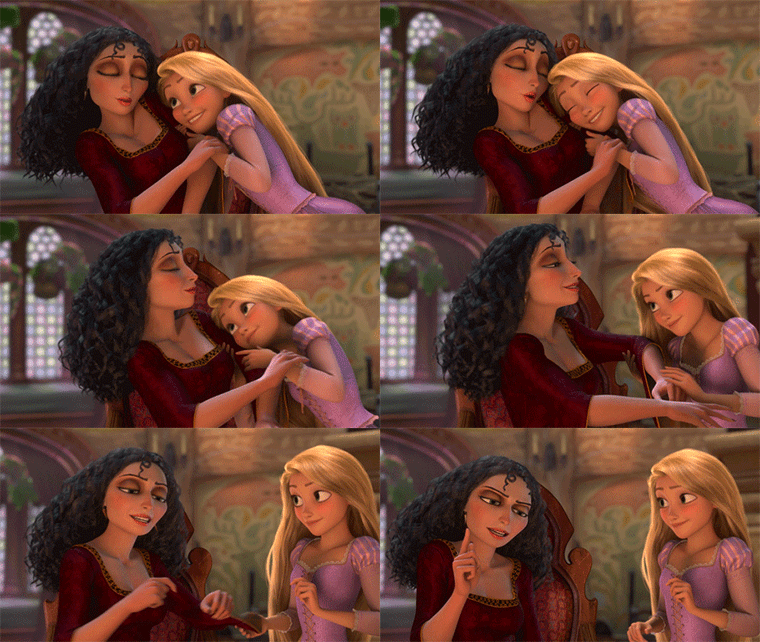
We’ve all seen that Gothel makes Rapunzel come to her for hugs, but today I realized it goes deeper than that. Gothel doesn’t want Rapunzel showing physical affection unless she has been given specific permission. Opening her arms is that unspoken permission.
For example, towards the beginning, when she’s reminding Gothel that it’s her birthday tomorrow, she grabs her arm in exuberance. Gothel is put out and then pries Rapunzel’s hands off her arm, all the while pretending she doesn’t remember (or care) that her birthday – something Rapunzel is extremely excited about – is fast approaching.
She also uses Rapunzel’s need for physical affection, deliberately taunting and “teaching” her with it by pretending to offer it, then taking it away immediately.
The first bazzilionty times I saw this movie, I always assumed Rapunzel was relieved to see Gothel towards the end of Mother Knows Best just because she was scared.
But now I realize it’s not only because she’s scared, but because Gothel is now giving Rapunzel permission to seek the creature comfort of physical contact that she so desperately needs after the gamut of fear she’s run.
Eugene, on the other hand, starts showing physical affection as soon as he starts feeling any affection for Rapunzel at all. He uses it as a comfort. Yet Rapunzel keeps her hands to herself.
It continues when he gives her the little flag, touching the small of her back in an affectionate way. But her hands (and attention) are full at this moment.
In fact, the first time she realizes she’s touching him, and he’s touching her, and there’s affection and enjoyment buzzing between them, she’s the first to pull away.
She’s alarmed at first, then apologetic and sheepish. Sorry I was touching you, Eugene. And he politely takes a step back, tuned in to her discomfort and giving her a little more space.
But that is why the moment on the boat is so important, and why Rapunzel has the reaction she does.
In taking Rapunzel’s hand, out of the blue (as far as she can tell), it’s sending her a clear message that he feels the same about her that she does about him, and that physical affection is both alright and wanted. That he will seek out her attention in a way Gothel never has. And from this moment on, she touches him often, holding hands for the rest of the song, brushing his hair from his face as he lay dying, and never letting go of his head, even after he’d died in her arms. Not to mention kissing him when he lives again, holding hands on the balcony while they wait for her parents and end-of-movie smooching.




 There's a Mirror on the Wall