do not put up with passive agression. the people in your life should respect you enough to be straight forward with you. If someone does not come to you directly with an issue, it is not yours too fix. you can’t spend all your time picking apart your relationship with someone, searching for what you did, and blaming yourself when you don’t even know what for. it’s not fair for people to put you through that.
equally as important–learn to dismantle the impulse to be passive aggressive on your end. cultivate the skills required to be honest and accountable about your feelings, not just to the people around you, but also for your own sake. it’s when you learn to be honest to yourself about what you’re feeling that you really start to flourish.
*this is especially important: these days on Tumblr there’s a wonderful atmosphere of being able to talk openly about your mental illness or your struggle. And that’s great! But there’s a difference between sharing in order to help yourself and other people and sharing just because you have no other coping mechanisms. As much as you’re able, try to work on developing a different outlet. People aren’t qualified to be your therapist because they’re nice to you a couple of times. Please remember that they have lives too, and their job is not to make you feel better or pity you, no matter how difficult your life is.
And last but not least:
But…
I really don’t have a way to better this.
Your interests are your own. I can’t advise anyone to change their interests to fit in with a certain group of people – that’s stupid, and actually quite damaging to your sense of self.
Instead, I would recommend that, maybe if you feel like your topics of conversation are falling flat with this group of people, you move on to other, greener pastures. There are bound to be places where your ideas mesh better with an audience.
And of course – try to be considerate about what you say and how you say it.
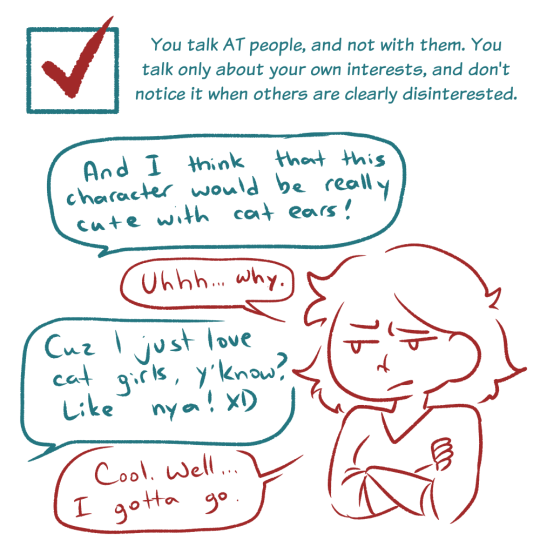
Sometimes, what might seem like a harmless comment to you might be a very discomforting thought to another person. I recently had a conversation on a forum with a guy who was telling me that his headcanon was that Pearl (from SU) would soon get a male love interest who loved mechanics and weapons next, and that would be her best arc, because she would finally get a ‘healthy’ love interest.
His intentions were good, but he was entirely unaware of how cringey this kind of thing was to a bunch of (probably queer) people, who have spent their entire lives being told that the only ‘good’ character development for them would be to get a ‘male love interest’. No one wanted to be the jerk to say “fuck off, we don’t want that to happen” but everyone was answering him in a flat way, trying to discourage the discussion further. Instead of picking up on the hint, he bulldozed on, thinking he was having a ‘lively conversation’ which was, in fact, in its late stages of death.
I know I’ll probably get a few messages to this saying: What about people on the Autistic Spectrum? Sometimes, people can’t pick up social cues or ‘hints’. And if that’s the case, it’s incredibly difficult to understand why you’re not having any luck communicating despite your best efforts.
I feel that on a person level, please believe me. I made this infograph for THAT VERY REASON. Because I WAS that awkward kid who didn’t pick up on hints well. In fact, I still have trouble talking to people. If any of you have had the misfortune of being my conversational partner, you’ll know that I tend to be overly blunt and come off as very unfriendly. It’s something that I, myself, am working on currently in order to grow into a better person. It’s a struggle in progress, but I am aiming towards the progress side, and I just wanted to help out others while I was at it.
This is a really good starting guide to the social skills everyone thinks you should have just picked up magically.
So, yes, this is exactly the advice I think autistic people would benefit from; it actually tells you concrete, actionable, things you could do. I wish someone had told me this stuff when I was a kid.
Especially the first one! I have a really hard time knowing if somebody actually wants me to do something unless they are specific about the task and direct it towards me completely.
> The college I attended was small and very LGBT friendly. One day someone came to visit and used the word “gay” as a pejorative, as was common in the early 2000s. A current student looked at the visitor and flatly said, “we don’t do that here.” The guest started getting defensive and explaining that they weren’t homophobic and didn’t mean anything by it. The student replied, “I’m sure that’s true, but all you need to know is we don’t do that here.” The interaction ended at that point, and everyone moved on to different topics. “We don’t do that here” was a polite but firm way to educate the newcomer about our culture. […]
> It turns out talking about diversity, inclusion, and even just basic civil behavior can be controversial in technical spaces. I don’t think it should be, but I don’t get to make the rules. When I’m able I’d much rather spend the time to educate someone about diversity and inclusion issues and see if I can change how they see the world a bit. But I don’t always have the time and energy to do that. And sometimes, even if I did have the time, the person involved doesn’t want to be educated.
> This is when I pull out “we don’t do that here.” It is a conversation ender. If you are the newcomer and someone who has been around a long time says “we don’t do that here”, it is hard to argue. This sentence doesn’t push my morality on anyone. If they want to do whatever it is elsewhere, I’m not telling them not to. I’m just cluing them into the local culture and values. If I deliver this sentence well it carries no more emotional weight than saying, “in Japan, people drive on the left.” “We don’t do that here” should be a statement of fact and nothing more. It clearly and concisely sets a boundary, and also makes it easy to disengage with any possible rebuttals.
> Me: “You are standing in that person’s personal space. We don’t do that here.”
> Them: “But I was trying to be nice.”
> Me: “Awesome, but we don’t stand so close to people here.”
> Them: Tells an off-color joke.
> Me: “We don’t do that here.”
> Them: “But I was trying to be funny.”
> Me (shrugging): “That isn’t relevant. We don’t do that here.”
I really really do want to endorse this. Making a person’s behavior about capital-M Morality is a great way to get people to dig in their feet and escalate situations. By going “Hey, that behavior doesn’t fit in this context.” it removes a ton of the resentment and toxicity on both sides of the interaction.
if you ever try to befriend me and you expect to be in frequent contact with me i am so sorry. i do that with maybe two people and even then i often go days or weeks without saying anything before talking daily for a while.
the point is if we dont talk that doesnt mean i dont like u and think about u a lot im just terrible at maintaining close relationships
People easily mistake neurodivergent speech patterns and communication styles for run-of-the-mill pretentiousness.
I don’t want to get too specific right now, but a lot of people who are neurodivergent (namely autistic, but there’s lots of overlap) struggle with communication. To them, writing/typing may be far easier and more natural than speaking aloud, but it can still come off as unusually formal, overly precise, or more awkwardly structured than usual. Sometimes it’s interpreted as “pretentiousness” because it doesn’t have the same casual cadence many neurotypical writers may use.
This.
wait people consider this offensive?
Not offensive so much as irritating, I guess. It’s low-hanging fruit and easy to mock whenever people pick up on something “off” about you.
Other times, people assume that you employ formal language or “advanced” vocabulary because you’re trying too hard to sound intelligent or superior. What you intend to be clear and specific may be interpreted as condescension.
Ship, you just wrote about ten chapters of my life story. The flip side of this is when you take something someone else says at face value, but they meant something different than what you thought they did, and they’re like, “You knew what I meant; you’re just being pedantic.”
Oof, yeah. I can figure things out for myself and I can follow instructions, but vague/incomplete instructions throw me off tremendously… but I can’t always distinguish between someone’s neutral attempts to be informative versus a passive aggressive “hey, you stupid fuck, I bet you can’t even get the most simple directions right unless I spoonfeed you”. What is mockery, and what is establishment of a basic premise?
Knowing that other people will sometimes say things insincerely for the purpose of humiliating you, it’s easy to becomes suspicious of friendly comments. I met my friend Alexi because I responded to her compliment about my clothing with “fuck you” because it rang all my “this person is teasing you and will use your assumption of good will to hurt you” bells. Nope! She was sincere! I kept going over the interaction in my head until I decided that my initial calculations were incorrect and she was legitimately being nice to me. I found her again, apologized awkwardly, and we’ve been friends ever since. But that was face to face! There were other cues on the table, and the pressure of close proximity encouraging reconciliation. Think how often misunderstandings like that happen on the Internet.
…
*is very suddenly and unexpectedly reminded of the worst and earliest years of school*
(This is not a bad thing, despite the feeling of being punched in the chest, just. I am uncertain how to quantify what this means for me, to find that someone has been able to put into words one of the aspects of me that was targeted – my brain keeps saying caused, because I was blamed for being bullied – by the people who made my life miserable at school for five long years.)
so hey who else was taught as a kid that “”””wanting attention”””” in any way was wrong and shameful and has grown up unable ask for help or support even in great distress/suffering
Parent: why do you never come to me for help
(two days later)
Me: I need help with something
Parent: CAN’T YOU SEE I’M BUSY WHY CAN’T YOU DO ANYTHING BY YOURSELF GOD YOU’RE SO-
Me: never mind
And don’t forget the You Can Tell Me Anything (Except Things I Don’t Want to Hear)™.
Bonus round of You Can Tell Me Anything (But If I Don’t Like It You’re In Big Trouble Even If You’re Asking For Help)
Petition to fucking salt and burn the concept of “attention-seeking behaviour” as something intrinsically bad in children
To elaborate: If a child especially* is seeking attention, it’s because they fucking need some attention. “Attention and interaction from adults” is a non-negotiable neurological need. It is as important as food and water and clothing and a place to pee.
There will be times when a child seeks attention that are Unfortunate, either because now is not a good time for attention, or because the manner in which they are trying to get the attention is Unfortunate. See also “TALK TO ME WHEN YOU ARE ON AN IMPORTANT PHONE-CALL” and “I WILL GET YOUR ATTENTION BY SCREAMING AND BREAKING YOUR STUFF.”
But here’s the trick: if they are seeking attention then, and in that way, that means that they are not getting attention they need otherwise. And not reinforcing the bad behaviour is only half the solution. The other half is giving them attention in other ways and responses to other things.
If the only way that a child gets attention is by acting out? They will act out. Their all-powerful lizard-brains (which are absolutely, in children, VERY POWERFUL) will eventually literally just see the negative consequences of the behaviour as the price to pay for getting the attention their brains absolutely need as much as their bodies need food and water and to take a piss.
You cannot get out of the absolute responsibility to give a child under your care regular positive attention and interaction. If the child under your care is starting to show bad attention-seeking behaviour? That is a fail-proof diagnostic that on some level that child is not getting the attention and validation they need.
This does not mean that you do things that will tell them “yes, behaving this way will get you good attention.” But it does mean that you need to start showing them how to get more good attention from you.
You have to start teaching, “No, you cannot crawl all over me when I’m on the phone – but when I hang up the phone you can come ask for a hug or for me to look at your drawing”. YOU HAVE TO DO BOTH PARTS OF THIS. If you need a child to stop doing things like Making Messes for Attention, you have to start GIVING THEM attention for good things (and you know you might have to start at the very very bottom of the rung with “thank you so much for not making a mess today! Let’s play hide and seek!” Or something similar, but TOUGH SHIT, YOU ARE THE GROWNUP, THEY ARE THE CHILD).
… and if the child in question is younger than 12 (well really 18 at least, but DEFINITELY 12) months just fucking pay attention to them, they don’t have the cognitive capacity to understand putting off fulfillment, ok?
You know what the WORST THING possible for a baby to start doing is? Not trying to get adult attention.
Because that means that their brains have decided that you have abandoned them in the grass for the hyenas to eat, so they’re just going to stop developing and start dissociating. And this ends up with attachment disorders that will actually cause the child great difficulties in later life.
If a baby is crying and honestly distressed, fucking soothe it already.
(nb: yes, to some extent babies do need to learn to self-soothe; this lady has an actually sane article about this process which is a miracle, which gets into more detail about the processes involved and how it is a PROCESS, not just leaving the baby there to cry itself into hysterical exhaustion and teaching it that you won’t respond to its needs. PROCESS.) (nb2: sometimes the sleep/soothe process also gets into genuinely Medically Complicated Territory at which point you should be working with an actual paediatrician with specific training/etc, and you STILL don’t just leave the fucking baby there to scream for hours, trust me).
This has been your swear-filled elaboration of a friend’s aggravation for the day. Tip your server.
*adults also need attention, but adults are, well, adults: it is in fact their own responsibility to figure out how to seek attention from people who have the capacity to give it to them, at times that are good for everyone involved, etc. Children, however, are damn well children and it is the responsibility of caregiver adults to fulfill their needs and TEACH THEM how to fulfill their needs as they grow.
Also, sometimes you as the adult may need to SET THEM UP so you can give them positive attention, if they don’t give you enough opportunities naturally. Something really stupidly easy. Something tiny, I don’t mean a big reward but literally just saying thanks or smiling or other mild positive acknowledgement, and then lather rinse repeat until the kid (or. Uh. Horse. Just as an example.) learns to trust you as a source of normal positive human interaction, and then I guess just keep going with the positive interaction. (This obvs. doesn’t mean being totally happy and positive all the time because that’s a) not possible and b) learning how to deal with fucking up and negative emotions is also important, just that ONLY giving negative attention is not good for the reasons stated above.)
Yesss. A concept I use a lot with parents is, “Catch them being good.” Make a point of spotting the moments when they ARE doing what you want, and let them know you’re paying attention.
And you’re right, it’s not just praise. It’s literally anything. The point is “serve and return” interactions that literally build brain circuitry:
“Because that means that their brains have decided that you have abandoned them in the grass for the hyenas to eat, so they’re just going to stop developing and start dissociating. And this ends up with attachment disorders that will actually cause the child great difficulties in later life.”
– i’m socially exhausted
– i don’t have the time right now
– i don’t know how to reply
– i have a bad memory and got distracted
– i’m having a depressive episode and don’t have the energy to socialise
not reasons i haven’t replied back:
– i’m ignoring you just because
– i hate you
– i’m fed up with you
– i don’t want to be your friend anymore


 There's a Mirror on the Wall