You’ve heard the story: Honeybees are disappearing. Beginning in 2006, beekeepers began reporting mysteriously large losses to their honeybee hives over the winter. The bees weren’t just dying—they were abandoning their hives altogether. The strange phenomenon, dubbed colony collapse disorder, soon became widespread. Ever since, beekeepers have reported higher-than-normal honeybee deaths, raising concerns about a coming silent spring.
The media swiftly declared disaster. Time called it a “bee-pocalypse”; Quartz went with “beemageddon.” By 2013, National Public Radio was declaring “a crisis point for crops” and a Time cover was foretelling “a world without bees.” A share of the blame has gone to everything from genetically modified crops, pesticides, and global warming to cellphones and high-voltage electric transmission lines. The Obama administration created a task force to develop a “national strategy” to promote honeybees and other pollinators, calling for $82 million in federal funding to address pollinator health and enhance 7 million acres of land. This year both Cheerios and Patagonia have rolled out save-the-bees campaigns; the latter is circulating a petition calling on the feds to “protect honeybee populations” by imposing stricter regulations on pesticide use.
A threat to honeybees should certainly raise concerns. They pollinate a wide variety of important food crops—about a third of what we eat—and add about $15 billion in annual value to the economy, according to the U.S. Department of Agriculture. And beekeepers are still reporting above-average bee deaths. In 2016, U.S. beekeepers lost 44 percent of their colonies over the previous year, the second-highest annual loss reported in the past decade.
But here’s what you might not have heard. Despite the increased mortality rates, there has been no downward trend in the total number of honeybee colonies in the United States over the past 10 years. Indeed, there are more honeybee colonies in the country today than when colony collapse disorder began.
Beekeepers have proven incredibly adept at responding to this challenge. Thanks to a robust market for pollination services, they have addressed the increasing mortality rates by rapidly rebuilding their hives, and they have done so with virtually no economic effects passed on to consumers. It’s a remarkable story of adaptation and resilience, and the media has almost entirely ignored it. …
Bull fucking shit.
As a beekeeper who’s been following this very closely, the bounce back has been after awareness of the dangers of neonicotinoid pesticides to pollinators in general and bees in particular, which has led to decreased use of them and straight up bans in some areas.
Those pesticides were approved even after research had been done proving they could be harmful to pollinators because pesticide companies could make a holy fucking shitload of money off of them, and they knew it, so they paid off the people they needed to pay off to get them approved anyway.
And the reason there are more colonies now than 10 years ago? Is because of people who rose to the challenge to help bees, but it wasn’t pros (who helped in their own way, but they can’t take credit for this).
It’s because ordinary people who don’t make squat off bees started caring, and keeping them as a hobby. There’s more new beekeepers now than there’s been in decades. I know because I bloody well helped train a good many of them in my area, and because over the last 10 years of registering my hives with the Iowa DNR I’ve watched the number of registered hives on their sensitive crop pesticide restriction maps spike drastically, from maybe like 2 or 3 in my area ten years ago to several dozen when I logged on to renew my registration this April.
(you cannot legally apply pesticides or herbicides to any crops within 1 mile of a sensitive crop (bees are classed as a sensitive crop) without notifying the keeper of the sensitive crop beforehand, and then you can only apply at night.)
And it’s all hobbyists. Not pros. Not beekeepers who sell pollination services. People, like me, who end up sinking as much cash into the hobby as we earn.
Capitalism didn’t do shit. Ordinary good people who were concerned did, and paid for it out of their own bloody pockets, with no thanks to bloody capitalism.
Honestly the mere fact that some people refer to Daddy Long Legs as “harvestmen” is creepier than 90% of all deliberately created horror but like the worst part is that the alternative is calling them Daddy Long Legs
True harvestmen, and not cellar spiders which are the other Daddy Long Legs, are truly omnivorous- known to eat everything from spiders, to fecal matter, to leaves and fungus… But one of the singularly most interesting habits of a particular European species is their almost symbiotic relationship with beehives– particularly man-made beehives. When a bee dies inside the hives, workers will remove the the corpse to just outside the hive just before dark. And the harvestmen? Well, they live up to their name.
So what you’re saying is that they are the grim reaper for bees.
So today started out dumb, but this afternoon was AWESOME.
I’m on the porch attempting to construct a railing for the stairs when I notice a weird noise. Like, a kind of droning or buzzing? And it’s getting loud. So I investigate. It’s coming from the neighbor’s yard.
It is a metric fuckton of bees. I have never seen so many bees in my life. It is a fucking swarm of bees, and I have been reading about bees because I got a wild hair a few weeks back about wanting a hive of my own, but haven’t yet convinced Husbandthing, and there is suddenly a SWARMING HERD OF WILD HONEYBEES IN THE NEIGHBOR’S YARD.
I see postings on the neighborhood page all the time for feral swarm collection, but I also know the guy in the house across the alley just set up a hive. “Hey I think your hive escaped,” I text him.
He calls me back about three minutes later. Turns out, the swarm he was supposed to get never came; the company went out of business and his order got cancelled, and he’d found out HALF AN HOUR AGO. And he says he’s got a friend who is a professional beekeeper, and he’s going to go pick her up and would it be okay if they came and got this swarm please please please?
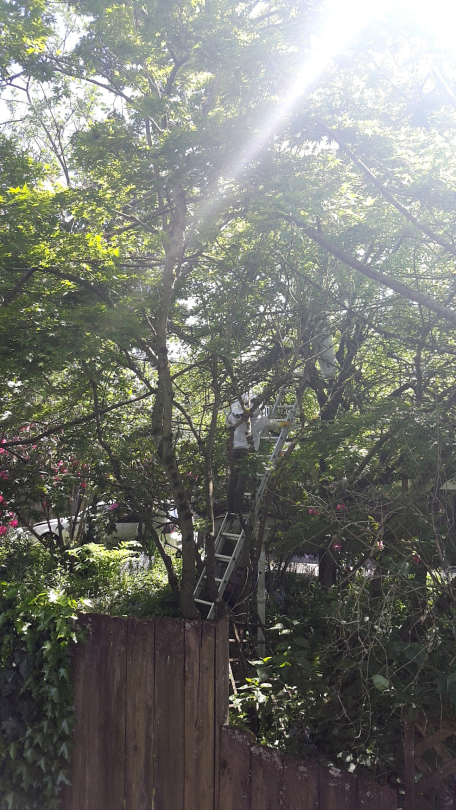
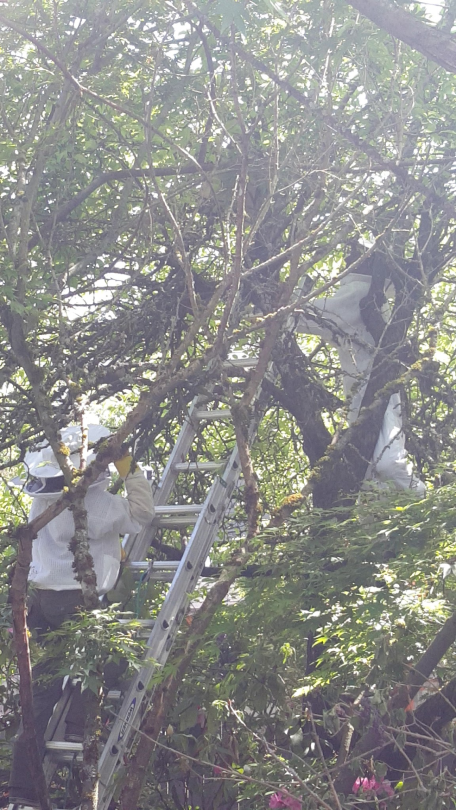
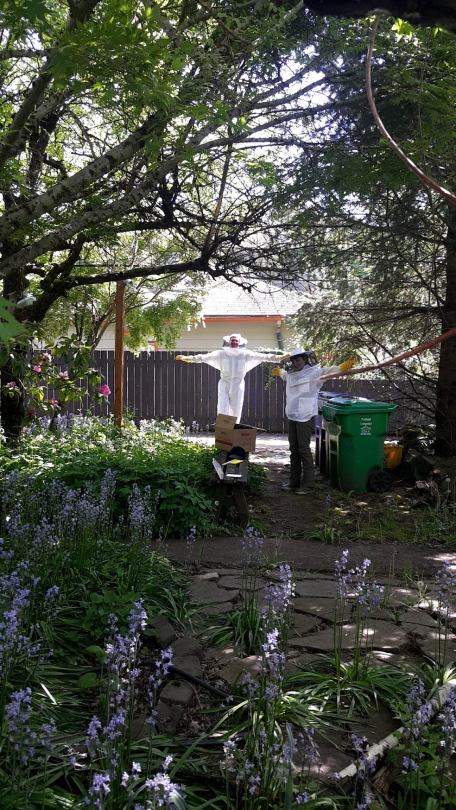
So Bee Neighbor and Professional Beekeeper show up and immediately don bee suits. Apparently there is fierce competition for feral swarms, and the swarm in the neighbor’s tree is HUGE, and also twenty feet off the ground, and Bee Neighbor wants them very badly.
The tree the bees are in is in a yard belonging to neither of us, so we go knock on the door, but there’s no answer. I knock on the house adjacent to it, but that guy’s not home either. Finally, I text the neighbor on the other side of me to see if he’s got contact info for the property owner, who is incredibly shy and in three years has never made eye contact. No luck.
So…we trespass. We get my extension ladder, and Bee Neighbor climbs the tree while Professional Beekeeper stands on the ladder and walks him through the swarm collection. Turns out, you just shake the swarm into a box, and as long as the queen makes it into the box, the rest of the swarm will eventually follow. Bee Neighbor has never collected a swarm before (this is, in fact, his very first swarm of bees ever) and it takes the two of them the better part of an hour in the tree trying to shake the swarm into the box.
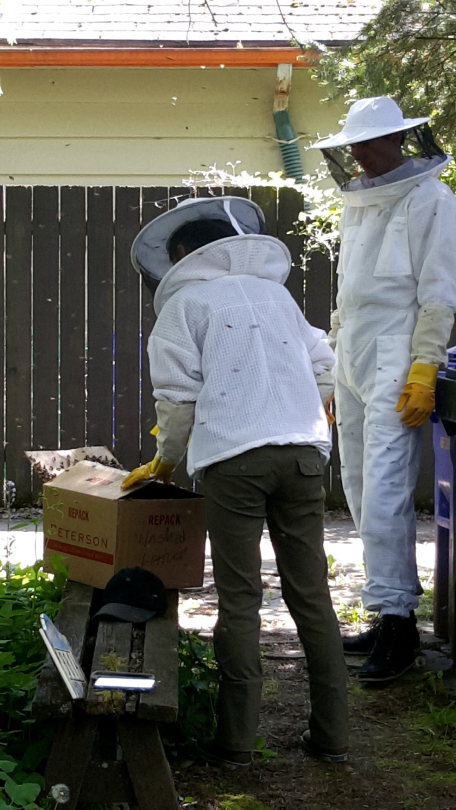
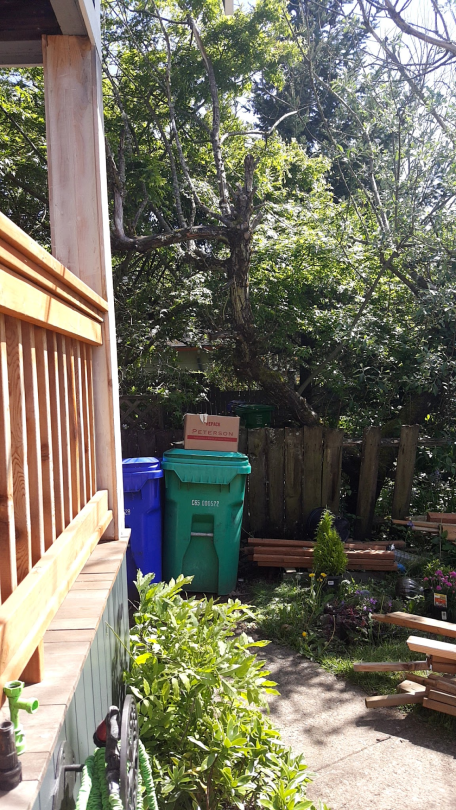
Bees eventually get into the box. Bee Neighbor gets out of the tree without dying, and Professional Beekeeper examines the swarm and makes pleased noises. At this point, the box is the neighbor’s driveway, and about two thirds of the swarm is still milling around the box all confused. Since the neighbor isn’t home and we can’t contact him, he risks coming and parking right in the middle of a huge cloud of bees. Professional Beekeeper doesn’t want to move the box too far away, because we risk the milling bees losing the queen’s scent and never going into the box. An equidistant point between the current location and Bee Neighbor’s yard is the top of my recycling bin.
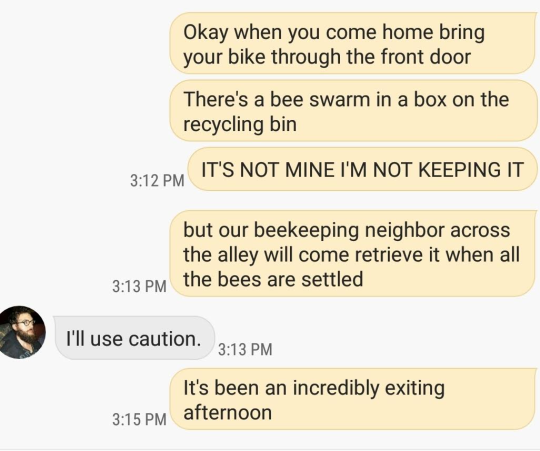
So they put the box of bees on my recycling bin, and I text Husbandthing.
Now I have a box of bees that I am babysitting. They’re being all lazy and dopey and bumbling around. I think I might be in love. Bee Neighbor will pick the box up later tonight and put them in his hive, and then the bees will be MY neighbors too!!
THIS HAS BEEN THE BEST DAY EVER
#beekeeping #also we left a note on the absent neighbor’s door #hi sorry we trespassed #but as you can see from your security cam footage #there was a giant cloud of bees #and we came and got them #we figured you did not want a yard full of bees #and we will love them #yours very sincerely #the friendly neighborhood bee team [Tags by @sacrificethemtothesquid]
#and I just don’t feel entitled to someone else’s life’s work.
That comment exactly!! It’s not mine and I can survive without it, so I will.
This is why honey is not vegan.
The problem here is that honey, especially if you buy it ethically from an apiarist, isn’t actually detrimental to the well-being of the bee or the hive. In the wild, honey is used as a food stock, but in a domesticated honeybee colony, the bees are fed quite well, and so the honey is a surplus.
The alternatives, like sugar, relies on monocrops in third world countries, with transient labour. Growing up, there was a sugarcane field by my house, and I’m sure the Haitian men who worked backbreaking hours hacking a machete through knife-bladed leaves in 40 degree heat for a couple dollars a day would have traded a testicle to be a Canadian honeybee. Stevia’s going the same way, iirc.
Additionally, apiarists are actually huge proponents and activists for sustainable bee-keeping, and it’s estimated that the domesticated hive may be the last great hope for declining populations, because we can optimize their chances for survival.
It’s their life’s work, sure, but it’s not the death of them to use it responsibly.
literally read anything about the history of sugarcane and the cuban sugar industry if you think sugar is or ever has been more ethical than honey
Beekeepers-
Provide a home for the bees
Keep that home warm in the winter
Keep the bees well fed, negating the need for honey, which the bees would make anyways
Still do not take all the honey, just in case
Protect the bees from predators
Monitor the hives for any signs of the parasites, diseases, etc. that cause colony collapse disorder
Their bees-
Provide a valuable and reliable source of pollination for plants in the area, both wild and crops
Help keep the local ecosystem healthy
Honey-
Is one of the healthiest things you can eat
Is able to keep for a EXTREMELY long time (Millennia even), making it more valuable than many perishable foods without being full of preservatives
Can be used to soothe sore throats, nauseau, etc.
Has been eaten by humans since at least Ancient Egypt (We’ve found STILL EDIBLE honey in tombs)
Is a great tool in cooking, adding sweetness without raising the sugar content much
Is a staple food in many people’s diets
Honey is amazing you can put it on or in pretty much everything I goddamn love it and you should too.
Honey is also a natural antimicrobial that has been used medicinally since time out of mind on external wounds like edible neosporin.
Particularly useful in the treatment of dermal abcesses.
“oh no we steal it from the bees!”
*has no problem benefiting from exploited migrant farm workers*
Hello! My name is Morgan and I have been a beekeeper for almost 2 years. In this time I have learned so much about bees and their importance. Sadly, bees are facing many problems such as habitat loss and I wanted to do something big! So I created this patreon.
You may have heard about the decline of many bee species and wondered how you can help. Not every one has a spacious backyard to plant flowers, or the ability to become a beekeeper, so here’s a solution: Adopt a beehive!
With a monthly donation of either 1, 5, 10, 15, or 40 dollars you will receive monthly status updates on the hive and how the money you donate is being used.You will revive digital photos of the hive and the bees living inside it. You will also be given the option of choosing a beehive to adopt! Hive Venus, Hive Jupiter and Hive Pluto.
With these donations I plan on building native bee hotels, planting wildflowers, rescuing honey bees and so much more.
If the link doesn’t work, you can go to the British Bee Keepers Association (BBKA) website and look for ‘Adopt a Beehive’ which will take you to their adoption page. They have different hives all over Britain as options! I am so happy that I’m not the only one excited by this discovery!
thank you for doing that for everyone!
And a few links for bees on this side of the pond:
hmm what if i did a “adopt a bee hive” thing for my bees,,,, would yall be into that? i could probably give samples of honey/beeswax lip balm depending on if the bees make enough honey to share. also monthly updates on how the bees are doing?
the other adopt a beehive thing is only in Europe so i thought one in the us would be nice?
would this bee cool? feedback?
OH and i could also offer an option on which kind of bee you would like to support! like you could sponsor building a native bee hotel instead! i have many idea




 There's a Mirror on the Wall