
Tag: adhd
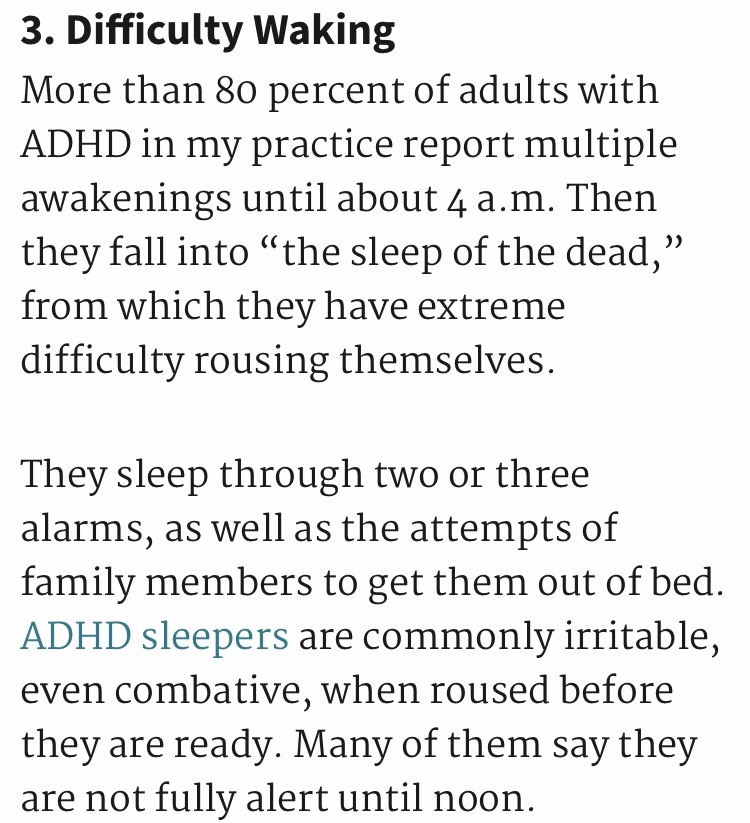
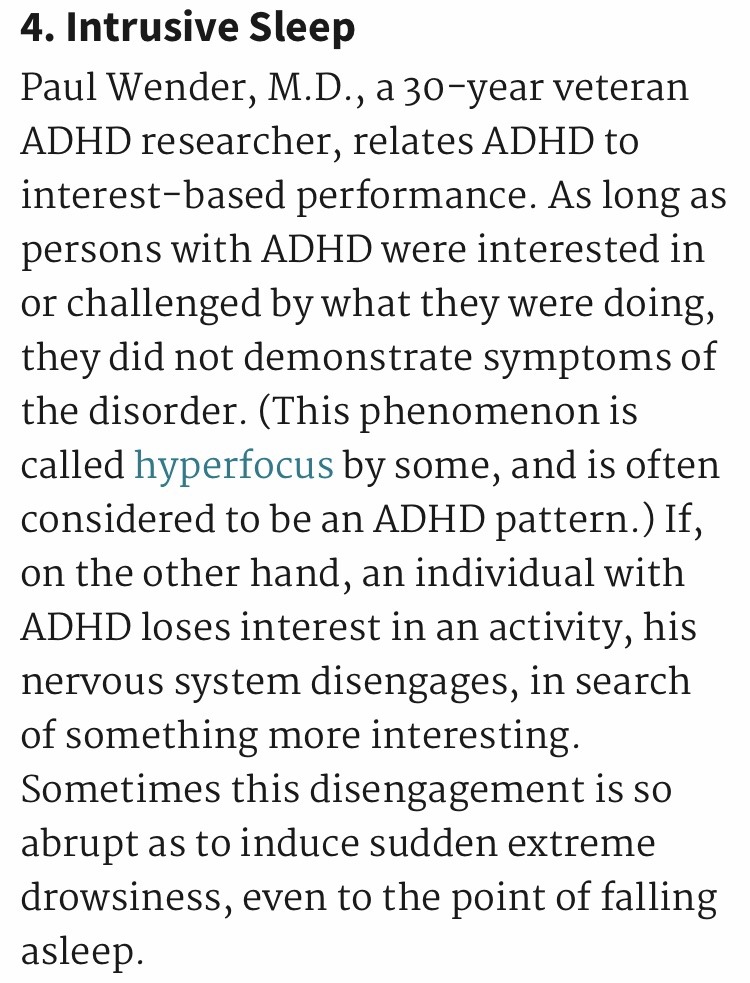
its really weird to see all these articles about how people who have ADHD have sleeping problems but the issue I have is that if you look at it as a matter of your circadian rythym being out of sync? of COURSE you’re not going to be able to sleep. we don’t say people who can’t fall asleep at 4 pm and sleep 8 hours have insomnia, because that’s not a normally agreed upon time to sleep and its not your bodies time to sleep. if you tell someone to go to bed at 10 and they can’t sleep till 3 am sometimes in just not insomnia. people with ADHD are often wired to sleep from 4 am to 12 pm ish because of the delayed onset of melatonin but if you let us go to bed at the time we need? most of us actually sleep pretty well and consistently.
wAIT THIS IS AN ACTUAL THING THAT EXISTS
“For most adults the onset of melatonin is around 9.30 pm; in ADHD children compared to controls this occurs at least 45 minutes later, and in adults with ADHD even 90 minutes (van der Heijden ea, 2005; van Veen ea 2010). After melatonin onset, it normally takes 2 hours to fall asleep, but in adults with ADHD it takes at least 3 hours (Bijlenga et al, 2013).”
Look at me awake at 1:47 am and reblogging this post.
So I’m actually trained in therapy for addressing insomnia and one of the things we learned is that a good chunk of sleep problems are societal disorders – as in they WOULDN’T EXIST as problems if society didn’t assume everyone was on the same circadian rhythm and that being up and working 9-5 was mandatory/normal. Blew my mind and made so much sense. You are not the problem, society is literally the problem.
things i didn’t know were caused by adhd
I wanted to make a list of things i do or used to do, of things i often blamed or hated myself for, got into trouble for or made me feel like a failure. hopefully it helps someone ❤
- I know I must do the thing but I can’t do the thing – I never knew executive dysfunction was something/I had it, but it explains everything. I know people will get mad if I don’t do x, or I’ll have issues if I don’t do it, but I just can’t get up and do it. I always just thought I was lazy, but it’s entirely different.
- Not going to classes. Partly because of exectuvie dysfunction, just not being able to go through the 20 steps to just even get out of the house no matter how much I know I need to. Partly because of all the things around me towards and on the train, to class, the mere thought of these was exhausting. I skipped a lot of classes feeling horrible, guilty, worthless,, stupid, you name it. This was a big issue for me and probably will still be once I go back, but now I at least know the reason why.
- Getting too emotional. I cried all the time as a child. I still cry really easily. I can break down within a minute from being completely fine to an absolute mess. Negative attention is murder- RSD is a big issue. Thought I was just whiny and weak.
- Not cleaning my room. It’s a mess, I hate the mess. I can clean some areas sometimes, and it’s been clean, like… months ago. I know I need to handle it. I just… don’t.
- Stop hobbies, projects, things that I liked, just out of nowhere. Always felt guilty about letting go of stuff so fast.
- Lying. “I watched that movie.” “I did the homework.” “I watched what you sent me.” Even if there was nothing negative happening if I was honest, I still couldn’t accept that I “simply didn’t do the thing”.
- impulse. buying.
- “why the fuck am i drained from energy all of a sudden, i feel like i’m gonna crash and literally any sound will destroy me rn”
- talking too fast. this was the 1 and often only complaint I get at presentations.
- oversharing, then hating myself for it.
- “how the fuck am I bored with this already i was obsessed ten minutes ago.”
- “i’m going to the store.” *three hours later*. “I think I’m ready- wait what was I buying again.”
- losing my important stuff???? like always????? dk where anything is ever
- as a kid I was always preached at because “you always want to be able to do everything right away and if you don’t you get frustrated and stop.” I never knew why this was until now.
- my dad also always got mad because if we’d be looking at a site together I’d already click the button or do stuff before he got the chance to read and it pissed me off
- hyperfocusing on either negative things like triggers or buying things that are extremely expensive so i end up feeling egoistic and self-centered.
- “wait so you should actually feel like… more energy after you drank caffeine?”
- and so much more.
One last hot take and then I’ll shut up: the reason adhd is framed first and foremost as a learning disability when it is in fact more apt to call it an emotional processing disorder is bc our society is only concerned w the ways neurological disorders impede a person’s ability to “function” aka get a job and contribute positively to capitalist society. How adhd affects interpersonal behaviors and emotional health is only relevant insofar as it relates to a person’s level of societal functioning PERIOD. There is no interest in improving our actual livelihoods
This is why girls are often not diagnosed w adhd until they are much older, bc they are forced to develop certain social awareness and self-surveillance capacities at an extremely young age and thus don’t perform “poorly” in the areas usually looked at to signify the disorder. But that doesn’t mean girls don’t take that distress out thru other avenues, just that the many alternative iterations of the disorder are ignored by professionals bc they don’t matter as far as society is concerned, as long as a girl is performing “well enough”
I am like 75% YES THIS about this post.
The last 25% is like, it’s not NO interest. People who study and treat ADHD do care about emotional suffering. On the other hand–the money, the research dollars, the operating budgets, the reports, the ways we talk to parents, the way we make people care, all have to speak the language of intellectual capacity and capitalist productivity.
Even now, if we say, “This disorder means the child will have no or few friends during elementary school,” the people responsible for funding assessment and therapy are like, yawn, make an eight-week after-school social skills group if it really matters. But if we say “this child might not get into college because of this” then HOT DAMN, suddenly people give a shit and will shell out money about it.
Something that may come as surprising to folks whose needs and comfort levels are already catered to by the world around them, is that “coping” is exhausting.
There are a great many people who are perfectly capable of adjusting to certain situations, be it a matter of social interaction, or physical disability, medical conditions, or whatever the case may be. Through trial and error we have discovered tricks and methods that allow us to function in a society that wasn’t created with us in mind, and we’re very good at making it look like we’re getting along just fine.
But it’s tiring. Always, constantly having to be vigilant and on-guard while everyone around us takes everything in stride, and then no one understands why, at the end of the day, we shut down. Because we were able to “get by” throughout the day, suddenly our unwillingness or inability to cope is no longer valid.
It’s like carrying a 20 pound weight all fucking day long. Just because you can doesn’t mean you don’t need or deserve a break. And then when you finally put the weight down, everyone around you scolds you and chastises you, accuses you of being lazy, insists that you’re just “faking because it’s convenient.”
This is why it’s so fucking unbearable living in a home where everyone chooses to disregard your limits and your comfort levels. Family members will say, “I’m not going to cater to your needs, because the ~real world~ won’t cater to you and you need to get used to that.”
Consider: People who struggle and cope through everyday life are already painfully aware that the “real world” doesn’t give a fuck about us. This is why we develop coping strategies that allow us to function. This is why when we finally come home, when we are FINALLY through with the “real world” for the day, we just want some goddamn compassion. We just want the people we live with to place value on our needs, comfort levels, and limitations. We want the people who say they love us to demonstrate that love through doing whatever small thing they can do to ensure that when we’re in the comfort of our own homes, we can actually be comfortable instead of having to continue carrying around that weight that we’ve been forced to hold up all. day. long.
“If you can control yourself at work, you can control yourself at home”
Well, nope. I can control myself at work BECAUSE I can let go at home.
Is that !
having to ‘normal human’ for a few hours at a time is fucking exhausting and not being able to relax when i get home is the reason for half my melt downs.
Thing #1 that frustrates me about ADHD/Executive Dysfunction advice:
“Oh, you have a mental/neurological issue that makes it difficult for you to be organized, follow routines, stick with systems, maintain a schedule, do your work, etc.? Well, what you need to do is GET ORGANIZED! Schedule everything! Find a system and stick with it! Maintain a schedule! Do your work as it comes in!”It’s like that Allie Brosh comic where her fish are dead, and everyone’s offering to help find them, or advice like “feed them!” Or “make puppets out of them!” And she says, “No, see, that solution is for a different problem than the one I have.”
Yes, I would love to do those things! I have tried to do those things! I am still trying to do those things! But it’s like that post about how you’re going through an invisible obstacle course, and what looks like a block to everyone else seems like a wall to you. Instead of saying, “it’s a block! Go around!” It would be much more useful to hand me a bag of flour so I can see the obstacles for myself and how to get around them.
I keep looking for something I can do. I can’t maintain an agenda- closest I can do is lot appointments into Google Calendar. I can’t use to-do lists- they overwhelm and freak me out and I end up doing less than before. Breaking down a task into a bunch of tiny pieces should work in theory, but again, freaks me out, and I usually end up spending an hour planning and then I never actually do. I can’t set deadlines for myself. Whatever part of the brain allows other people to say, “yes, it’s due on the 29th, but I want to be done on the 25th” just doesn’t work. I can’t make my brain think something needs to be done until the last minute. This is especially bad in classes where everything is due at the end of the semester. I end up doing what I just did, and having to do two whole classes worth of work in two days. Oddly, once that level of desperation kicks in, I’m capable of sitting down and pounding through the material- but for some reason, I can’t tap into that level of focus without a short, urgent, important deadline. Maybe one day I’ll figure it out.
Thing #2 that bugs me about all self help: Don’t wait for motivation! Just do it!
I think my definition of “motivation” is different from the usual. Most people see “motivation” as meaning something like “wanting to do something, looking forward to doing something, doing the thing with energy and happiness because it is the thing you want to do.”
My definition is closer to “having enough willpower to make myself do the thing despite everything in my brain begging me to go watch Netflix instead.” So when people say, “you don’t need motivation!” What I hear is “everyone else seems to have this source of willpower they can eventually learn to tap into that just doesn’t exist for me.” My best technique for doing stuff is having other people make me do it. Which freaks out my social anxiety because then I feel like I’m intruding on their time to make them help me with mine.
The thing is, I’m not lazy. If I were just lazy this would all be easier to cope with. I WANT to be doing things, I WANT to be successful, I WANT to be productive. I even try, really hard, and the effort that exhausts me seems to be so much lower than the typical threshold. But every time I try to be as productive as I want to be, I burn out in a couple days.
I am on the verge of tears because this is everything that frustrates me about my own ADHD. Every word of this reflects my experience.
i’m so bad today i can only read every fifth sentence and it STILL hits me in the gut. well expressed.
my executive dysfunction lately has been so bad i can’t even work on my hobbies. i can’t even stim right. one of my favorite stims is to lay out a textile work in progress and play with the pieces, rearranging them and finishing their edges and doing all the fiddlybits. lately, even though i have a nice clean worktable and my quilt pieces all laid out by color, i have managed to iron a grand total of like… 6 of them. in three days. i like ironing quilt pieces. it’s satisfying to me. but it just… doesn’t seem to be happening.
people who’ve never experienced executive dysfunction seem to think our disability only applies to things that are hard or unfun, and therefore suspect we’re just making excuses not to do stuff we don’t want to do. but it’s not like that. i have trouble doing stuff i enjoy doing. i have trouble doing stuff i have to do to live, like eating. sometimes the stuff i get distracted into doing is less fun than the thing i was trying to do – plenty of times i go to get food and get distracted and fold laundry instead. because folding laundry is a routine, it’s an organizing task, which takes less executive function than making food, which requires making a lot of little decisions and judgement calls based on what’s in the fridge, what dishes are clean, etc.
if you had something wrong with your brain that forced you to fold laundry when you wanted a sandwich, wouldn’t you call that a real disability?
Had to read this three times in order to read all of it because my brain is in skim mode, but yeah. THIS.
^^^^ Why adhd is highly comorbid with Depression and Anxiety! Why I have low key depression and anxiety but don’t hit the benchmarks for formal diagnosis.
The top post? Me exactly I want to cry
I have procrastinated getting up to get cake. CAKE, people. This is n o t about wanting to do something.
I was procrastinating eating lunch when it was literally sitting on the table to my side.
I am procrastinating a hobby I’m good at and enjoy, and cleaning the house which I don’t enjoy doing but do enjoy the results of. Hell, I can’t even decide what’s for dinner and I’m the cook.
Are People with ADHD Lazy? The “Moral Diagnosis” of ADHD
“…the idea that a person with ADHD is just being lazy is amazingly persistent. This doesn’t adequately acknowledge the significant amount of effort that they are often exerting. Their minds are working away, trying really hard to organize a boatload of undifferentiated information in their brains, even as they might seem “lazy” because they have trouble completing (and sometimes even starting!) tasks. But fMRI research conducted with children who have ADHD reinforces that “lazy” is simply an ADHD myth. In a presentation to the Society for Neuroscience, biologist Tudor Puiu suggested that in children with ADHD an important mental control area of the brain (the dorsal anterior cingulate cortex), works much harder and, perhaps, less efficiently than for those without ADHD. “These networks are disrupted. The ADHD brain has to work harder than the normal brain,” he said.
ADHD adults can tell you they are working really hard to get mentally organized—expending tons of energy on it—yet are frustrated that they get consistent feedback from important people (teachers when younger, parents, spouses, friends) that they aren’t working hard enough. This confuses hard work with results—and the two are sometimes strikingly disconnected for those with ADHD. One person I know described what it feels like to have ADHD as “having the Library of Congress in your head, but with no card catalogue.” Think about how hard it would be to get organized—a Herculean task! Dealing with this sort of mind 24/7 can lead to a sense of helplessness—a sort of “I’m dancing as fast as I can so please don’t ask more of me” feeling. Sometimes that feeling is voiced (and often met with a disbelieving, “Then why aren’t you doing better if you’re trying so hard?” from a frustrated spouse or parent.) Sometimes the “I’m dancing as fast as I can” feeling is not voiced but simply leads to feelings of overwhelm or paralysis.”
—Melissa Orlov (full article here)
What’s the Real Lesson?
Here’s something that happens to ADHD children a lot: Getting pushed beyond their limits by accident. Here’s how it works and why it’s so bad.
Child says, “I can’t do this.”
Adult (teacher or parent) does not believe it, because Adult has seen Child do things that Adult considers more difficult, and Child is too young to properly articulate why the task is difficult.
Adult decides that the problem is something other than true inability, like laziness, lack of self-confidence, stubbornness, or lack of motivation.
Adult applies motivation in the form of harsher and harsher scoldings and punishments. Child becomes horribly distressed by these punishments. Finally, the negative emotions produce a wave of adrenaline that temporarily repairs the neurotransmitter deficits caused by ADHD, and Child manages to do the task, nearly dropping from relief when it’s finally done.
The lesson Adult takes away is that Child was able to do it all along, the task was quite reasonable, and Child just wasn’t trying hard enough. Now, surely Child has mastered the task and learned the value of simply following instructions the first time.
The lessons Child takes away? Well, it varies, but it might be:
-How to do the task while in a state of extreme panic, which does NOT easily translate into doing the task when calm.
-Using emergency fight-or-flight overdrive to deal with normal daily problems is reasonable and even expected.
-It’s not acceptable to refuse tasks, no matter how difficult or potentially harmful.
-Asking for help does not result in getting useful help.
I’m now in my 30’s, trying to overcome chronic depression, and one major barrier is that, thanks to the constant unreasonable demands placed on me as a child, I never had the chance to develop actual healthy techniques for getting stuff done. At 19, I finally learned to write without panic, but I still need to rely on my adrenaline addiction for simple things like making phone calls, tidying the house, and paying bills. Sometimes, I do mean things to myself to generate the adrenaline rush, because there’s no one else around to punish me.
But hey, at least I didn’t get those terrible drugs, right? That might have had nasty side effects.
#I wonder if this might potentially apply to people with autism as well?#because I haven’t been diagnosed with adhd but MAN do I fee this#and like I had the situation a lot of people went through#breezed through elementary and high school and in gifted and talented#but then college happened and I was LOST
There’s a lot of overlap between ADHD traits and autism traits. Whether you meet the diagnostic criteria for ADHD, too, I have no idea (because I’m a random person on the Internet), but you might find ADHD resources helpful in figuring out your life challenges.
A lot of “help” for executive function skills comes from neurotypicals who are naturally good at it and lack insight into people who aren’t, which makes it spectacularly useless to the people who actually need it.
Well shit this explains so much about me
This is why I want to scream when NT professionals try to insist that forcing ADD people into “the zone” is the best treatment for ADD. Forced focus is exhausting because it’s fueled by adrenaline. We have reams of medical data that frequent adrenaline rushes in young people are horribly bad for their development and causes a laundry list of problems later in life, both physical and mental.
Literally NT professionals: I know you can accomplish this task if I push you into a state of artificial panic every time I want you to do it.
Me: Or you could, idk, help break the task into smaller, less scary bits, use a reward structure at each stage to reinforce positive association, or even turn it into a game because ADD people are kind of hardwired to love game-like structures and anything that has a whiff of fun to it.
NT professionals: That requires imagination, time, and mental energy that I, a NT person who is not struggling with overwhelming self-doubt and mental block at this moment, simply cannot be bothered to spare.
Me: Oh right, of course. Carry on with terrorizing small children, then.
Nothing like the abusive teaching styles described above happened to me, because I was good at doing work, until I magically stopped being good at doing work sometime in 9th grade and instead started being bad at doing work. At that point and at my school, teachers were more loose about when work got done, so I started procrastinating until the last minute. This worked really well for me and I have had all A’s and the extremely occasional B+ in every class.
It’s only now, reading this post, that I’m realizing why my clever “do it at the last minute” strategy works so well.
😦
One of the reasons I work in the stressful jobs I do (aside from my abysmal college performance)
Is that it’s hard for me to get any work done unless it feels like a life-or-death situation
So, I work at a place where life-or-death situations happen on the regs
I was a really great worker until I switched into an office track and realized that without the nonstop panic and stress of a retail/food service position i’m almost entirely unable to prioritize and complete tasks.
Having ADD [or ADHD] makes life paradoxical. You can superfocus sometimes, but also space out when you least mean to. You can radiate confidence and also feel as insecure as a cat in a kennel. You can perform at the highest level, feeling incompetent as you do so. You can be loved by so many, but feel as if no one really likes you. You can absolutely, totally intend to do something, then forget to do it. You can have the greatest ideas in the world, but feel as if you can’t accomplish a thing.
Dr. Edward M. Hallowell (via 8ierra-kay)
3 Defining Features of ADHD That Everyone Overlooks
“When we step back and ask, “What does everyone with ADHD have in common, that people without ADHD don’t experience?” a different set of symptoms take shape.
From this perspective, three defining features of ADHD emerge that explain every aspect of the condition:
1. an interest-based nervous system
2. emotional hyperarousal
3. rejection sensitivity”
Oh
I’m reblogging first, then clicking through to read the article (less likely to lose it or forget to do either), but just from the piece quoted – oh. Yes. That does lay it out rather succinctly, doesn’t it?
I needed this when I was fucking TEN.
 There's a Mirror on the Wall